
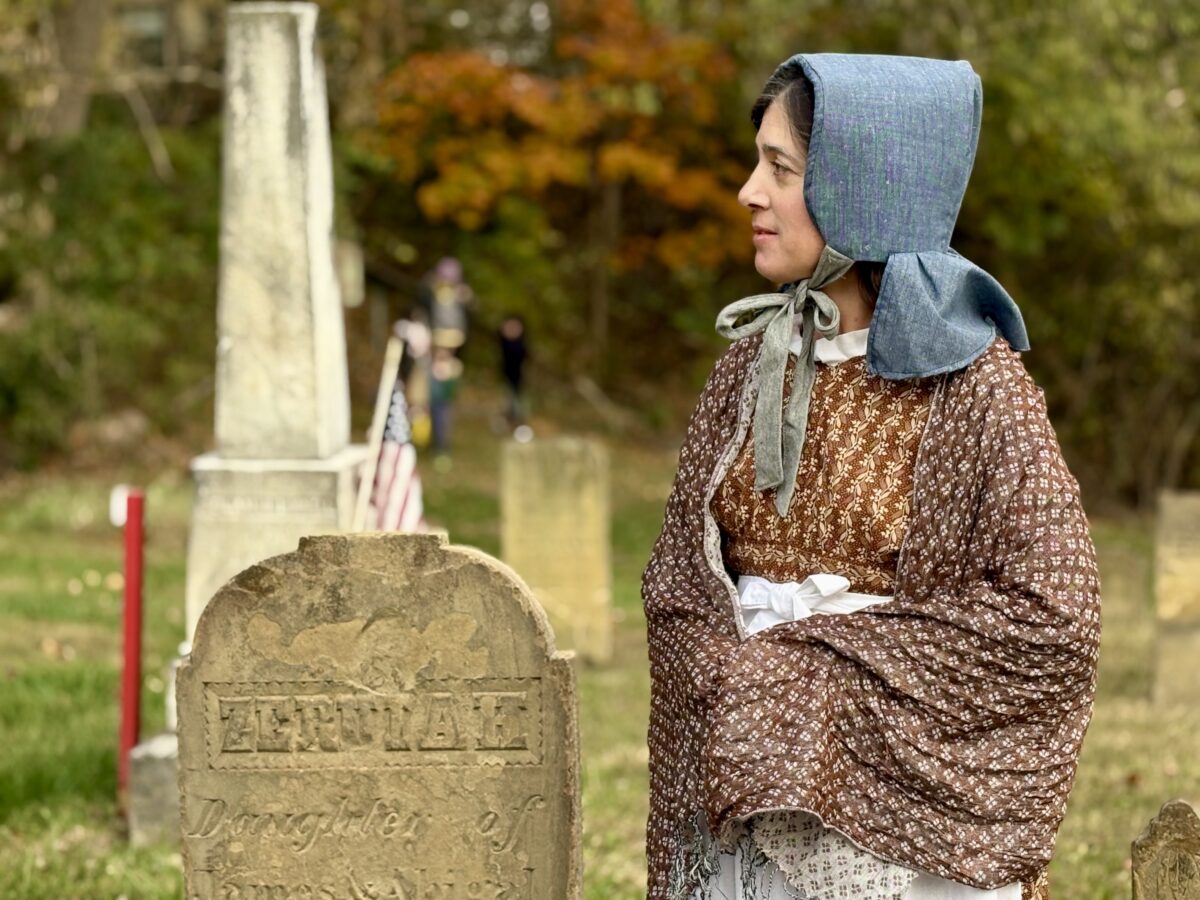

In an extensive line formed under the Old Colony Burying Ground sign, Granville’s living residents eagerly waited for a chance to meet the ghosts of the village’s past.
The historic Granville Ghost Walk returned for the first time in seven years on Saturday, Oct. 26. The tour brought four prominent Granville families to life: The Linnell family, the Hillyer and Munson family, the Mower and Richards family and the Gilman family, to tell the tale of Granville’s founding two centuries ago.
While the ghost walks were not an annual thing according to volunteer and organizer Lyn Boone, the pandemic is part of the reason the Village has gone so long without one in recent years.
Read more: Lyn and Keith Boone preserve Granville’s history, one gravestone at a time
“After the pandemic, it has really been a matter of when the right mix of volunteers were ready and available to put a ghost walk on,” Boone said. “It is entirely a volunteer effort.”
Tour guides like Erie Stewart greeted residents at the south gate of the cemetery. Stewart said he volunteered to help introduce residents to the bit of history they were about to walk into.
“I love history,” Stewart said. “I love to know more about who came before me, who was taking care of the town.”
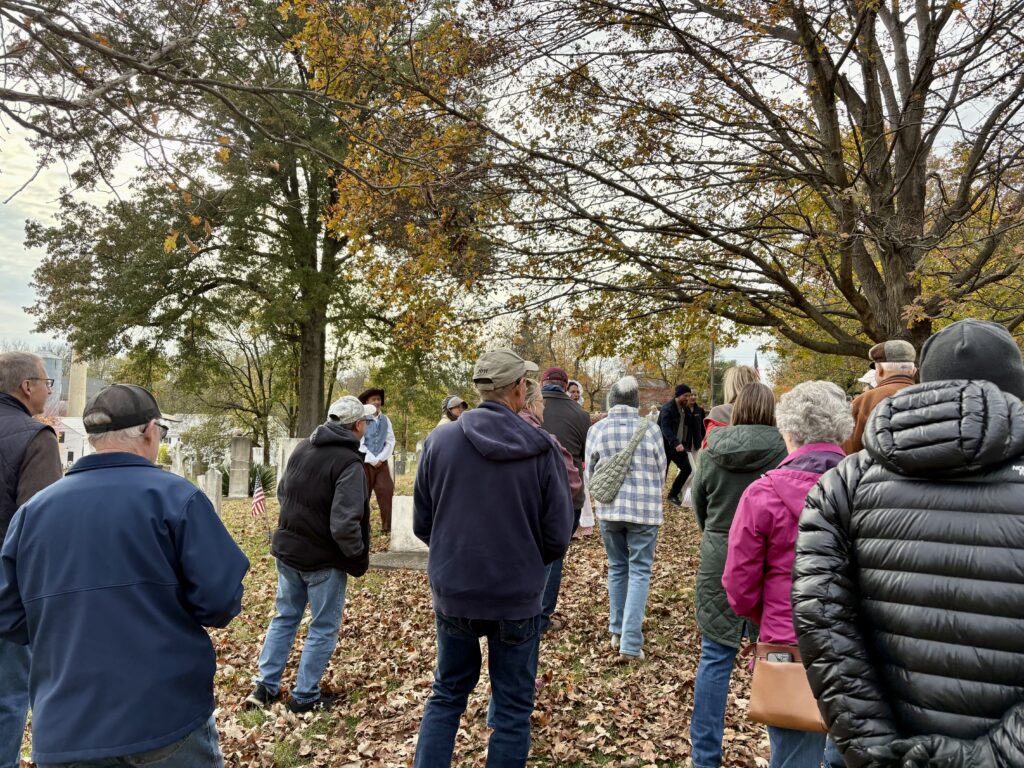
More than 300 people strolled through the Old Colony Burying Ground on Saturday, Oct. 26, 2025, for the return of the historic ghost tours. 
More than 300 people strolled through the Old Colony Burying Ground on Saturday, Oct. 26, 2025, for the return of the historic ghost tours. 
More than 300 people strolled through the Old Colony Burying Ground on Saturday, Oct. 26, 2025, for the return of the historic ghost tours.
The dry, fallen leaves that littered the cemetery lawn crunched under the footsteps of the cemetery’s visitors. People weaved around headstones, some slightly eroded or seemingly pieced back together.
But not everyone buried in the Old Colony was lucky enough to get one. Otherwise, the cemetery would be filled with about 2,000 headstones. Out of the 2,000 to be buried there, only 900 have been identified. Where are the other 1,100? They’re somewhere in there according to tour guide Maureen Clark.
“The first person that we know was an infant, a one-day old infant, that was buried here, 1806,” Clark said. “The first person to have a gravestone wasn’t until 1807.”
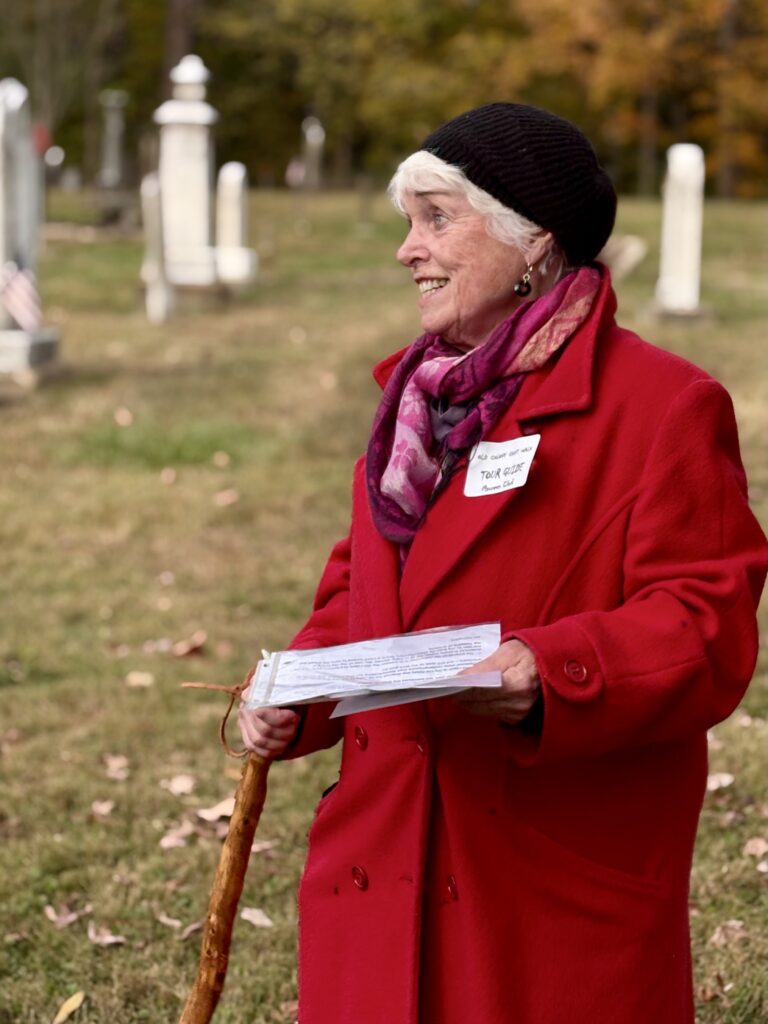
The cemetery is the resting place for an estimated 75 veterans who fought in wars such as the American Revolution, the Civil War, and the War of 1812.
One noticeable sound seemed to be missing during the Ghost Tour, the sound of the Granville Milling Company Mill running. Boone requested that the mill be stopped during the tour, making it easier to hear the ghost stories.
The first ghosts to greet tourists were Joseph Linnell and Polly Linnell, played by Brian Gregory and Emily McCall. Gregory, or the ghost of Joseph Linnell, spoke about the creation of the four churches right in the center of town, and the many accomplishments of his sons: one went on to become mayor, another started the Granville Academy. Another son, Joseph Jr., was a known abolitionist who assisted in the underground railroad.
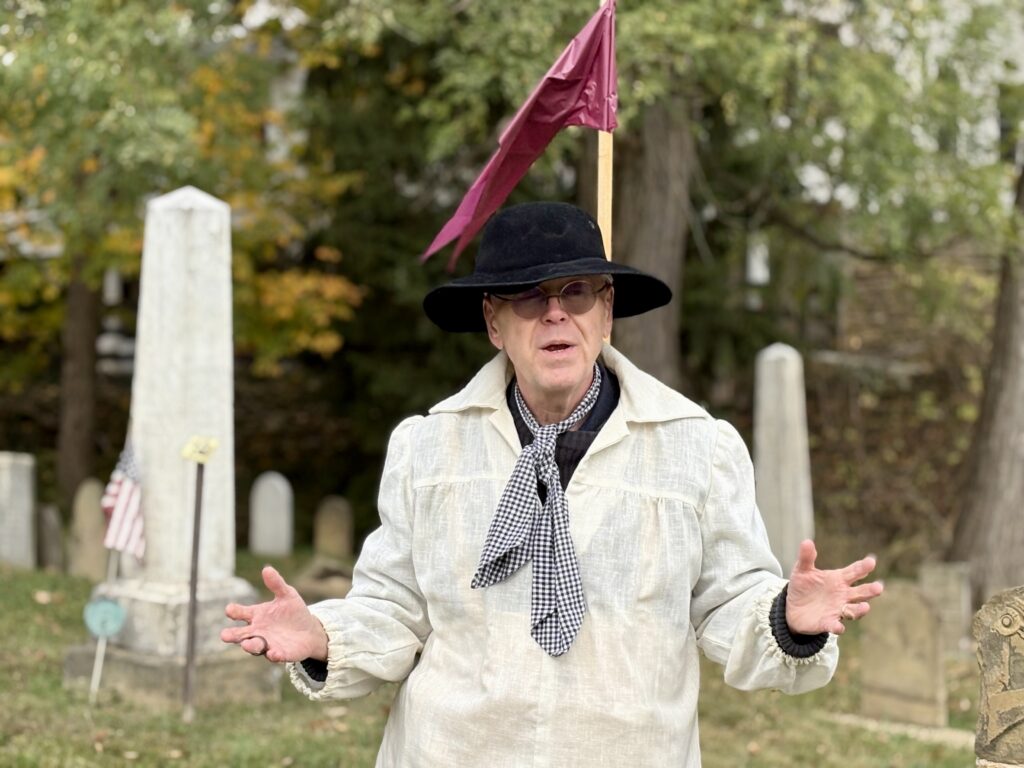
For 30 years, part of Joseph Linell’s headstone went missing. According to Gregory, a Denison University student saw the missing part of the stone in a trench near the cemetery, and pulled it out. Now, Linell’s headstone is complete.
This isn’t Gegory’s first go around as a ghost of Granville. This history lover and longtime Granville resident enjoys reenacting the characters of Granville’s founding.
“We’ve lived here for almost 30 years,” Gregory said. “You have to live here 100 years before they consider you part of Granville, so you know we’re working on it.”
Granville Township Trustee Bryn Bird put aside her current role in Granville’s politics to appear as the ghost of Adah Hillyer.
“So who have you modern day folks been talking to the Linnells?” Bird/Hillyer said. “Oh, that Polly Linnell, I bet she was just filling your ears with all the tales of how hard it was when she came over here 20 years ago. But you know, we came on different traveling groups, and ours was as hard as hers.”
Hard it was. Some of the Hillyer children were run over by the oxen-pulled wagon on the journey to Ohio. Though they survived the run-ins with the cart, four of Hillyer’s children did not make it to adulthood, and are buried in the cemetery.
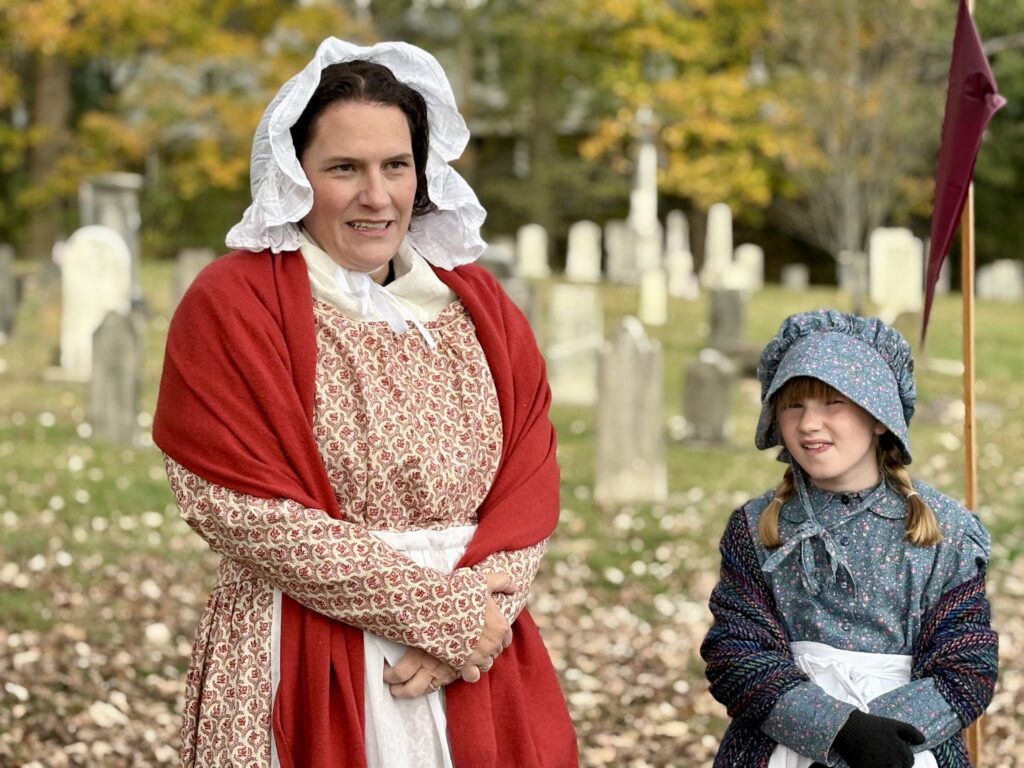
One of Hillyer’s surviving sons, Justin Jr., was also an abolitionist with ties to the Underground Railroad.
“His home was so beautiful that they eventually moved it right around the corner onto River Road.” Hillyer/Bird said. “Well, I bet most of you actually enjoy his home still to this day for that River Road coffee house.”
One of the more prominent families in town, the Mower and Richards family, were heavily involved in early business enterprises, including a store in Granville located where the Kussmaul Gallery is now. When the Ohio and Erie Canal was built, it made it a lot easier for businessman Lucius Mower to get goods to that store.
Henry Richards, played by Louis Shuler, was a nephew to Lucius Mower and a clerk at the store.
“I remember how exciting it was when things would arrive from back East,” Shuler/Richards said. “In the early days, they arrived by wagons. But eventually they arrived by canal boat. It seemed like the whole town would wait for the arrival of new things to buy.”
Shuler, 10, said that preparing his role as Henry Richards was just like preparing for any play.
“I would just remember my lines and keep practicing it over and over,” Shuler said. “It’s kind of like any play.”
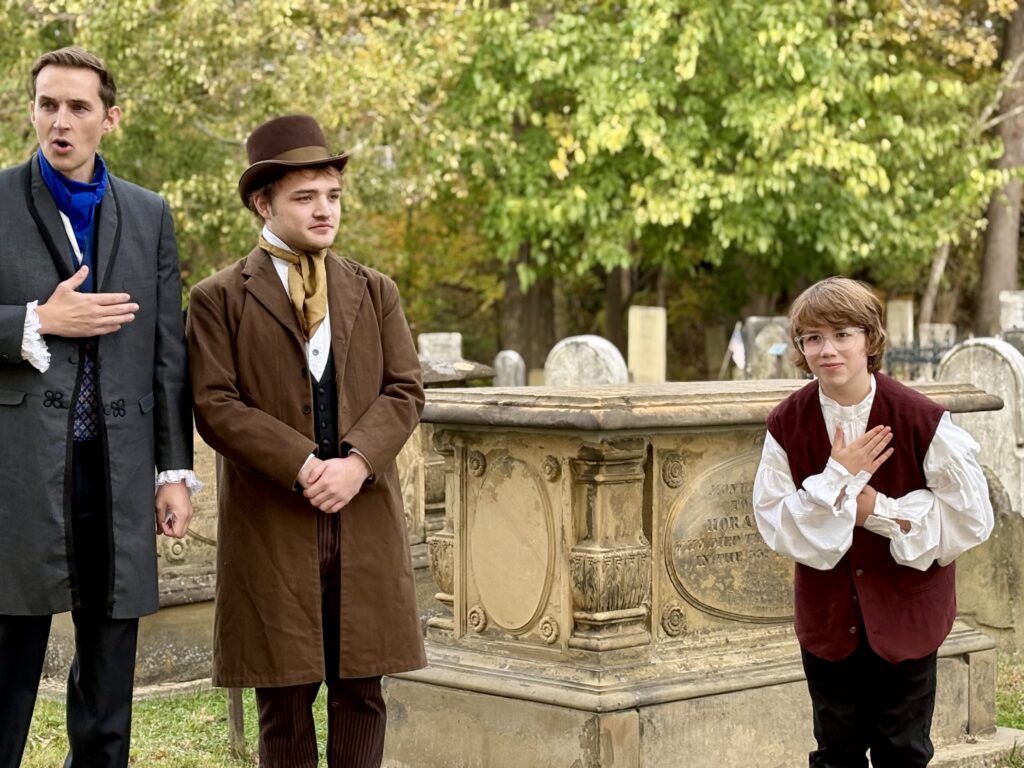
The Gilman family, featuring Norman Kennedy as Elias Gilman and Meghan Duvall as Rachel Gilman were the last stop on the ghost walk. The Gilmans lived where Denison University’s Kappa Alpha Theta house is now, the oldest frame structure in Granville.
Kennedy said it’s gratifying to see all the Granville residents who want to learn about the history of the Village.
Duvall said that taking on one of the characters, while helping others learn, was also a way for her to find out more about Granville’s founding.
“I didn’t know anything about it, and so I got to get that little sliver of information which makes me appreciate the founders,” Duvall said.
At the end of the tour, Eagle Scout hopeful William Bukala stood behind a table advertising his Eagle Scout project: a virtual, historic walking tour of Granville that residents can access through a website at any time, not just around Halloween.
“It’s a virtual walking tour that can be done around Granville, and it’s done through a QR code,” Bukala said. “It’s on a website, and you can go through popular stops around Granville, and you can go look through texts, look through pictures, and there’s a map on there.”
Bukala is using the book “Granville: The Story of an Ohio Village” by William T. Utter to gain information about Granville, as well as utilizing a few resources at Denison University. Bukala saw a need for future generations to access the history of Granville, and wanted to meet it.
“I wanted to get younger people like me in the community more interested in history,” Bukala said. “And I also have a strong passion that it’s important to know about the history, where you live, and how Granville got here.”
The most interesting part of learning Granville’s history for Bukala has been coming to understand the collective effort, especially from the Mower and Munson families, that it took to create the town.
Bukala’s project can be accessed at granvilleohiowalkingtour.shorthandstories.com.
Maddie Luebkert writes for TheReportingProject.org, the nonprofit news organization of Denison University’s Journalism program, which is supported by generous donations from readers. Sign up for The Reporting Project newsletter here.