

Licking County residents have a new opportunity to engage in conversation about housing and homelessness in the community on Tuesday, Nov. 18.
“Living on the Edge: Financial Stability in Licking County” will take place Tuesday, Nov. 18, from 6-8 p.m. at the DoubleTree by Hilton, 50 North 2nd St. in Newark. The event will explore the latest ALICE (Asset Limited, Income Constrained, Employed) data and assess the risks of housing instability in the community. It will be a next step in understanding the broader forces shaping life for Licking County families.
Read more: Number of households struggling is on the rise in Licking, ALICE Community Partners meeting shows
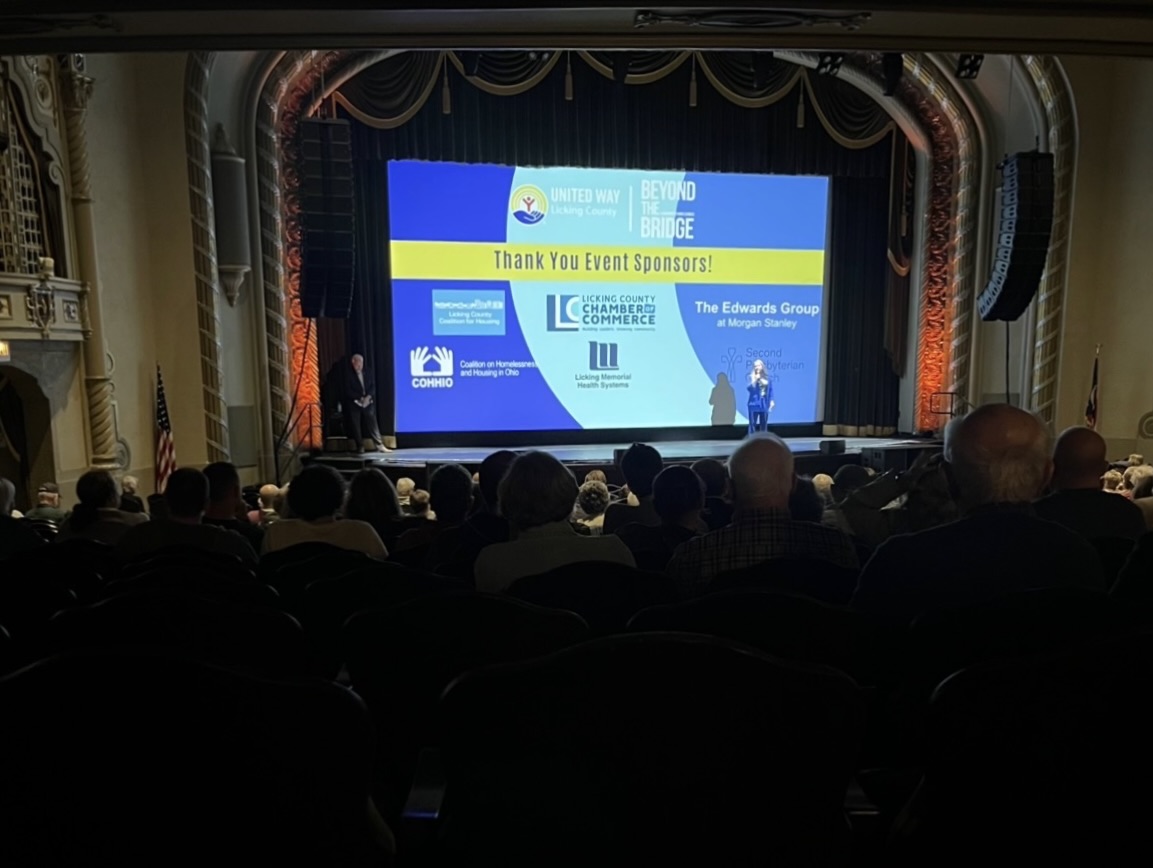
This event is a follow-up to “Beyond the Bridge: A Solution to Homelessness,” a film screened by the United Way of Licking County at the Midland Theatre on Oct. 7.
Many local community members who attended the screening shared their thoughts on how the film impacted them and what they believe Newark and Licking County as a whole can do to create long-lasting solutions.
Ellen Clark of Newark, who serves as head of missions at the Granville Presbyterian Church, said she left the theater feeling both inspired and grounded in her ongoing work.
“I was greatly encouraged because my job at the church is mission outreach, so I’m working with a lot of different agencies who are working with the unsheltered,” Clark said.
When asked what the community can do to make progress, she emphasized the need for awareness and participation.
“The first thing is to be aware and educated with this topic,” she said. “Attend council meetings, attend commissioner meetings to understand both sides of affordable housing in our community.”
Carol and Ken Apacki of Granville, who are also members of the Granville Presbyterian Church, said the film hit close to home. The couple has volunteered at local warming centers and community dinners for years.
Read more: Newark warming center seeks volunteers as another artic blast hits Licking County
“My first impression was that Ken and I worked at the warming center and the community dinners, where we’re working with people who were coming in from the streets,” said Carol Apacki. “While watching the movie, I kept seeing the faces of our local population of people who are struggling without adequate food and housing. It’s continuing to grow here locally, as food pantries are running out of food and housing prices are going way up.”
Apacki said the film underscored how real change depends on community leadership.
“Every successful venture they showed in other cities came from strong leadership of the community,” she said. “We have a role to play in support, but we can’t implement successful strategies without the buy-in and the leadership of our city and our county leaders.”
Her husband, Ken, also echoed that point while addressing the economic side of homelessness.
“A $15 job at McDonald’s is not sustainable,” he said. “You can’t sustain yourself on that, can’t afford a down payment, can’t afford a rental. Without family support, a lot of people can’t even get started. And to criminalize it will not help. Making it a criminal offense to be homeless is not a useful step.”
Across the United States, housing is becoming more inaccessible to low-income and middle-income families, according to the National Low Income Housing Coalition. A 2025 report from the coalition found that a Licking County resident working at minimum wage – $10.70 per hour in Ohio – would need to work “2.6 full-time jobs” to afford a 2-bedroom “fair market rent” apartment.
Mike Schmidt, president of the Licking County Foundation and a Newark resident, said the documentary changed the way he thinks about homelessness.
“I was incredibly impressed with the film itself. It really changed my perceptions,” Schmidt said. “When asked what Newark can take away from it, Schmidt pointed to the collaborative work already underway and the need to keep expanding it.
“A lot of us from the Coalition on Housing, the United Way, we’re all working collaboratively to try to find solutions to this,” he said. “This film presented many different communities that are similar to ours, different situations and different solutions, and I think we’re going to have to take a combination and work collaboratively to ensure that a solution is presented.”
While “Beyond the Bridge “offered examples of cities that are finding success, attendees said the real test will be turning those lessons into local action. The conversation continues Tuesday night.
Click the link here to sign up. https://fundraise.givesmart.com/form/P5a0Ww?vid=1mligj
Brie Coleman writes for TheReportingProject.org, the nonprofit news organization of Denison University’s Journalism program, which is supported by generous donations from readers. Sign up for The Reporting Project newsletter here.