

Editor’s note: This is part 2 of a series highlighting the history of Ohio’s barns, alongside the people who love and preserve them. Read part 1 of the series, which highlights a team preserving historic barns, here.
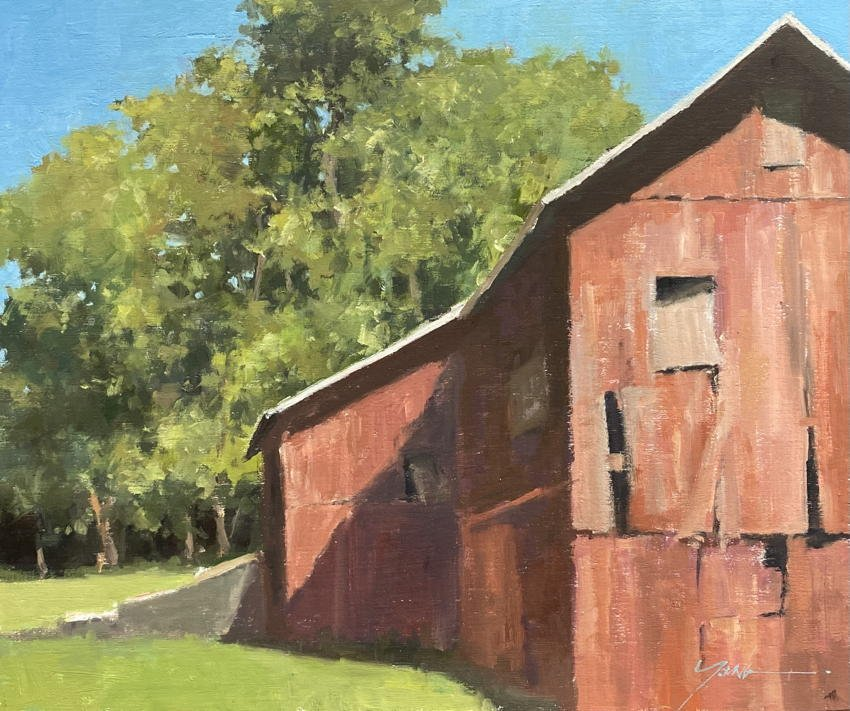
James Young paints barns like other artists paint portraits.
There’s painstaking care and intentionality in the way he depicts the shadows cast across the face of a barn or the sun peeking through a missing roof panel. Their expressions range from stoic to lonesome.
Young started painting barns in 2006 and simply hasn’t stopped.
He grew up in Granville, Ohio, and worked on farms as a kid, but was eager to experience something other than the slow-paced living of his hometown. He graduated from Columbus College of Art and Design with a degree in painting and moved to New York to pursue a career as an artist.
He spent years exploring different subjects, looking for something to inspire his creativity. He was painting still lifes of fruit, blown up on five-foot canvases, before he was given the advice to paint what he loved. Young instantly thought of home.
“It seems obvious to me now, like most things do in life once you find them,” Young said.
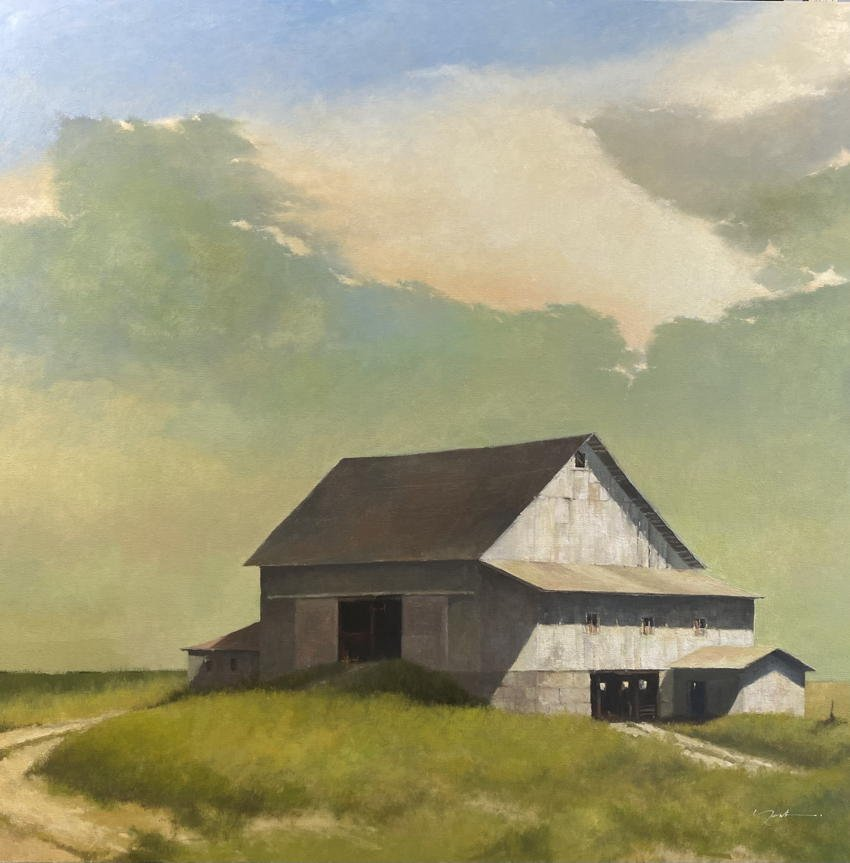
Young’s work relies heavily on commission work.
“The romantic aspects of the barn are the farm and its history,” Young said. He works with pictures that customers supply of existing or preexisting barns, and recently produced a five-painting series for a customer.
“She brought me five or six photo albums, hundreds of photos, of the farm she grew up on,” Young said. “The photos were mainly shot by her mother, who had a really great eye.”
Young was particularly struck by her understanding of composition and light.
“I consider her mom the artist,” Young said. “She started the creative process back in the ’60s, and I got to carry on with it.”
Although some customers request accurate snapshots of their family barns, Young finds more satisfaction when he is allowed more creativity with his process.
“I think that the real art is taking the barn, but trying to create a painting that shows the history or the feeling of this subject,” Young said.
As central Ohio continues to house massive development projects, such as Intel’s New Albany plant, Amazon warehouses, and other manufacturers, much of the area’s farmland is being lost.
According to the 2009 USDA Statistics Service, Ohio lost over 36,000 farms and 3.3 million acres of farmland between 1970 and 2007. That number has only continued to escalate with recent development in central Ohio.
When construction was done to widen State Rt. 161 between New Albany and Interstate 270, many farms along the route were lost due to construction. Young preserved them the only way he knew how – through art.
“I recorded as much as I could, through photos and sketches, a lot as commission work from people who were losing property,” Young said. “It was like asking a portrait artist to paint someone who is going to die soon.”
It’s part of Young’s job as an artist to detail history.
“I’m keeping a visual journal of this area,” Young said. “You don’t realize how quickly things change until you look back at them.”
See more of James Young’s work at www.jamesyoungartist.com
Selah Griffin wrote for TheReportingProject.org, the nonprofit news organization of Denison University’s journalism program, which is supported by generous donations from readers. Sign up for The Reporting Project newsletter here.