

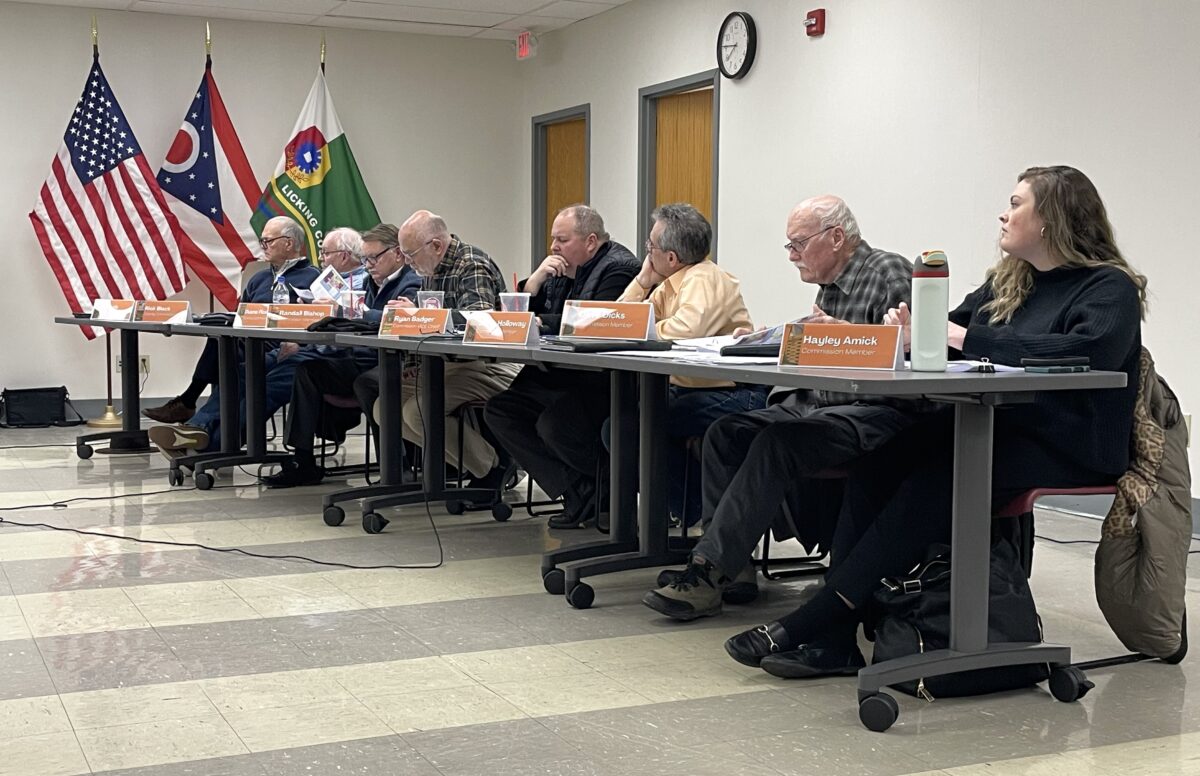
The Licking County Planning Commission gave its blessing Monday night to a proposal by St. Albans Township to become the first in the county to effectively ban data centers.
The commission also heard an update during the Feb. 2 meeting about efforts by The Shelly Company to operate asphalt- and concrete-mixing facilities along Raccoon Creek just outside Alexandria in St. Albans Township.
The commission wasn’t being asked to take any action on the request to the Federal Emergency Management Agency (FEMA) by Shelly Materials, a Shelly Company affiliate, to revise the floodplain map for property it leases from local resident James Geiger. But the commission, which previously rejected the Shelly request for a permit to operate there, could be asked at a future date to take action in the matter.
Area residents who filled most of the seats in the commission’s meeting room at the Licking County Administration Building on Feb. 2 spoke for the data-center ban and against the floodplain map revision.
Planning Commission member Steve Holloway launched the discussion of data centers when he asked Planning Director Carson Combs what could be done at the county level to manage the wave of data centers washing over central Ohio. Of the 194 data centers in Ohio, 113 of them are in central Ohio, according to Data Center Map, which tracks data centers around the world.
Holloway said he has heard concerns from residents about the resources used by data centers, especially water and electricity.
Combs said there is little the county can do because those resources and natural gas lines, which are in demand to fuel electric-generating plants being built to power some data centers, are managed at the state level by the Ohio Power Siting Board and the Public Utilities Commission of Ohio. The same goes for small nuclear-power plants, which some data-center operators are seeking to install.
“County government regulation is somewhat limited,” Combs said. “The township level is the best place to regulate this.”
And that’s exactly what St. Albans Township is working toward now.
The county planning commission’s approval of a non-binding recommendation to approve a zoning change in the township endorses the removal of “Internet Publishing and Broadcasting; Telecommunications; Internet Service Providers, Web Search Portals, and Data Processing Services; and Other Information Services” from the conditionally permitted uses of Sec. 1502 of its zoning code.
| Read more: No data centers here: St. Albans Township officials seek to ban complexes popping up around them
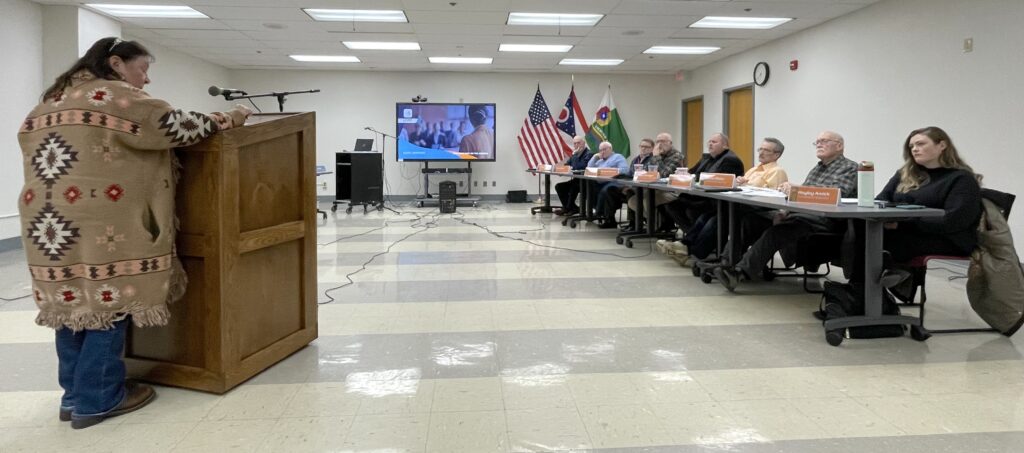
Residents Elaine Robertson and Sarah Chaulk spoke in favor of the data-center ban.
“What happens in 20 to 30 years when technology moves on and these facilities are obsolete?” Chaulk asked. She raised concerns about the community being stuck with hulking empty structures that could be contaminated with industrial waste.
Robertson pointed to the rapidly growing number of data centers in New Albany and next door in Jersey Township and said that St. Albans Township is being proactive. “This is a good opportunity for us,” she said.
Commission member Randall Bishop argued that eliminating any option for such businesses is going too far, and that it’s a heavy-handed approach that would diminish the opportunity for some farmers to sell their land for development.
“I know this won’t make me popular, but when you do this, you really restrict property rights,” he said.
Commission member Tim Bubb, who is also a county commissioner, said every township is different in topography and the desires of residents. His feeling, he said, is that if township residents and officials want it, and it’s reflected in the township comprehensive plan and zoning code, “I’ll support it.”
The planning commission voted unanimously to support the zoning change to ban data centers. It goes next to the St. Albans Township Zoning Board for a hearing and vote, and if approved, to the township trustees for a hearing and vote, said Brad Mercer, planning manager for the Licking County Planning & Development office.
“Unanimous approval,” said St. Albans Township Trustee Tad VanNess after the vote. “It doesn’t get much better than that.”
Shelly Materials site floodplain
Those who lined up to speak against the latest effort by Shelly Materials to win approval for heavy industry along Raccoon Creek on the southeast side of Alexandria included Robertson, who is a founding member of the Raccoon Creek Environmental Alliance, Granville Village Council member Laura Mickelson and Granville Village Manager Herb Koehler.
All repeated concerns they have raised in the past about the potential for pollution to enter Raccoon Creek through the normal course of business, which involves industrial materials that include petroleum products, and if accidental spills would happen at the site in the future.
Raccoon Creek water helps recharge the wellfield from which Granville draws the drinking water for Granville and Alexandria residents, and Mickelson said a spill could poison the water supply.
| Read more: Shelly Company continues effort to operate asphalt and concrete plants at Alexandria
Robertson said it’s a conflict of interest that the engineer making the technical argument to FEMA to revise the floodplain map was hired by Shelly Materials.
“The integrity of it is called into question,” she said.
Koehler said the proposed map revision does not consider recent development in the area, which may have changed the contours of the land, and it doesn’t consider recent trends in rainfall, such as when downpours dump inches of rain in short periods of time.
And he said it’s unclear how the proposed change would affect wildlife in the area, including endangered species. Overall, he said, it’s an “unquantified risk to the watershed.”
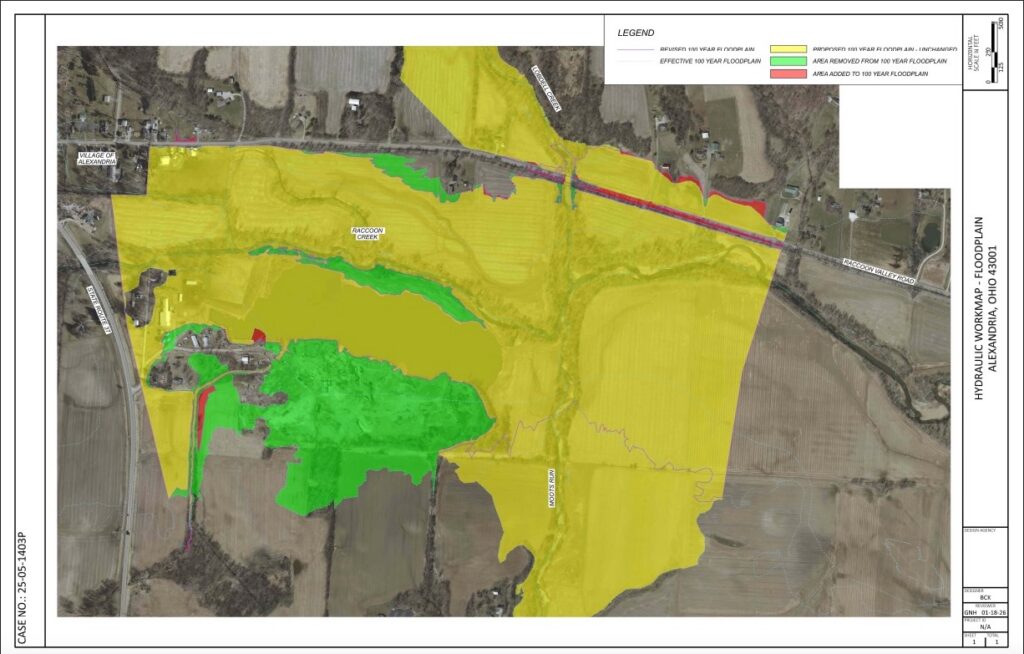
The discussion of the revised map at the planning commission meeting was part of a process that has been going on for three years as Shelly Materials repeatedly seeks approval to operate on the Geiger property. To date, the company’s proposal has been rejected several times by the planning commission and the courts.
Independent reviewers hired by FEMA have 90 days from Jan. 19 to look over the engineer’s responses to their comments and questions, Mercer said, but if another federal government shutdown occurs, it could take longer than 90 days.
The reviewers could send back more comments and questions. If they and FEMA decide the maps are acceptable toward the goal of revising the floodplain maps for land around Raccoon Creek southeast of Alexandria, the Shelly Company would then face county review.
Mercer said that if and when that happens – no sooner than three months from now – the county planning office will place a public notice and give area residents the opportunity to comment before a final decision is made.
Alan Miller writes for TheReportingProject.org, the nonprofit news organization of Denison University’s Journalism program, which is supported by generous donations from readers. Sign up for The Reporting Project newsletter here.
1.26.26-PACKET-draft