

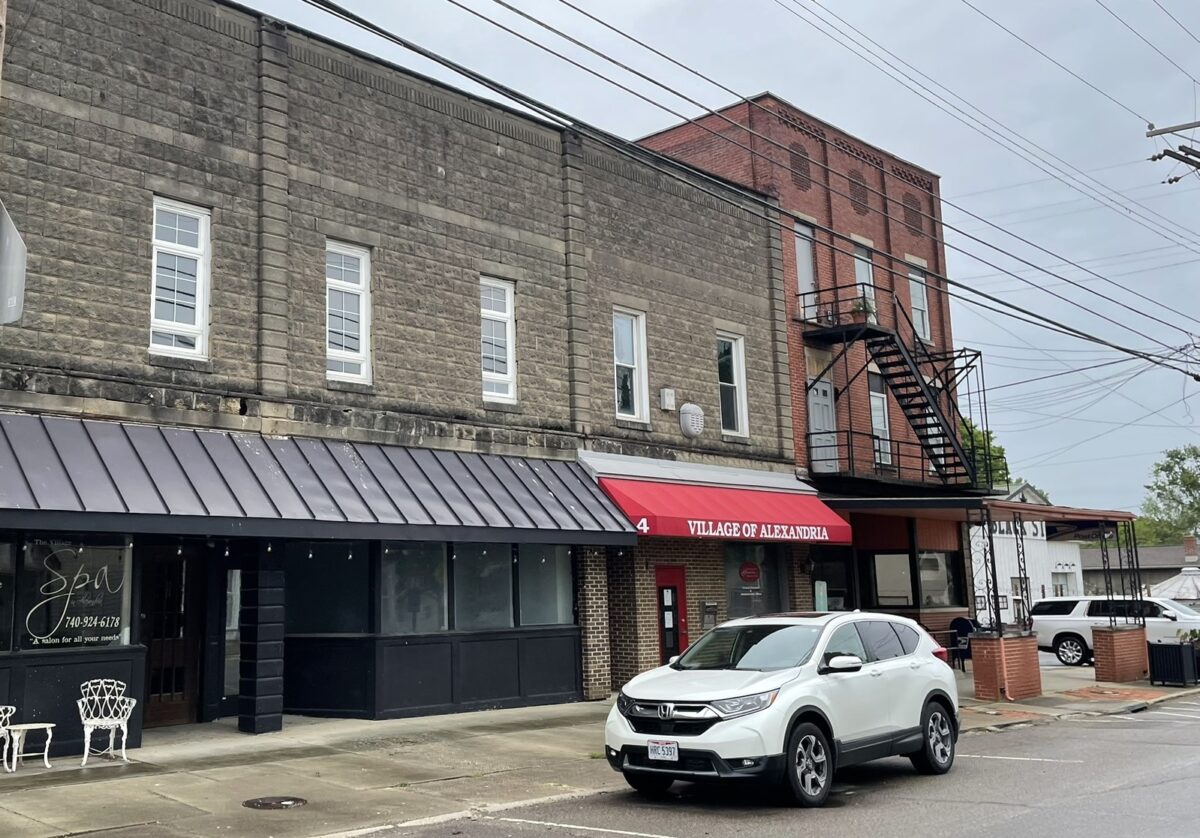
Arguments about which of two potential water-and-sewer service providers would be best for Village of Alexandria residents have divided the village council.
Since Sept. 1, Alexandria Village Council meetings have been dominated by questions surrounding two water-and-sewer operation proposals – one contract from the Village of Granville and the other from the Licking Regional Water District. The council meets again at 7 p.m., Nov. 17.
Granville has provided water to Alexandria since the 1980s and has managed the village’s sewage-treatment plant since 2023.
A renewal of the Granville contract, which was introduced to the council at the Sept. 1 meeting, would give Granville’s water-sewer operators jurisdiction over the Alexandria system, which goes beyond the current contract with Granville. The new contract would be in place for three years, and would cost the village $2,400 a month for the first year.
The council decided that the issue wasn’t pressing enough to vote on that evening – nor spend a significant amount of time discussing. Council members decided that more time should be spent negotiating the terms outside of regular meeting times, and that they would return to the issue on Sept. 15.
On the 15th, however, the conversation turned into a back-and-forth between Alexandria Mayor Sean Barnes and skeptics on the council.
“I’ve got a lot of concerns,” Councilmember Mitch Peters said during the Sept. 15 meeting. “I don’t think it’s in the village’s interest to sign a three-year contract with only the price of the first year being known, that’s the first thing. Nobody would sign an open-ended contract that doesn’t tell you what you’re going to pay.”
Peters and council member Lyle Simpson wanted to be sure the village was considering all of its options and sought a proposal from the Licking Regional Water District (LRWD), a public entity that operates in communities in western Licking County. LRWD assembled two proposals: One would allow Alexandria to maintain control and ownership of existing water and wastewater infrastructure, and the other proposes a system in which LRWD assumes control, responsibility and maintenance of the village’s public water and wastewater systems – and eligible debt.
Peters and Simpson brought the Licking Regional Water proposals to the village council meeting on Oct. 6. The LRWD contract includes much of the same language on operation and jurisdiction as the first contract, and would cost the village $2,300 per month for the first three years – $100 less per month than Granville’s proposal.
“We’re a small village with limited resources, and we need to use those resources judiciously,” Simpson said in October. “If we can spend our money better, I think we have the duty to do that.”
“I think either of these are a good short term option,” he continued. “Long term, I think we need to really consider what we’re going to do with this sewer plant. It’s nearing the end of its time.”
But the proposals from Licking Regional Water come with stipulations.
“Both proposals are premised upon a cooperative relationship between Alexandria and LRWD,” LRWD Executive Director Jim Roberts wrote in an introduction to the utilities proposals. “Accordingly, each proposal includes as a material term Alexandria’s withdrawal from the pending administrative and judicial proceedings challenging permits associated with LRWD’s Pet Run Wastewater Treatment Plant and Raccoon Creek Wastewater Treatment Center, together with Alexandria’s withdrawal from the Municipal Utility Coalition.”
The Municipal Utility Coalition – previously known as the JAG, for Johnstown, Alexandria and Granville – was an agreement between the three communities that effectively would have managed water and sewer services in those communities and unincorporated areas between them.
The three municipal governments originally formed this group in an effort to preserve the rural character of the area, manage development and limit LRWD’s service to the area. In January 2026, however, Johnstown left the coalition, leaving a coalition of Alexandria and Granville.
Other council members had reservations about the LRWD contract.
“In reading the proposals from Licking Regional, I did not like the pieces they put in there that said we would have to get out of JAG, we would have to drop any opposition to the Pet Run and the Raccoon Valley stormwater and wastewater,” said Councilmember Sarah Chambers. “I don’t think that council should be told what they can protest or drop just so we can do this to save $100 a month.”
Chambers compared the stipulations to “blackmail.”
Councilmember Carianne Meng agreed with Chambers’ characterization of the terms, and noted that the LRWD contract also fails to comply with the village’s comprehensive plan that was passed in July 2026.
“The whole point of that comprehensive plan was to retain our established direction, to have a say in where this community goes in terms of development,” she said.
These issues aren’t the only thing the council is worried about, though. LRWD carries more than $100 million in debt, according to the utility’s 2025 financial statements, and Councilmember Spencer Giese expressed his concern that attempts to remedy this debt would result in higher water and sewer prices for village residents. While the Granville contract allows Alexandria’s government to continue to set prices for residents, the LRWD proposal would delegate rate setting to the water district.
“We can hear how great the prices are right now, but once they’re in control of billing, we have no say in that matter, we cannot help our village residents. We cannot help our citizens,” Giese said. “They’ll be charged what they’re charged. We can control our charges [now] as we are a village offering this service to our assistance. If we take away the service we provide, what are we?”
Roberts told The Reporting Project that the district hopes to provide Alexandria with an alternative option that will save the village money and benefit their residents.
“We have fought hard and will continue to fight hard to keep our rates very reasonable and not put the burden of any new developments on any of our current ratepayers,” Roberts said. “Our proposal to Alexandria did indicate that Alexandria residents would pay our in-district rates. There’s not a surcharge because they’re not part of the original footprint of the district. So, we think that’s very fair.”
Roberts also said that the reasoning behind requiring Alexandria to drop any legal proceedings against LRWD is simple.
“If we’re going to be partners, it wouldn’t make sense for them to still be filing legal claims against us,” he said.
LRWD also has an existing contractual partnership with St. Albans Township, where the village is located. At the Oct. 20 meeting, St. Albans Township Trustee Tad VanNess spoke up during the public comment portion and encouraged the council to at least consider LRWD’s proposal.
“[Licking Regional] is something to consider, from my perspective,” VanNess said. “The water all tastes the same and the sewer all goes away.”
Originally, the idea that the village might need a new contract for water and sewer services came up in late 2025 as a result of a requested wage increase from Alexandria’s current operator, Jack Liggett. When Barnes and Kendra Borror, the village administrator, discovered that they did not have enough funds to provide the increase Liggett requested, they began pursuing other options
“We just started looking around to see if it would be possible for us to find a better setup, since we were potentially going to lose this operator that we have due to our financial restrictions. We ended up in a conversation with Granville, and they actually were open to the idea of one of their operators potentially operating as our operator, and us paying a contractual fee,” Barnes said.
Granville Village Manager Herb Koehler told The Reporting Project in September that he was hopeful that the contract would further solidify the partnership between the two villages.
“Because we already have a contract with [Alexandria], we decided to roll all of these services into a new contract that covers everything we’re currently doing on the water providing side, and then also the distribution side and then the wastewater side,” Koehler said in September. “So we’ve collaborated on a new contract. It’s in its final form. We have not passed it yet, and neither has Alexandria, but we’re about to do that probably in the next couple of meetings. And it does exactly what we hoped … and that is to strengthen the partnership between Alexandria and Granville.”
The Reporting Project reached out to Liggett, who also works full time for the City of Johnstown. He said that he heard about the contract through “rumors,” and hasn’t heard from Alexandria personally.
“After 30 years, it’s pretty disappointing,” Liggett said. “I was disappointed they didn’t come talk to me about any situations to start with. I think it’s upon [the village] to reach out to me if they’re changing the status and operation of the plant.”
But the council is facing an additional challenge in determining who should be involved in the proposal discussions. Already, one representative from the law firm that represents the village has recused himself from being involved in discussions after advising Peters to do the same.
“My recommendation was that he recuse himself from any discussion of anything to do with our water-sewer contract and the meeting that he had with Licking Regional, which resulted in that contract, was not in keeping with my recommendation,” explained David Ball, an attorney at Rosenberg & Ball, which provides legal services for the village. “The person who handles the operation of our sewer plant prefers to contract with Mr. Peters’ employer when they are on larger projects, so to the extent that replacing him would lead the village to no longer use Mr. Peters’ employer, that’s the basis of that concern.”
Ball recused himself from further discussions after Peters challenged his potential conflict of interest.
“Speaking of recusing themselves, I think you should recuse yourself,” Peters told Ball during the Oct. 6 council meeting. “Not only can you benefit if this would go through, it may lower your rates. You live in Granville. Your business is in Granville. And, your wife’s on council.”
“Okay. I recuse myself,” Ball responded. Raymond “Chip” Moats, another lawyer at Rosenberg & Ball, provided legal counsel during the Oct. 20 meeting.
Despite requests for updates to Granville’s proposal following negotiations, copies of the contract given to the council on Oct. 20 had not been rewritten with council members’ concerns in mind. Because of this, they did not move forward with the first reading of an updated contract with Granville.
“Until we have two things to compare, I don’t think we can do anything else,” Chambers said.
The meeting ended with no decision made on the status of either contract, and they expressed their intention to revisit some of the contracts’ provisions before attempting to vote on it in November. Alexandria Village Council meets next on Nov. 17 at 7 p.m.
Margo Ellis writes for TheReportingProject.org, the nonprofit news organization of Denison University’s Journalism program, which is supported by generous donations from readers. Sign up for The Reporting Project newsletter here.