


Licking County residents and leaders from across the county gathered with neighbors and strangers alike last week to discuss the future of the community.
Twice.
Hosted by LC Forward in partnership with Planning NEXT, a Columbus consulting firm, these community conversations are designed to inform the county’s first comprehensive plan in 25 years.
The third and final of these community conversations will be at 6 p.m. on Tuesday, June 30, at Pataskala Grace Church, 3517 Headleys Mill Road.
“Either we come together as a community … or these corporations will do it for us,” said Licking County Commissioner Duane Flowers, speaking about the rapid growth and development in the county during his welcome speech at the second meeting, held at Licking Valley High School.
The first two meetings, held on Tuesday and Thursday last week, started with an introductory presentation by Sarah Kelly, the facilitator for the community conversations and director at Planning NEXT. Kelly explained the process and the end goal of a comprehensive plan for the county.
Kelly emphasized that the plan would not be a legislative document.
“[We are] starting with a vision and goals and ending with an actionable plan,” Kelly said. She explained that the reason the county needs a plan like this is to align infrastructure investment and guide long-term fiscal and economic stability.
Kelly said the plan is not to spur growth or influence zoning, adding that power to manage growth lies with local governments. She also said the plan would not be rigid. After its implementation, it would be subject to change.
In the presentation, Kelly talked about growth trends in the county. By 2050, she said, planners anticipate the county’s population of about 180,000 will grow by about 50,000 people. “That’s like adding a whole other city of Newark,” Kelly said.
Following the presentation, participants worked together around their tables, identifying themselves and what they treasure about the county.
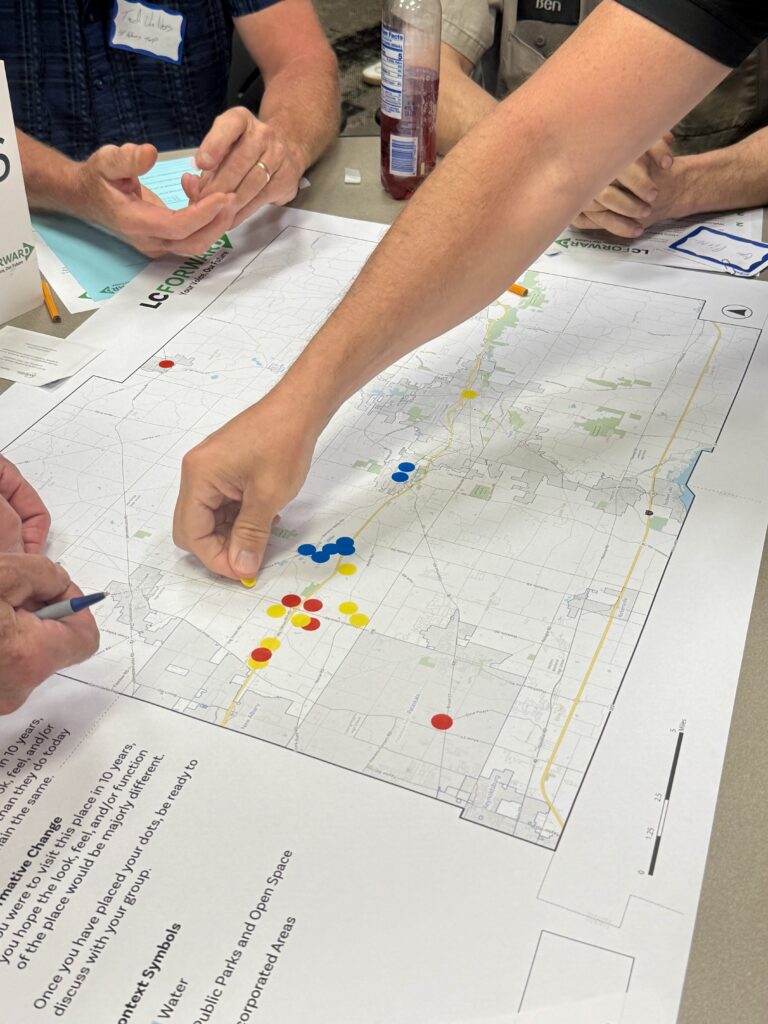
The second activity had each participant place six dots on a map: Two blue dots to show areas they would like to keep the same, two yellow dots to show areas where they would like to see some change, and two red dots to show where they would like to see transformative change.
The purpose of that exercise was to help the LC Forward leadership team understand how the county is changing now and what people want change to look like.
That information will aid the leadership team in creating the plan. However, this will not be the only time they seek feedback from the community. In fact, those who were unable to attend any of the in-person meetings, and those who have additional thoughts to share with LC Forward, can fill out the survey on the LC Forward website.
Kelly made it clear that the community will be involved in every step of the process.
Some attendees held some skepticism around this process and how seriously their input would be considered. Some from St. Albans township, for example, expressed frustration because they have already spent about $50,000 to create and update their township comprehensive plans. They said they don’t need a countywide plan in addition to their plan.
Other attendees saw the discussion as an opportunity to make an impact on the future of the county.
“If we engage and stay engaged, we can make a difference,” said Mike McFarland, former mayor of Hebron.
Nora Meeks writes for TheReportingProject.org, the nonprofit news organization of Denison University’s Journalism program, which is supported by generous donations from readers. Sign up for The Reporting Project newsletter here.