

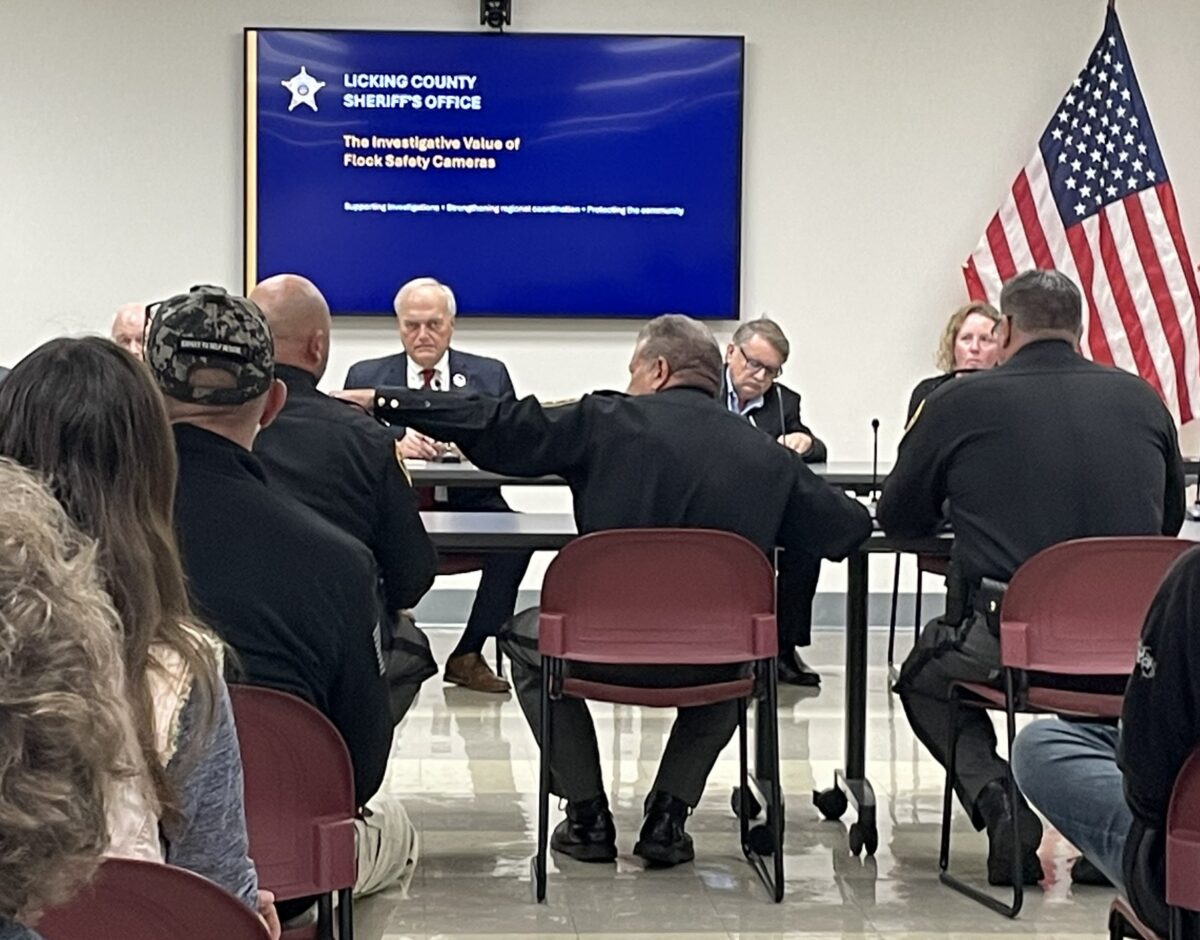
So many people showed up to a Licking County Commissioners’ meeting Monday afternoon to hear Sheriff Randy Thorp talk about how his staff uses Flock surveillance cameras that they had to move the meeting to a larger room.
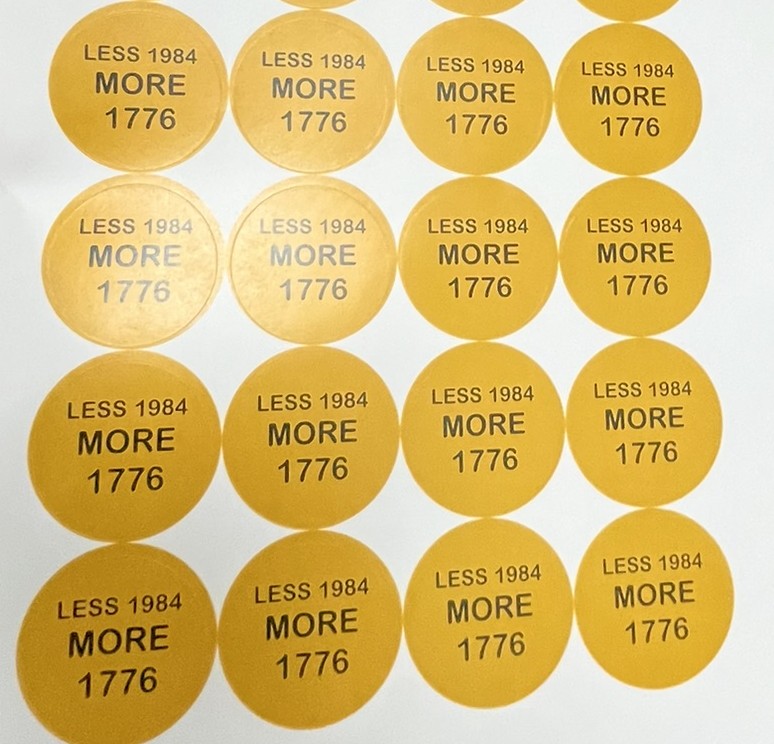
Many in the audience for the 2 p.m. meeting on Nov. 2 wore stickers that said “Less 1984, MORE 1776,” referring to the dystopian novel by George Orwell in which “Big Brother” is always watching versus the rights guaranteed by the U.S. Constitution – specifically the 4th Amendment protection against unreasonable search and seizure.
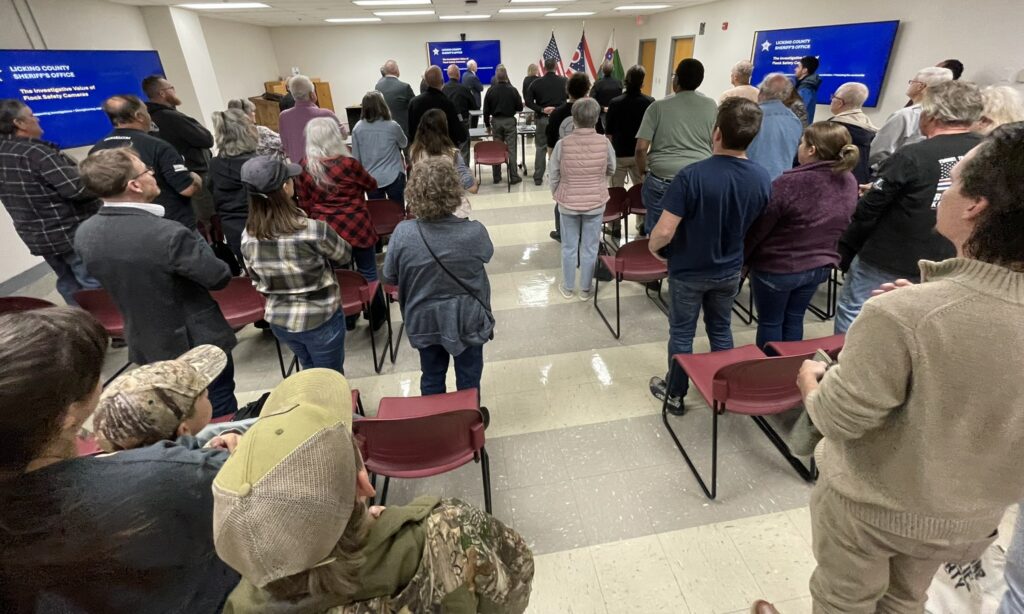
And at least some of them indicated they wanted to do more than listen. They wanted to ask questions about who uses Flock camera images of cars and license plate numbers from Licking County, and for what purposes, given that the sheriff’s staff acknowledged that they share Flock data with “thousands” of other police agencies.
Even after moving the meeting from the commissioners’ meeting room on the fourth floor of the Licking County Administration Building to the much larger basement meeting room, it was standing-room-only for about 40 of the more than 100 people in attendance.
“It’s not a town-hall, it’s not a debate, and we’re not taking questions from the audience,” Commissioner Tim Bubb said at the start of the meeting. But he said the commissioners would do their best to ask questions they knew would be on the minds of people in the room.
Pat Lebold, a former Newark Township Trustee, said after the hour-long meeting that he had met with the commissioners and asked for a meeting about Flock cameras, but he wanted a town-hall meeting in which residents could have a dialogue with officials.
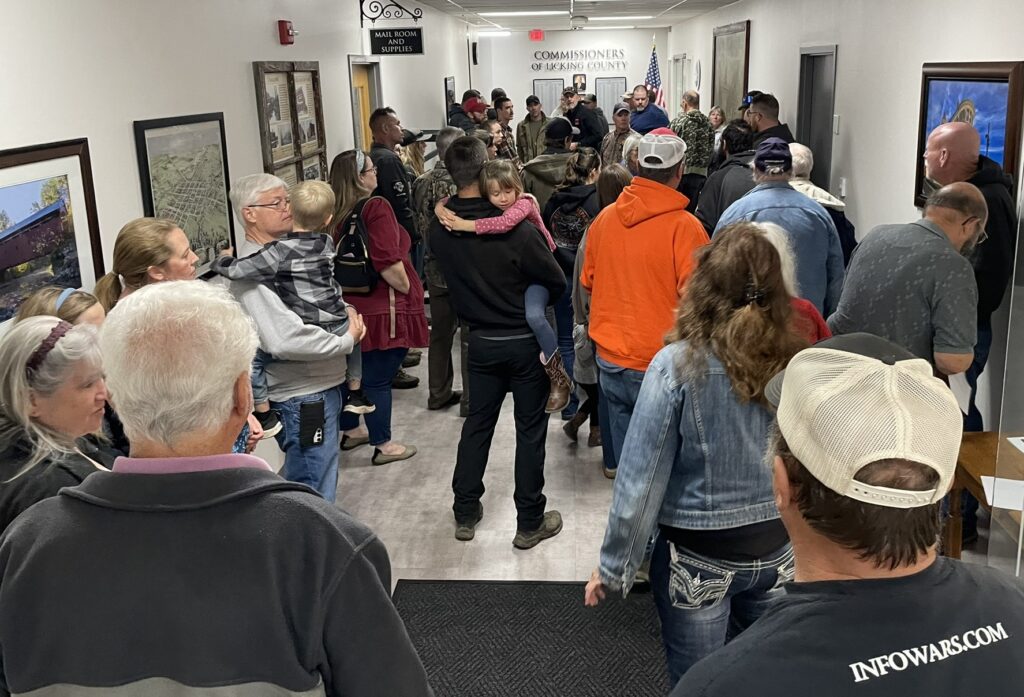
Lebold spoke to the crowd as they were moving from one room to the next, saying that his concerns about Flock cameras should not be seen as anti-law enforcement, because he appreciates those who work in the safety forces.
But he said that Flock cameras are intrusive, and because of data sharing, it’s unclear where it ends up or how it might be used later.
Sheriff Thorp told the commissioners that he considered the information available from Flock surveillance cameras to be one of the most valuable tools in law enforcement and he “is very much in favor of them.”
Unlike some other police agencies that have discontinued using the cameras under pressure from concerned citizens, Thorp said he would seek to renew the county’s contract with Flock when it expires.
He was accompanied to the commissioners meeting by five top deputies, who explained that the office has been using Flock cameras since 2023, and it spends $195,000 a year for 60 cameras positioned throughout the county. That does not include Flock cameras under contract by other police agencies, schools and businesses.
The sheriff’s staff said they share Flock data with other police agencies when requested, but not with private businesses or other entities. They said Flock deletes images 30 days after they are captured, and that the company will reduce the storage time to seven days starting Jan. 1, 2027.
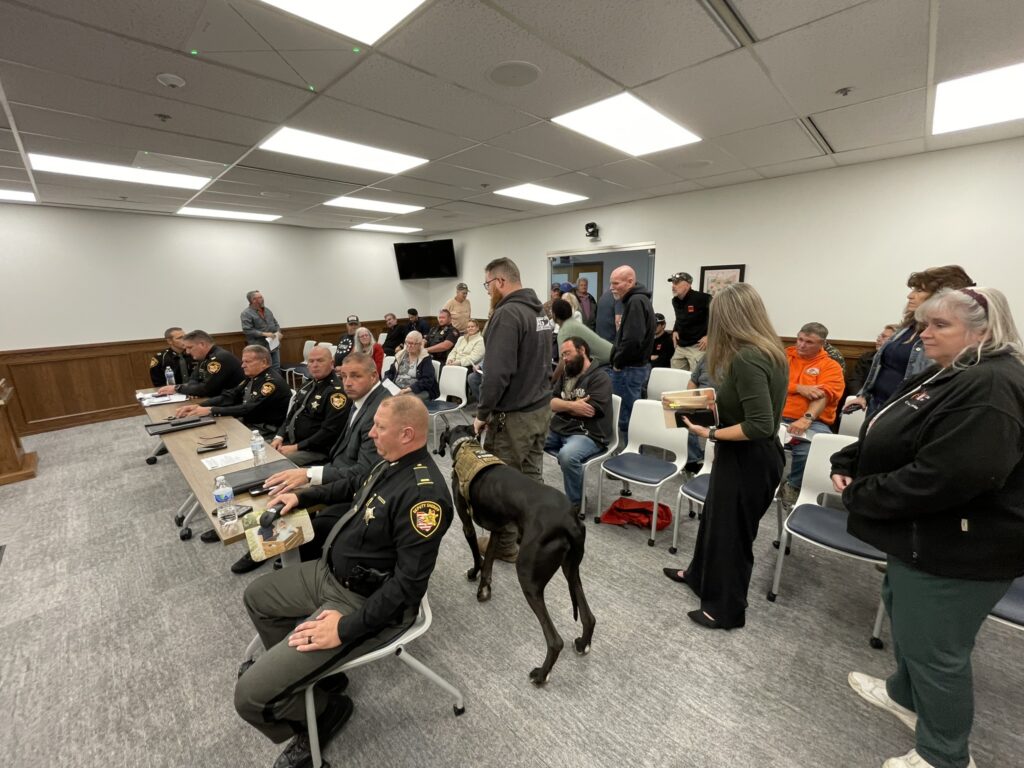
The sheriff’s top deputies said the office has strict policies about how and when the information can be used by deputies, and Thorp said any employee who violates policy “will suffer the consequences.”
Lt. Justin Woodyard of the Detective Division walked the commissioners through several cases in which information from Flock cameras led to the apprehension and arrest of suspects in cases involving homicide, abduction and sexual assault, and a string of robberies and burglaries.
In a 2025 example, Woodyard said information from a Flock camera led to a suspect in a homicide case being arrested in Orangeburg, South Carolina. “The murder weapon was located in his car,” Woodyard said.
In another 2025 case of a missing juvenile, a witness described a red Cadillac seen in the area of an apparent abduction. A Flock camera provided an image of a red Cadillac and its license plate. That information was entered into the state Law Enforcement Automated Data System (LEADS), which provided a name and address of a suspect. A search of the vehicle showed evidence of a sexual assault, and the suspect was arrested and charged.
In solving the string of burglaries and robberies, Woodyard said that a silver Dodge Dakota was described by witnesses who said it had distinguishing features later seen in Flock camera images from the area. Deputies obtained a warrant to put a GPS tracker on the vehicle, followed the person “and caught the suspect in the middle of committing an offense.”
During the “public comment” period of commissioners’ regular meeting on Monday morning, three people spoke against Flock cameras, and all raised concerns about how third parties might use the information Flock collects.
Two of the speakers, both from Newark, said they work in the technology industry.
“It’s not a question of trusting the sheriff or the sheriff’s department,” said Michael Quaintance, adding that his concern is about potential abuse of the information, and that even the name “Flock” suggests that people should raise questions.
“The name suggests that we are a flock of sheep to be monitored and catalogued,” he said.
Commissioner Duane Flowers told Thorp and his deputies that he supports them, and that “law enforcement is important to me and 99.9% of the people in this room. But I believe most of these people don’t trust government.”
In that context, and with Flock cameras appearing in so many places, and with recent accounts of potential abuse of Flock data by some in law enforcement, including in Reynoldsburg and Columbus, “it causes concern,” Flowers said.
Lebold asked the commissioners at the end of the meeting to schedule a town-hall meeting during which the public could ask questions of the sheriff and commissioners – “and hold it in the evening. Some of these people took off work to be here this afternoon.”
Alan Miller writes for TheReportingProject.org, the nonprofit news organization of Denison University’s Journalism program, which is supported by generous donations from readers. Sign up for The Reporting Project newsletter here.