

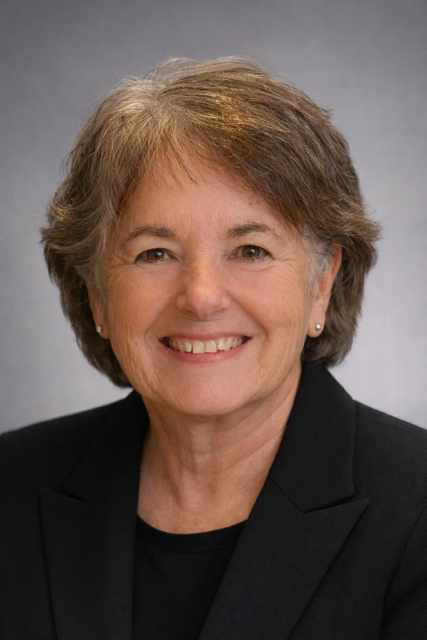
Mary “Kathy” McLeish was quite happy to be retired.
She turned 70 earlier this year, and she planned to spend the rest of her days happily enjoying time with her family. But with an open Licking County commissioner’s seat and no other Democratic candidates slated to run, McLeish knew she couldn’t sit out this election.
“I feel like 68% of the country feels we’re headed in the wrong direction with almost everything and I felt like I had to do something,” McLeish said.
McLeish, a Newark resident, is vying to serve as the first Democratic Licking County commissioner in nearly 20 years. She’s facing Republican Mark A. Van Buren and write-in candidate Brian Belcher for the seat currently held by Commissioner Rick Black, who is retiring after 12 years in office.
Read more: Why are there three county commissioners?
When McLeish learned Black was retiring and the Licking County Democratic Party didn’t have someone to campaign for the open seat, she asked several people she knew if they would be willing to run. None of them agreed, citing careers, family and already-busy lives.
“You know the old adage, ‘If you want something done, you may as well just do it yourself,’” said McLeish. “And everyone kept asking me, ‘Why don’t you run? Why don’t you run?’ And then I realized, either I’m going to lose my mind or I’m going to run.”
So McLeish – who spent more than 20 years working in public and early childhood education – started her campaign for county commissioner with a focus on advocating for children and families, building stronger communities, and collaborating with the public, non-profit, and private sectors.
Throughout her career, McLeish has held several leadership and advocacy positions, including regional director of the Child Care Resource Network and administrator for the Licking County Children and Family First Council. She’s also spearheaded several initiatives, including the county financial literacy program, and is a deacon at the First Presbyterian Church in Granville.
“For over 30 years, my life’s work was driven by the simple belief that every child deserves a strong start, every family deserves a champion, and every community thrives when we lift each other up,” she said during an Oct. 1 candidate forum co-hosted by WCLT, the Licking County Farm Bureau and The Reporting Project. “Through it all, I learned that public service isn’t about policy; it’s about people.”
Read more: 2026 Licking County Candidate Forum
Her goal, she said, is to leverage existing tax funds and put them to use supporting communities and prioritizing taxpayers.
“There’s just a lot going on right now that we need to have a pulse on, because it’s all trickling down to the local level,” McLeish said.
Those challenges, McLeish said, include the rising cost of living, protecting the environment and “responsible growth,” the influx of data centers in the region and transparency around tax dollars.
“We’re losing our middle class and we need to listen to them,” McLeish said. “We’ve got a lot of people in this community who are hungry, and we need to figure out a safety net until the economy gets better.”
In Licking County, more than a third of residents are considered “asset-limited, income-constrained, employed,” or ALICE – a metric developed by the United Way to help understand how people living with incomes above the federal poverty level are still struggling to make ends meet. A lot of those families rely on resources like the Food Pantry Network, though those safety nets are wearing thin under changing federal policies.
McLeish grew up in Pataskala and used to drive by farmland on her bus route as a kid. Now, that farmland is filled with hundreds of homes, businesses and data centers.
While McLeish understands the need for some data centers, she says people don’t have enough information to “safely” move forward with more of them in the community.
“I don’t want to stop technology,” McLeish said. “But I want growth to happen responsibly, and I know data centers are the buzzword right now, but we’re just putting out one fire after another and we’ve got to build some fire stations before we keep starting all these fires.
“Some say we’re in this race against China to build as many data centers as we can,” McLeish continued. “But China has over 300 data centers and there are, like, 5,000 or more data centers in the United States.”
In the United States, there are more than 3,000 data centers currently operating with another 1,400 in various stages of development, according to Data Center Map, a Denmark-based database. In China, though, Data Center Map indicates just 376.
Ohio is home to more than 240, making it the state with the fifth-highest number of data centers in the country, according to the Office of the Ohio Consumers’ Counsel. Of the 240 around the state, 50 are in Licking County – more than any other county.
“I feel like the state and the federal government 100% dropped the ball on regulating AI and data centers, and who gets left holding them back?” McLeish said.
McLeish said she would not sign any non-disclosure agreements with data centers if she gets elected as county commissioner, as county commissioner Tim Bubb said he did in 2022. She said transparency around decision making – and making decisions alongside community members – is important to her.
McLeish said she made it to eight or nine different parades throughout the summer, and has managed her campaign as a grassroots movement with the “best supporters in the world.”
“Since I announced I would run, everyone has just come through for me in ways I just can’t even imagine,” McLeish said.
“I want people to vote for me because I will do the job well and represent every forgotten voice in this community,” McLeish said. “We have got to help one another, and I don’t see it getting better anytime soon.”
Early, in-person voting began at 8 a.m. on Tuesday, Oct. 6 at the board of elections office at 20 S. 2nd Street in downtown Newark. Hours are 8 a.m. to 5 p.m. weekdays through Friday, Oct. 23. Hours are 8 a.m. to 4 p.m. on Saturday, Oct. 24; from 7:30 a.m. to 7:30 p.m. on Monday, Oct. 26; from 7:30 a.m. to 8:30 p.m. on Tuesday, Oct. 27; from 7:30 a.m. to 7:30 p.m. Wednesday, Oct. 28 until Friday, Oct. 30; from 8 a.m. to 4 p.m. on Saturday, Oct. 31, and from 1 p.m. to 5 p.m. on Sunday, Nov. 1. There will be no in-person early voting the Monday before Election Day. In-person voting on Election Day will be from 6:30 a.m. to 7:30 p.m. on Tuesday, Nov. 3. Absentee ballots – including mailed ballots – must be returned to the board of elections by 7:30 p.m. on Election Day.
Shaye Phillips writes for TheReportingProject.org, the nonprofit news organization of Denison University’s Journalism program, which is supported by generous donations from readers. Sign up for The Reporting Project newsletter here.