
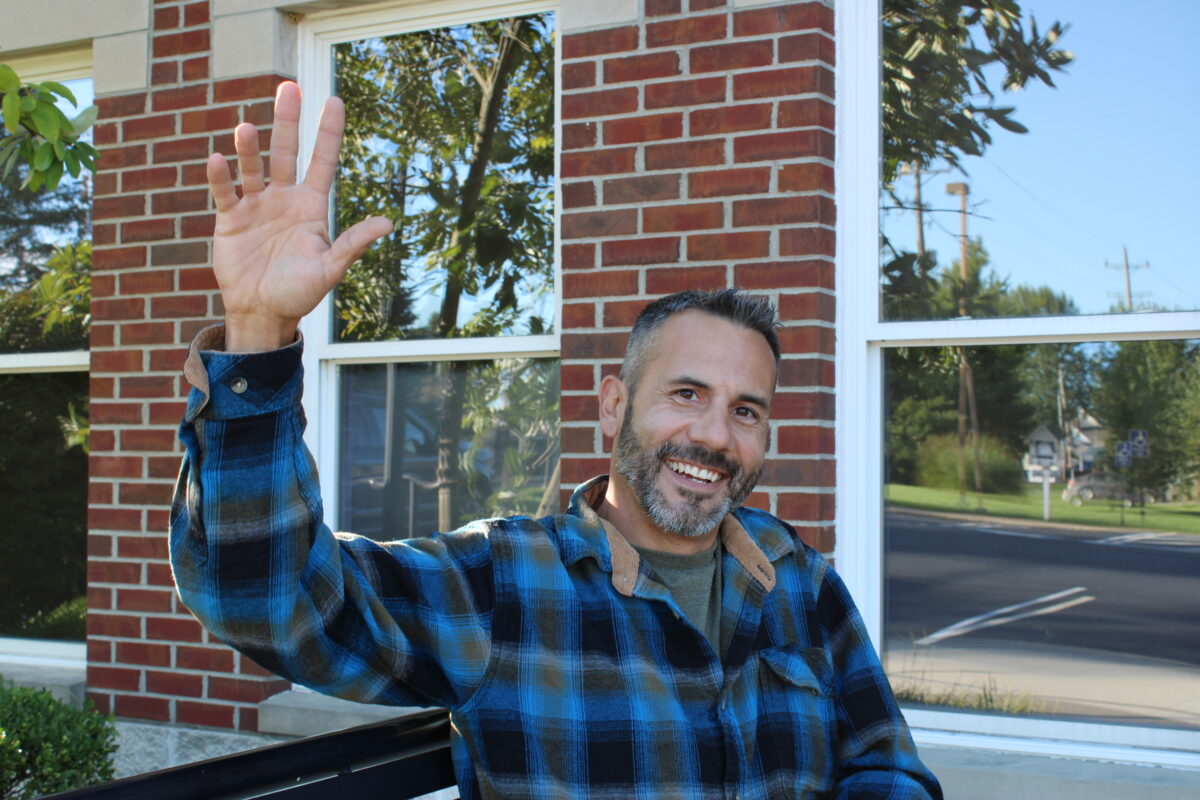

Brian Belcher is running for Licking County commissioner, but his name will not be on the ballot.
Instead, he’s running as an independent write-in candidate, meaning residents interested in voting for him will have to mark the blank bubble on the ballot, then fill in his name.
Belcher, 42, did not run for election during the May primary and filed his declaration of intent to run as a write-in candidate with the Licking County Board of Elections in early summer after hearing concerns from his friends, neighbors and residents across the county.
He’ll face Democrat Kathy McLeish and Republican Mark A. Van Buren for the seat currently held by Commissioner Rick Black, who is retiring after 12 years in office.
Read more: Why are there three county commissioners?
Belcher, a foreman working on large-scale projects around the county with the International Brotherhood of Electrical Workers (IBEW) 683, was born and raised in Licking County, and said he has lived his entire life within five miles of Johnstown.
“I love Licking County, and I’m not very happy with the direction that it’s heading,” Belcher told The Reporting Project. “The Licking County I would like to see in the future is not the Licking County that we are seeing now.”
The challenges – and the core reasons he’s running, he said – surround growth and development, communication and government transparency.
Managing “growth with guardrails” is key, he said.
“I’m not against growth,” he explained. “I’m against us constantly reacting to growth after problems are already here. Roads, water, sewer, electric, emergency services and the surrounding communities need to be part of the conversation before the project gets ahead of them.”
He said he would like to see growth continue – just at a more manageable pace.
“I don’t want to see a project get started wherever it is in the county and the county not be prepared – or the area, township, city – not be prepared to even have this project,” he explained. “To build a house, you need to have a driveway first so you can get material. You don’t start building the house. And that just takes planning and oversight.”
He’s been in construction for almost two decades. Now, working in management, part of his work is keeping all individuals involved with the project on the same page. Through this work, he’s noticed gaps in communication between involved parties, often solved when the two groups communicate with each other.
“We have a lot of good people doing their individual jobs, but what I’ve found over the last several months is that the pieces don’t always connect,” he said. “That’s where my experience comes in, where that’s what I do for a living is make sure everyone’s on the same page and following through.”
Read more: 2026 Licking County Candidate Forum
That’s where transparency and communication come in.
“I saw several gaps that I quickly realized that there’s a better way to structure it and make things more efficient because of what I have been dealing with,” Belcher said. “I have a lot of residents reach out to me, not knowing exactly what’s going on, and that’s not their fault. It’s that a lot of the information is not necessarily broadcasted in a manner that I see that it should be.”
He’s also noticed an increased need for transparency.
He wants more conversations between the townships, the cities and the counties to plan accordingly for what’s to come, particularly from the rapidly developing western portion of Licking County – home to the delayed $28 billion Intel chip manufacturing facility, housing development proposals, data centers and more.
“The western part of Licking County, with the growth that’s coming this way, and the New Albany Company, we are trying, in my opinion, to plan around what they’re planning,” he said. “But we have no idea what their actual plan is.”
He followed up by saying that he does not believe any elected official should be signing any non-disclosure agreements with developers or corporations like Intel, as county commissioner Tim Bubb said he did in 2022.
Belcher’s platform is focused on putting resident needs first. He’s interested in what is best for the residents of Licking County, first and foremost, and he said residents reach out to him often.
“The stories and experiences that they are dealing with, it’ll put a tear in your eye. It’s very heartbreaking to hear what people are going through,” Belcher said. “It reminds me of why I’m doing this because I’m not doing this for myself. I don’t care about the title. I don’t care about a title.”
Belcher is active on social media to communicate and engage with residents.
To combat the communication issue he was seeing with residents and in his place of work, he created an online resource called Who Do I Call?. The resource breaks down potential issues and directs the user to the person they need to call to get it sorted out. He also has been working on a countywide construction project and infrastructure map.
His goal, he said, was to make finding answers easier. “Communication should not be a scavenger hunt,” he said. “I’d like to see this [Who Do I Call?] implemented across the county.”
If elected, Belcher has a plan for what his first work as county commissioner would look like. His first goal would be to get everyone at the same table to figure out where the gaps are.
Belcher likes to look at the big picture, one of the qualities he thinks would help him in a potential new role as county commissioner.
When thinking about data centers, he looks at the big picture. He also has worked on almost all the major data center projects in the county.
“The concern is very real but it goes both ways,”Belcher said. “There’s a lot of questions around them, the electricity, the grid. There are a lot of negatives around them, but they do have some positives such as job creation and technology.”
He also added, “I don’t feel like data centers should be built in beautiful, perfect farmland. We’ve got warehouses in disrepair all over the county that need to be torn down anyways. Build them there.”
Belcher said he values God, peace, family and prosperity.
“It would mean so much for me to be able to have him have something better in life than what we had,” Belcher said about his 12-year-old son, Theo. “I try to lead by example. I’m very proud of him and hopefully he’s proud of me.”
Belcher aims to keep the impact on residents in mind first when making decisions.
“My moral compass is that I feel that elected officials should represent and do the will of the people,” Belcher said. “What about all the people who are going to be affected by this? The people who are their forever homes and the elderly, and they’ve been here for 60, 70 years in this home and everything’s changing, but hey, this is good on paper. Just because something’s good on paper doesn’t necessarily mean it’s good in reality.”
Early, in-person voting began at 8 a.m. on Tuesday, Oct. 6 at the board of elections office at 20 S. 2nd Street in downtown Newark. Hours are 8 a.m. to 5 p.m. weekdays through Friday, Oct. 23. Hours are 8 a.m. to 4 p.m. on Saturday, Oct. 24; from 7:30 a.m. to 7:30 p.m. on Monday, Oct. 26; from 7:30 a.m. to 8:30 p.m. on Tuesday, Oct. 27; from 7:30 a.m. to 7:30 p.m. Wednesday, Oct. 28 until Friday, Oct. 30; from 8 a.m. to 4 p.m. on Saturday, Oct. 31, and from 1 p.m. to 5 p.m. on Sunday, Nov. 1.
There will be no in-person early voting the Monday before Election Day.
In-person voting on Election Day will be from 6:30 a.m. to 7:30 p.m. on Tuesday, Nov. 3. Absentee ballots — including mailed ballots — must be returned to the board of elections by 7:30 p.m. on Election Day.
Ella Diehl writes for TheReportingProject.org, the nonprofit news organization of Denison University’s Journalism program, which is supported by generous donations from readers. Sign up for The Reporting Project newsletter here.