


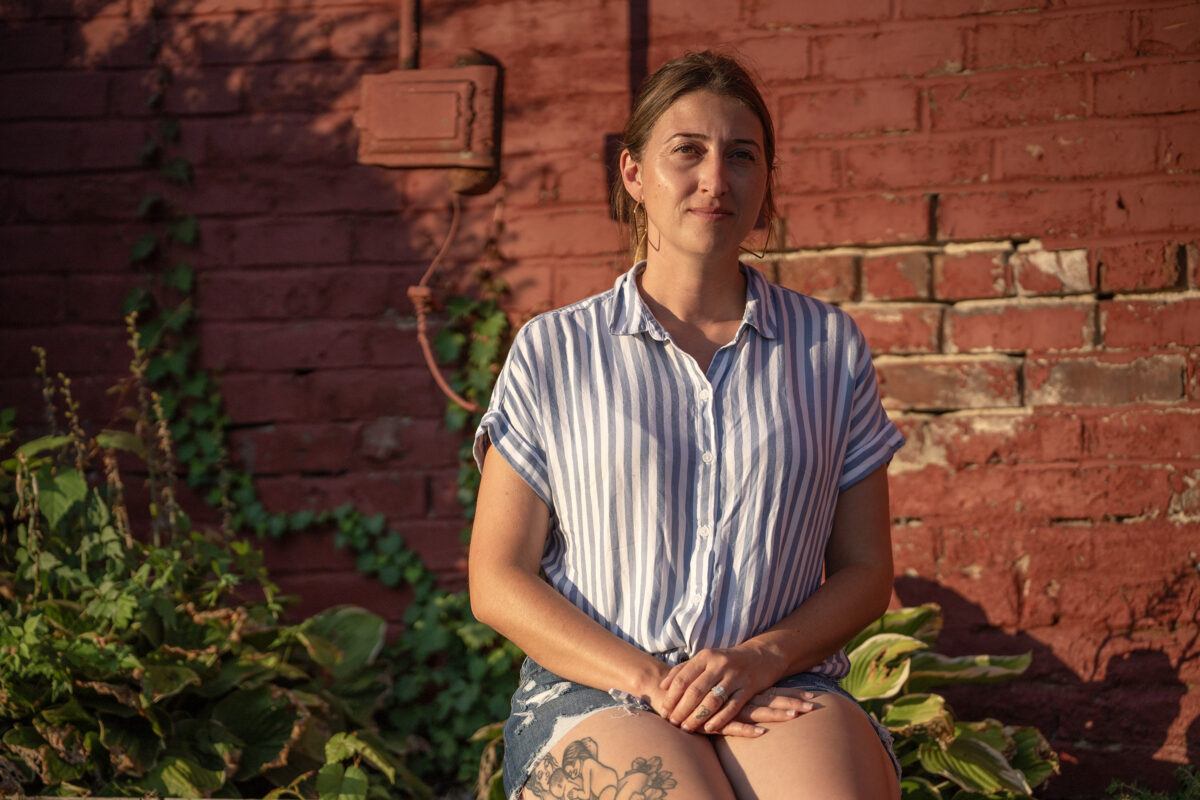
Kari Franchini can’t stop making calls.
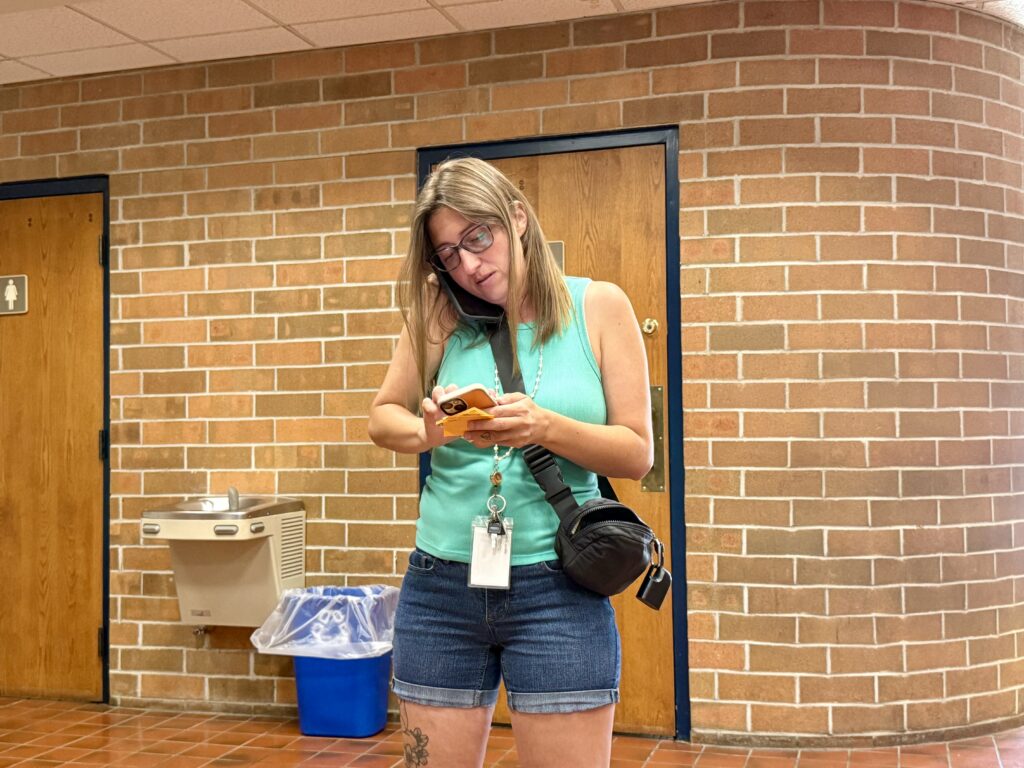
She has her work phone up against her ear and another in her hand as she waits in the lobby of the Licking County Justice Center.
She is here to send off a client to treatment – a process that Franchini says won’t take long. But when she approaches the front counter, her plans immediately change.
There’s an issue with the bond. Franchini’s client can’t leave jail yet.
In between phone calls, Franchini tilts her phone away from her face and looks at Chandler, the driver from Pike County Recovery Council. “I’ll fight to make it happen today,” she says.
While Franchini has never had issues at the jail before, she is used to adapting to bumps in the road.
“It’s always something, we navigate away.”
This is just an average day for her. Her work goes far beyond her title of substance use disorder (SUD) Community Nurse.
Her job is not the clear-cut role of a typical nurse.
“My job description is ‘nursing,’ but if I can do it, I’m going to do it,” Franchini said.
She uses her medical background often, from providing infectious disease testing to unhoused people, to passing out drug test strips, to distributing Narcan. But, as she stands in the lobby of the Licking County jail figuring out the situation with her client, Franchini explains that she does a lot of social work, too.
She drives her clients to appointments, takes them grocery shopping, makes calls for them, helps them navigate SNAP benefits and medicaid, and even holds onto their important documents in her office. She herself, however, is rarely in that office.
When Franchini was in nursing school she had a feeling that she could do more. She has a history with substance use disorder through her family. So she got online and started looking for jobs where she might be able to use her personal experience to make a difference within the nursing profession. She has now worked for The Freedom Center, an outpatient treatment center based in Mount Vernon, Ohio, for the past two years.
Franchini has faced a learning curve. The first six months were hard for her. She had to put in a lot of time to get to know programs and resources in the community.
The job, she says, is “about showing up and building a lot of trust.” Franchini spends a lot of time stopping by homeless encampments and organizations like the Drop-In Center and The Main Place.
Over time, by showing up every day, Franchini was able to build relationships with people struggling with substance use disorder, and very frequently also struggling with being unhoused.
“All of them call me Nurse Kari,” she said. “They know who I am.”
Some of her clients call her “mom.” Some call her “Kari.” Everywhere she goes, everyone seems to know her.
“I don’t take specific clients, I just take them all, all the time,” she says.
The people she works with are often trapped in a cycle, sometimes without any support system.
“They’re stuck in survival mode,” she says. Part of her job is knowing what resources will move them past that, from places people can get a meal or safely spend a night, to where they can seek treatment.
While waiting for the right paperwork to go through for her client’s release from jail, Franchini stops by the Community Drop-in Center. As she walks up to the front door of the drop-in she stops and says hi to almost everyone. Right as she gets to the door she runs into one of her clients.
“I’ve been bragging about you,” she says, beaming.
Seeing her clients succeed is the highlight of her job. She pulls up pictures of past clients before and after they went to treatment. She shows off the pictures the same way she shows off pictures of her kids.
She talks about one client who did not want to go into treatment. He then messaged her after he entered treatment saying “you were right.”
Franchini’s job requires a lot of patience and flexibility. Every day is a different set of problems and barriers she has to break through.
“Sometimes I get very frustrated when things aren’t working out as they’re planned or feeling like we need more of me,” she says. But even when it gets hard, Franchini keeps going to serve the people who need her.
But, she says she doesn’t get burnt out. Everytime she gets close to that, she gets a reminder of why she is doing this work.
“The good Lord does this thing where he knows when I’m about there. He knows that I’m getting tired,” Franchini says.
“He’ll put me in front of somebody that said, ‘Hey, thank you so much for taking the time to force me to go to that shelter because if I didn’t, I would have been dead in my car.’”
Franchini knows that for many of her clients she is the only person who is checking in on them to make sure they have what they need. Even with the many resources in Licking County,
Franchini says some of her clients struggle to venture away from what they know. Some people don’t have a support system at all.
“Having someone show up and tell them you’re here and have what they need, or just hanging out with them, it’s important,” she says. “Sometimes it’s about having someone who doesn’t give up.”
Franchini doesn’t judge or choose who she wants to help. In her eyes everyone deserves help and to be treated like a human being.
She has clients who have been to treatment multiple times, and she says if they called her right now and told her they wanted to try again, she would be there to help them.
“Who am I to decide if someone is worth saving,” she says. “If they’re alive, they’re worth it.”
As she drives to her next stop she gets a call. “They’re finally releasing our girl,” she says, redirecting her destination to the jail.
People are not usually happy when they walk into the Licking County jail. But as Franchini walks in for the third time that day, she is smiling ear to ear.
“Teamwork makes the dream work” she says as she high fives Chandler. But, it is only about five minutes before her work phone rings. She picks up and begins pacing back and forth, fully immersed in problem-solving mode.
She keeps her work phone pressed between her ear and her shoulder and scrolls through her list of contacts on her other. All while balancing a pad of bright orange sticky notes balanced on the phone.
Franchini has a client who is pregnant, and most treatment centers don’t accept pregnant women. But Franchini has found a place for her.
She is worried if her client doesn’t get into treatment today she won’t go at all. All she needs is a way to get her there. But the treatment center is 2.5 hours away.
She is scribbling down notes and calculations, trying to figure out if she can scrape together money for an Uber. After one call ends she scrolls through her contacts and dials another number, “OK, next call.”
After 30 minutes Franchini has found a way for her client to get to treatment using her web of resources she’s built in the community.
She hangs up and goes back to waiting for another client to be released. But, after a cumulative four hours in the jail, she isn’t waiting for very long.
Franchini can’t control the smile on her face as her other client, with an equally big smile, steps through the navy metal door.
“This is the highlight of my whole week,” she says as she and her client hug.
They walk out into the parking lot, and before her client leaves with Chandler for the two-hour drive to Pike County, Franchini hands her a bag stuffed with clothes.
“I ran around, I got donations from where I could and then I ran to the store to fill in where I could, got her the clothes that she needed,” Franchini explained later.
She, Chandler and her client stand beside Chandler’s van. Recovery will have difficult parts to it, Franchini says.
“Take a deep breath and before you try to leave, you call me, so I can say ‘girl, don’t make me yank you up.’” She smiles as her client nods. “I’m proud of you and you got this.”
Franchini compares the often arduous recovery process to the biblical story of Jonah and the whale.
“The worst part was being swallowed,” she says, gesturing towards the jail. “You’re riding back now, but you’re going to have to do the work when you get to the shore.”
“If you can do that,” she points at the jail again, “and you can do that,” she points at the street, “you can do this.”
Franchini and her client hug one last time before the woman leaves for recovery.
If you or someone you know is struggling or in crisis, help is available. Call or text 988 or chat at 988lifeline.org. To learn how to get support for mental health, drug or alcohol issues, visit FindSupport.gov. If you are ready to locate a treatment facility or provider, you can go directly to FindTreatment.gov or call 800-662-HELP (4357). Naloxone is available for free from Harm Reduction Ohio, the Licking County Health Department, or every Saturday from 10-12pm at the Newark Homeless Outreach on the corner of East Main and Buena Vista Street.
Nora Meeks and Ella Kitchens write for TheReportingProject.org, the nonprofit news organization of Denison University’s Journalism program, which is supported by generous donations from readers. Sign up for The Reporting Project newsletter here.