

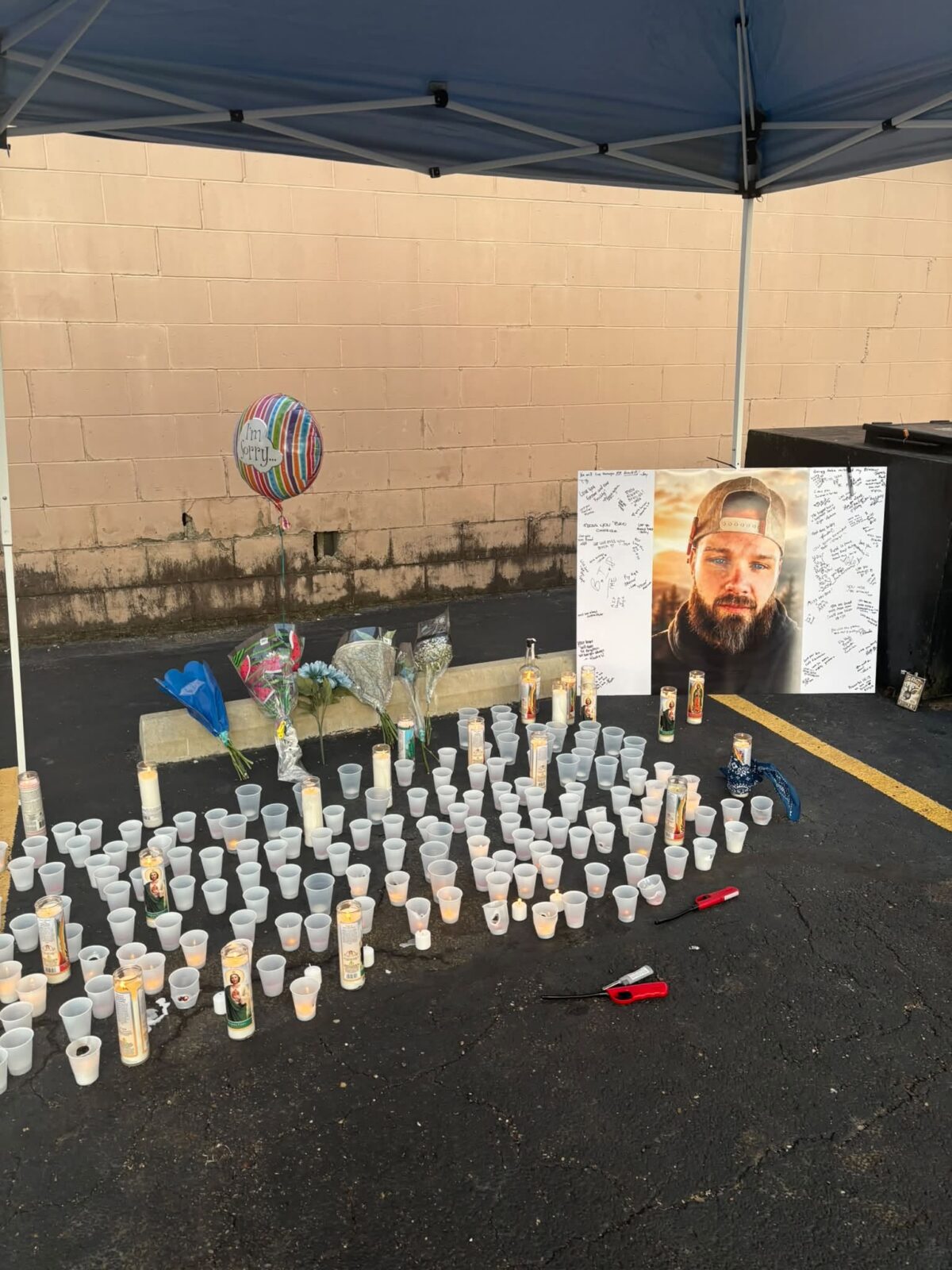
This story discusses suicide and substance use disorder. If you or someone you know is contemplating suicide, please call or text the National Suicide and Crisis Lifeline at 988.
Brock Lewis frequently gave away his clothing.
One winter, the Newark native gave an expensive coat to someone who didn’t have one. At a treatment center in Ironton, in southern Ohio, a man arrived with only the clothes on his body, so Brock gave him his own shoes and solicited clothing donations from everyone he knew in the facility. And at least once, he literally gave away the shirt off his back.
It happened during summertime, when Brock was already sunburned. His sister Hollie Linton took him to the Dollar General on East Main Street to get him a few things, including sunblock, a pair of flip-flops and a new T-shirt.
When Linton dropped him off, Brock said as he exited her car, “I know that dude,” directing his attention toward a guy standing on the sidewalk without a shirt.
She watched as Brock walked over to him, took off the T-shirt she had just bought him, and gave it to the man.


On the morning of Friday, July 3, Brock – the same compassionate guy who had spent so much of his life thinking of others – was found dead behind a green trash bin in a parking lot. A 911 phone call alerted Newark Police to his body behind The Cedar Bar and Grill, at the corner of North Cedar and East Indiana streets on Newark’s east side.
Brock died by suicide, according to the Licking County Coroner’s Office. He was 34 years old.
A Newark Police Department detective said there was no indication of foul play in his death.
Brock was one of three unhoused or marginally housed people found dead on Newark’s streets this summer, conspicuous deaths in a city that has grappled with a shortage of adequate housing, and mental-health and substance-use disorder resources in recent years. These are frequently intertwined challenges faced by cities and towns across the United States.
Brock’s death did not go unnoticed or unmourned.
Four days after Brock died, the pews at the Newark Church of the Nazarene on South Williams Street were full of people grieving and celebrating a man who loved his friends and family. A man who would always ask how you were doing before you could ask him the same question. A man who struggled with his mental health and with substance use, and who sometimes slept on the streets. A man who, despite all of this, was cared for and loved by those who knew him.
Brock’s death underscores the fact that suicide is consistently one of the leading causes of death for 25-34-year-olds in the U.S., according to the Centers for Disease Control and Prevention. Those who experience homelessness and those with serious mental illness are more likely to die by suicide. Brock fell into both categories.
Brock’s memorial service on July 7 began with The Beatles’ “Blackbird” sung by family friend Melissa Anderson.
Blackbird singing in the dead of night
Take these broken wings and learn to fly
All your life
You were only waiting for this moment to arise.
It is a song about finding light in the darkness, joy amid sorrow, relief from pain.
Linton, Brock’s older sister, told the gathering about her brother – sharing his struggles and his strengths. It was a service for someone who loved deeply and was deeply loved.
Those who remember Brock, born and raised in Newark, often bring up his eyes – bright, blue eyes that stand out in photos of him. Radiant.
“The story of my brother and who he was…,” Linton said as she paused and teared up. “He was a really great person. He deserved better, for sure.”
Those who knew him have repeatedly said the same. Brock Lewis was kind. Brock Lewis was funny. Brock Lewis cared about the people around him, the person he was talking with, the person to whom he was giving the shirt off his back.

From the corner of the parking lot where Brock’s body was found, the muffled sounds of cars can be heard passing by on Rt. 16 just yards away. A sign tacked to the fence announces a suicide memorial and awareness motorcycle ride on Sept. 12.
And two bunches of flowers are stuck in the fence to memorialize his tragic death, as well as his complicated but luminous life.
Weeks of trouble
The last few weeks of Brock’s life were chaotic. His points of contact with friends and authorities reveal a man who was struggling.
One morning in early June, Patty Fetter, who owns the Dairy Isle on East Main Street, found him asleep on a picnic bench behind her restaurant. It was hot and he was wearing two sweatshirts. She gave him food and water.

On June 14, Brock was seen sleeping in front of the CVS on East Main Street. An employee at the store called for a well-check on his behalf. He wasn’t causing a disturbance, but the employee was concerned. Police arrived, checked on him, and asked him to move along.
And then, on June 17 at 2:38 p.m., Brock was booked into the Licking County Justice Center. According to arrest records, he walked into the administrative lobby of the justice center and asked “to speak with a detective about a civil issue.”
The deputy in the lobby asked for his name and date of birth, which Brock provided. And the deputy found a warrant for his arrest on charges of “disorderly conduct.”
Two deputies escorted Brock to the jail intake area “without incident” and to a holding cell.
When deputies tried to complete the process of booking at 5:47 p.m., an incident report reads, “Due to his noncompliance and blatant disregard to follow simple instructions, he was sent back to his respective holding cell.” At 11:16 p.m., after six hours, he was still in intake. The report said that “Lewis refused to comply with intake questions.”
The intake process, according to jail policy, includes a mental-health screening, which involves questions about suicide ideation – a term used by clinical professionals to gauge the degree to which someone is developing ideas or thinking about suicide – as well as observations of behavior and assessment of whether the person needs a referral for more services.
A day later, Brock was arraigned. In a video of the hearing, he seems disoriented and incoherent. He stutters and appears confused.
On June 21, Brock became upset when a jail nurse passed by him without offering medication. He was verbally abusive. Notes in the incident report indicate that he was given a 48-hour lockdown “for being vulgar and disrespectful.”
Lockdown began on June 21 at 7:56 p.m. and ended on June 23 at the same time.
On June 22, his younger sister McKenzie Lewis received a text message from Jennifer New, who was in a relationship with Brock for many years. New had heard that Brock tried to jump from a second floor in the jail. The jail has no record of this incident.
McKenzie was concerned and called the jail to ask whether this was true, as well as to seek a mental-health check. She spoke with someone on duty who said they had not heard about the incident.
McKenzie asked to speak with someone about him, and she was transferred to the voicemail for the jail’s social work staff. She left a message and asked for a return call, but she said no one called.
Brock received a health assessment on June 30 around 11 a.m. The assessment nurse would have noted his physical state and, most likely, his demeanor. A spokesperson for the jail said that its social work department had plans to follow up with Brock regarding their assessment, which would have involved a mental health screening. That never happened, according to records from the Licking County Sheriff’s Office. Brock went to court later on June 30 and was released at 1:38 p.m., according to records.

It was 92 degrees and oppressively humid – as it had been and would continue to be for several days during a mid-summer heat wave.
On July 2, Patty Fetter saw Brock at the Dairy Isle again. It was around noon, and Fetter was sitting at a picnic table behind the restaurant when Brock came walking through the alley that passes beside the Dairy Isle and to nearby Carson Elementary School.
He was not well, she said. He told her that somebody put “staples with chloroform” in the back of his head. “So I got up, checked his head, and didn’t see anything.”
It was hot, she said, but he looked good and was wearing clean clothes.
“But I could see it in his eyes,” Fetter said. “I knew something was kind of different that day.”
Fetter texted Brock’s sister Hollie Linton. “I said, ‘Brock’s here. I fed him, I talked to him, I checked his head. I don’t see any injuries.’”
Linton didn’t believe her. She thought her brother was still in jail. Linton said she and Fetter both looked it up, and the online registry showed that he was still in jail.
“Whenever he becomes incarcerated,” Linton said, “I wake up every day and check the jail inmate list to make sure he’s still in jail.”
She said she had been checking the list and he was still listed. McKenzie said the same.
When asked about a possible time lag in updating the jail log, the jail spokesman said the online list of incarcerated people updates “every 15 minutes.”
Linton wanted to know more, so she posted on Facebook asking people to reach out if they had seen Brock. People responded: They saw him on East Main. They saw him at the Speedway. They saw him carrying what looked like paperwork. They offered up prayers. They said they would keep an eye out.
That same day, Tara Midkiff was working at The Bottle Shop on East Main. She said Brock stopped by around 9:30 p.m. He was on foot, holding a cigarette and a Four Loko, and he seemed to be in a good mood, Midkiff said. She told him that his sisters were looking for him.
“And I told him I would be here tomorrow, that he should come by.”
On the morning of July 3, 911 callers told dispatchers that someone was in the street at the intersection of Cedar and Indiana, northeast of downtown Newark, apparently trying to get the attention of drivers. One caller eventually drove into the parking lot to investigate and saw a body behind a green Waste Management trash bin.
Linton, who lives out of state, contacted McKenzie when she saw a social media post about the incident. A friend of McKenzie’s did the same and told her she should go look for Brock. She drove to Cedar Street and saw the crime-scene tape and his body on the ground. She could see his feet from a distance, but an officer said it wasn’t Brock.
McKenzie felt relieved and started to drive home. But then, a police car pulled her over. It was the same officer she had just spoken with.
The officer said she was sorry and that it actually was Brock. They had found his ID.
Lingering questions
Hollie Linton has worked in behavioral health for nearly 20 years. She’s a licensed social worker and currently serves as development director for a central Ohio-based nonprofit that works with mental health resources. She made it clear that her opinions are her own and not that of her employer.

Linton has questions about her brother’s time in jail, his condition upon his release, his manner of death and how people with mental-health struggles can be better supported.
“As somebody who has a loved one struggling with mental-health and substance-use issues,” Linton said, “this is a community that’s very resistant to change. I think they just become blind to the reality of how these issues impact our societies.”
Linton said the fact that in July, some members of Newark City Council questioned supporting the Community Drop-In Center on West Main Street with Community Development Block Grant funds underscores this assertion. The council eventually approved the $11,000 allocation, only after significant response from advocates.
Brock was a bright young man, but he faced much adversity, Linton said, and so his struggles with mental health and substance use did not come as a surprise to her. She said that eventually he was diagnosed with schizoaffective disorder and PTSD.
She said he struggled to accept his diagnosis and his need for medication. McKenzie concurred.
“I think it’s important for me to note, especially given my professional training and education, I did not expect anybody to order treatment for him, to mandate medication,” Linton said. “I didn’t expect anybody to save Brock.”
She just wanted Brock to be safe and the community to be safe, Linton said, and she wonders why he was released in the condition he was in.
“Where did this go wrong?” she asked. “Where have we failed? What are the areas of opportunity? Where are there gaps in service?”
Linton said she believes there’s a disconnect between law enforcement and available services.
Both sisters asserted that Brock should have been “pink slipped” by law enforcement on multiple occasions, but he was not. For someone to be “pink slipped,” or placed on an involuntary emergency mental-health hold at a hospital, the person must show intent to harm themself or someone else, according to Ohio law. And, according to Ohio law, a person taken into custody or ordered to be hospitalized may not be detained for “more than 48 hours.”
“But I think the important thing to communicate is,” Linton said, “I do not think that we treat this population with any amount of respect. I think that he’s been written off.”
There are systems in place that should be able to help catch and address mental-health concerns. Col. Chris Barbuto, of the Licking County Sheriff’s Office, said the arresting officer fills out a questionnaire that includes questions about suicide ideation. Then the person is asked questions directly. Again, during the booking process, the jail conducts a suicidal screening assessment.

Depending on responses to those questions, the incarcerated person could trigger a suicide watch. And as one source shared, some people, having had prior experience in jail, might not answer the questions or might respond in ways that would help them avoid suicide watch.
Barbuto said that jail personnel are aware of this so they also speak with the arresting officer to try to get a sense of the person’s state of mind. He said they try to catch things early. Due to medical record confidentiality, no record of Brock’s suicide screening assessment was available for review.
If an inmate seems intent on harm, they will be watched closely – and the jail has a policy that includes either a 10- minute watch or a constant watch following a suicide attempt.
If they have been on active watch, and they are going to be released, Barbuto said, “We make sure we release you to somebody or we take you to the hospital. We don’t just let you off by yourself.”
Incarcerated people in Ohio are supposed to receive a medical assessment, as well as a mental health assessment, within 14 days of incarceration. The average population of the Licking County jail in June 2026 was roughly 272 inmates. The jail has eight full-time nurses and four part-time nurses. It also has three social workers on staff.
In an email, a jail spokesperson said the jail conducts three suicide screenings. The first two are by a corrections officer – upon arrival and during booking. “The third screening is conducted by our social work department as part of the process outlined in our ‘continuum of health care services’ policy,” the spokesman said.
“Mr. Lewis did not meet with a social worker while in custody. … I was advised that the meeting does involve a mental-health assessment/screening. This is the same screening referenced in the ‘continuum of health care services’ policy.”
According to that policy, “Qualified mental health professionals will conduct a mental-health evaluation of all inmates within 14 days of incarceration.” Brock entered the jail on June 17 and was released on June 30 – meaning he was not there for a full 14 days.
Brock’s struggles
Hollie Linton was there the day Brock was born, helping deliver her brother and then helping to raise him. Linton said that their mother also struggled with mental-health and substance-use issues. Linton became his guardian when he was a young child and she was 21.
When their mother passed away in 2017, Linton said Brock seemed to spiral.
“He did not seem to be able to recover from that,” she said. From that moment on, things were hard for him and included intermittent homelessness.
He also started having more contact with the justice system. Whitney Babbert, director of operations at Bethesda Services, a Newark-based addiction-recovery and treatment organization, first met Brock in 2018 when she was working for Licking County Adult Court Services and worked with him for many years.
Babbert said Brock’s trouble with the law was always because of his mental health and substance use. Brock was “a troubled individual with a huge heart. I never had any issues out of him as far as aggressive or assaultive behaviors. But when he was sick, he was really sick.”
During one of those times in 2024, Brock kicked in the door of his sister McKenzie’s house. He said he thought his nieces were being attacked. When he saw that they were okay, he turned around and left.

His love for his family knew no bounds, McKenzie said, but sometimes it was that deep love that was behind the negative thoughts and the voices he heard.
“I felt completely devastated. Heartbroken,” McKenzie said, “watching his life just fall apart and unravel.”
Brock was charged with burglary following the incident at McKenzie’s house. The court ordered him to go to Twin Valley Behavioral Healthcare in Columbus. When Brock was taking medication, McKenzie said, he was healthy, and he was a different person. He would call to apologize. Over and over, she said.
“And that’s when he made the most sense in his life,” McKenzie said. “I could talk on the phone with him for 30 minutes and he understood the conversation, and at one point I remember him saying, ‘I just have been trying to figure out what’s real and what’s fake in the last couple years.’”
After some time at Twin Valley, Brock finished his sentence at the Licking County Justice Center. After that, in the fall of 2025, he went to live with McKenzie for several months. He found a routine and a place in her home. He would make coffee for her and breakfast for her kids. He would go to work and come home.
It was a beautiful time, McKenzie said. “He was so incredibly happy to be living here with me and my kids and getting to do life with us, and they were his world.”
But Brock began exhibiting the same behaviors that had made things difficult before, and in early January, he moved into a rooming house.
“I can’t imagine what it was like living inside of his brain,” McKenzie said. “He struggled every single day to be alive, and he did the best that he could. And he tried to put good into the world. He deserved the help that he needed, and the system failed him on that, time and time and time again.”
‘His heart still worked’
Brock spent much of his time on the east side of Newark. According to those who knew him, he frequented the Main Place, the Salvation Army and the Newark Homeless Outreach.
Trish Perry, one of the co-founders of the outreach and a board member of OhioCAN, which advocates for people dealing with addiction, said Brock came by occasionally. She first got to know him when she sent him cards while he was in jail. When he came by the outreach, he was always kind.
“You know how you can look into someone’s eyes,” Perry said, “and see that they had a good soul?”
On the first Saturday in August, with rain threatening and the clouds keeping temps cool at the outreach, a man in his 30s named Riley said he had met Brock in treatment. Brock always made sure to look out for everyone, he said.
“If he said he was going to help you, he was going to help,” Riley said.
Brock’s death resonated with many on Newark’s east side – with those who are unhoused and those who had been.
Nicky Gordon, a volunteer at the outreach, said he spent time on the streets himself and that the Brock he knew was a good person.
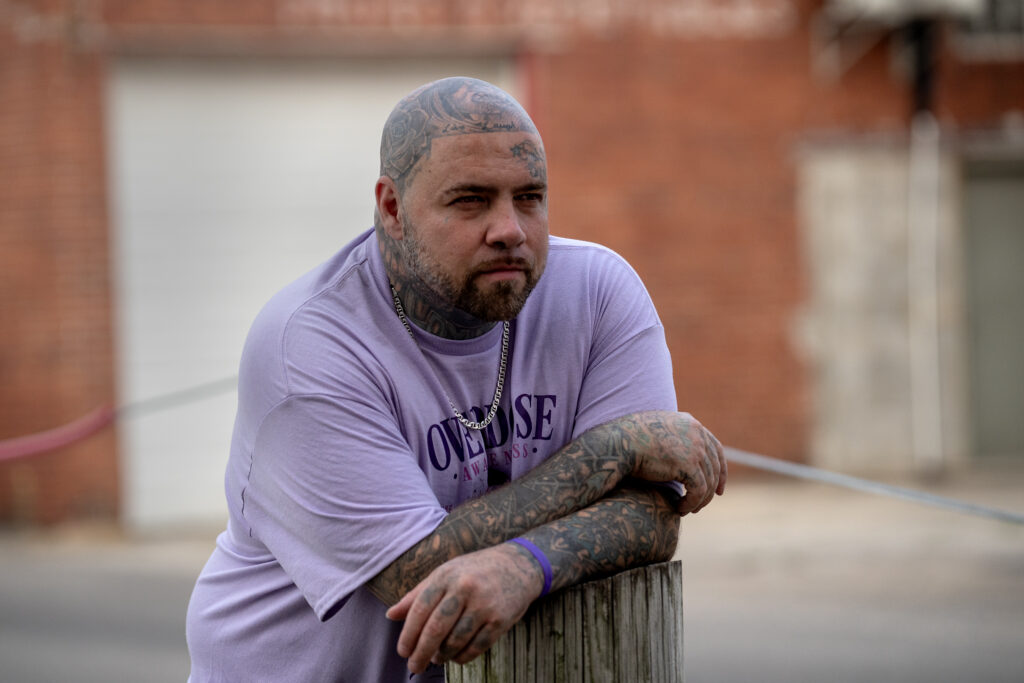
Gordon was on break from serving food, which on that day included a big bowl of fresh peaches.
“Brock,” Gordon said, “was not a casualty of himself; he was a casualty of the city. The city did this.”
He thinks that the right resources are not getting to help people like Brock, and he wants to see more people working directly with those who are unhoused.
“I feel like we failed Brock,” Gordon said. “As a community, we failed him.”
In an effort to address that issue, Newark has outreach programs and nurses who work directly with unhoused people. Five local organizations recently hired community navigators who will help people in unstable housing situations connect with resources – these positions are on top of the three navigators already supported by the Licking County Health Department.
The Dairy Isle on Newark’s East Main Street was always one of Brock’s touchstones. Behind the iconic, bright white and red restaurant is a green space with benches, shade, and calm from the street. It was a safe space for him.
And the owner, Patty Fetter, looked after him.
Fetter said many people on the east side are struggling – people who have been pushed to the margins of the city. She sees many of them.
“But people don’t sit and talk to them. They just see somebody who is dirty. They see somebody talking to themselves walking down the street. They don’t stop and think that those people have parents.”
When she first encountered Brock, she said, they didn’t see eye to eye. But she had a good feeling about him and soon grew to care for him. She had a connection to him, and Fetter said he had been popping by for the past three or four years.
Even though he struggled, she said, “his heart still worked.”
Brock would stop to chat and get a shredded chicken sandwich and a shake. He always asked her how she was doing, how her family was doing, and if she needed help with anything. He always seemed earnest about it, Fetter said.
And he was funny.
“He could make you laugh in 2.2 seconds over something dumb – like, crack me up.”
Sometimes, she would roll into work and find him sleeping on one of the benches. Once, deep in winter, she found him sleeping against the building.
Fetter said she regrets not doing more for him when she saw him last. “I just wish I would have gone out and got him, and had him for five more minutes. I wonder if that would have changed everything.”
“I do feel a lot of guilt,” she said. “Oh, wish I would have kept him.”
I tell you, I still look for that kid. I probably will for a really, really long time. But there’s a lot of Brocks around here.
Patty Fetter
Pastor Chris Hughes from Crossroads Baptist Church has seen the Brocks. He has been one of them.
Hughes said he knew Brock from his own time of struggle on the streets – as a person who used drugs and now as a person in recovery for 10 years. With a long beard, black-rimmed glasses, and a silver chain, Hughes is not your stereotypical preacher.

“We do a homeless outreach every Thursday from 6 to 8, down here at St. Vincent’s Thrift store,” he said about his congregation. Brock, he said, sometimes stopped by.
“Super, super nice guy, man. Full of love. Just lost. You know what I mean?” Hughes said. “And that hurts hard, because I’ve been in the same place. Over and over and over, I see so many people out here. … There’s so many Brocks out here.”
When Hughes saw Hollie Linton’s post on social media asking folks to contact her if they saw Brock, he said he prayed. And when he heard that a body had been found behind Cedar Bar and Grill, something told him that it was Brock.
Hughes said he had seen him days before.
He called to him, “Hey, what’s up? You good?”
Brock nodded.
If you or someone you know is struggling with mental health, free and confidential help is available by calling or texting 988 to the national suicide and crisis hotline. Naloxone is available for free from Harm Reduction Ohio, the Licking County Health Department, or every Saturday from 10-12 p.m. at the Newark Homeless Outreach on the corner of East Main and Buena Vista Street.
Brock Lewis’s family started the Brock D. Lewis Memorial Fund at the Licking County Foundation to “support initiatives focused on mental health, substance use recovery, homelessness, crisis intervention, and community education, while encouraging conversations that replace stigma with understanding.”
Jack Shuler writes for TheReportingProject.org.