


The debate over which utility should provide water and sewer services to western Licking County continued during the county commissioners’ first meeting in August.
It started as an informational presentation to the commissioners by the Municipal Utility Coalition of Licking County and became more of a debate on Aug. 5 when it was joined by Rob Platte, administrator for Jersey Township, who opposes to the very existence of the coalition; and Jim Roberts, executive director of the Licking Regional Water District, a public utility that currently has the authority to serve most of western Licking County.
Coalition members have said repeatedly that their interest in providing water and sewer services to parts of western Licking County is to manage growth in ways that preserve the rural character of their communities and protect school districts from being overrun by large numbers of students.
Platte asserted that public officials from the communities that make up the coalition – Alexandria, Granville and Johnstown – have developed a plan saying it could provide water and sewer services to rural areas of Granville, St. Albans and Monroe townships, and part of Jersey Township to seek “authority, control and money.”
Herb Koehler, Granville village manager and a spokesman for the coalition, disputed that claim.
“As a reminder,” Koehler said during the meeting and again afterward, “the Ohio EPA asked us to develop this plan.”
That request from the Ohio Environmental Protection Agency came after Intel announced in 2022 that it would build a $28 billion computer-chip manufacturing campus in western Licking County, touching off a wave of development in that area and an anticipated increase in demand for water and sewer services.
The EPA said it was time to revisit and potentially revise statewide water and sewer service-area boundaries, which have been unchanged for nearly two decades. The agency said it would start with Delaware and Licking Counties, two of the fastest-growing in the state, said Steve Samuels, a Columbus environmental lawyer who spoke to the commissioners on behalf of the utility coalition.
“In various counties, it said anyone who was interested in being a service provider should submit a facility plan and the state would consider it and the EPA will make a determination on what or who should be the service provider,” Samuels said.
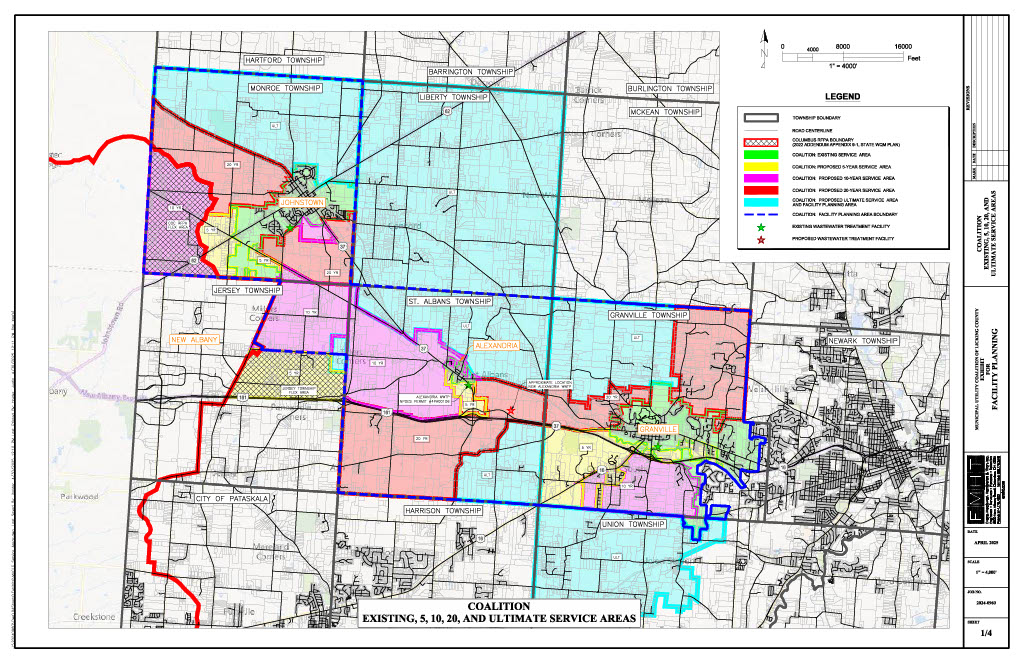
Koehler said the coalition’s plan was guided by the recommendations generated during a months-long series of community forums organized by the T.J. Evans Foundation and the FRAMEWORK recommendations for managing growth and development that resulted from the forums.
And Koehler said the coalition has no interest in replacing Licking Regional Water District as the one and only service provider in western Licking County. But he said the coalition has the interest and has the capacity – or will have the capacity over time with upgrades and additions to existing treatment facilities – to serve all of Granville, Monroe, St. Albans and Liberty townships, and parts of Jersey and Union townships.
Annexation to a coalition member community would not be required to receive services, Koehler said.
| Read more: Johnstown, Alexandria and Granville ask EPA to OK joint utility, Jersey Township files lawsuit
Roberts, of Licking Regional Water District, said the coalition plan “ignores that Licking Regional exists.
“It seems to suggest that we should just go away, but that’s not happening,” he said.
Roberts said he has heard the references to the FRAMEWORK recommendations and the coalition’s desire to manage growth to community standards, and he added that Licking Regional Water District has considered local comprehensive development plans in its facility plans for serving more than 18,000 acres in western Licking County.
He also said that he has read the FRAMEWORK document and is “100 percent sure there was no discussion in there of a hostile takeover of a governmental entity, and we (Licking Regional) are a governmental entity.”
County Commissioner Tim Bubb bristled at the inclusion of part of Jersey Township in the coalition plan, noting that Platte and township trustees there have said emphatically that they don’t want to be served by the coalition.
Sean Staneart, Johnstown city manager, told the commissioners that the coalition plan includes the northeast corner of Jersey Township because the Johnstown-Monroe School District dips into that portion of Jersey Township. School district leaders, who he said have been involved in discussions about the utility coalition, want help to protect the district against an influx of students, he said.
“I’m not sure you’re justified in trying to co-locate school and municipal boundaries,” Bubb said.
But the proposal is not to align school and municipal boundaries, because rural areas could receive water and sewer services without being annexed by Alexandria, Granville or Johnstown and retain zoning that requires large lot sizes that result in a minimal number of houses per acre.
As an example of what could happen in other rural areas of western Licking County, the Granville Exempted Village School District is bracing for a large wave of students in the wake of Heath annexing 225 acres in Union Township – land within the Granville District – and applying zoning that allows up to six houses per acre. District officials estimate that when fully built out, the 600-home subdivision proposed by M/I Homes of Columbus could add nearly 1,000 students to the 2,600-student district.
A Liberty Township trustee who attended the Aug. 5 commissioners meeting, Bill Bogantz, said that the township just east of Johnstown “has made clear that we want to remain rural. We don’t want water or sewer service.”
The coalition members have said that while they have done as the EPA requested and outlined in their facility plan the areas they could serve, they aren’t seeking to force services upon property owners or communities that don’t want it.
The Ohio EPA is still weighing proposals, and Samuels said it could accept all, some or none of the coalition’s proposal. He speculated that the agency will wait until after the Nov. 4 election, when voters in Alexandria and St. Albans Township will decide whether to merge and become one municipal entity.
County Commissioner Duane Flowers said that as someone who lives in eastern Licking County, he wants to make sure that any utility sending treated wastewater into tributaries of the Licking River are doing it to the highest standards, which Koehler assured they are doing and will continue to do.
Alan Miller writes for TheReportingProject.org, the nonprofit news organization of Denison University’s Journalism program, which is supported by generous donations from readers. Sign up for The Reporting Project newsletter here.