


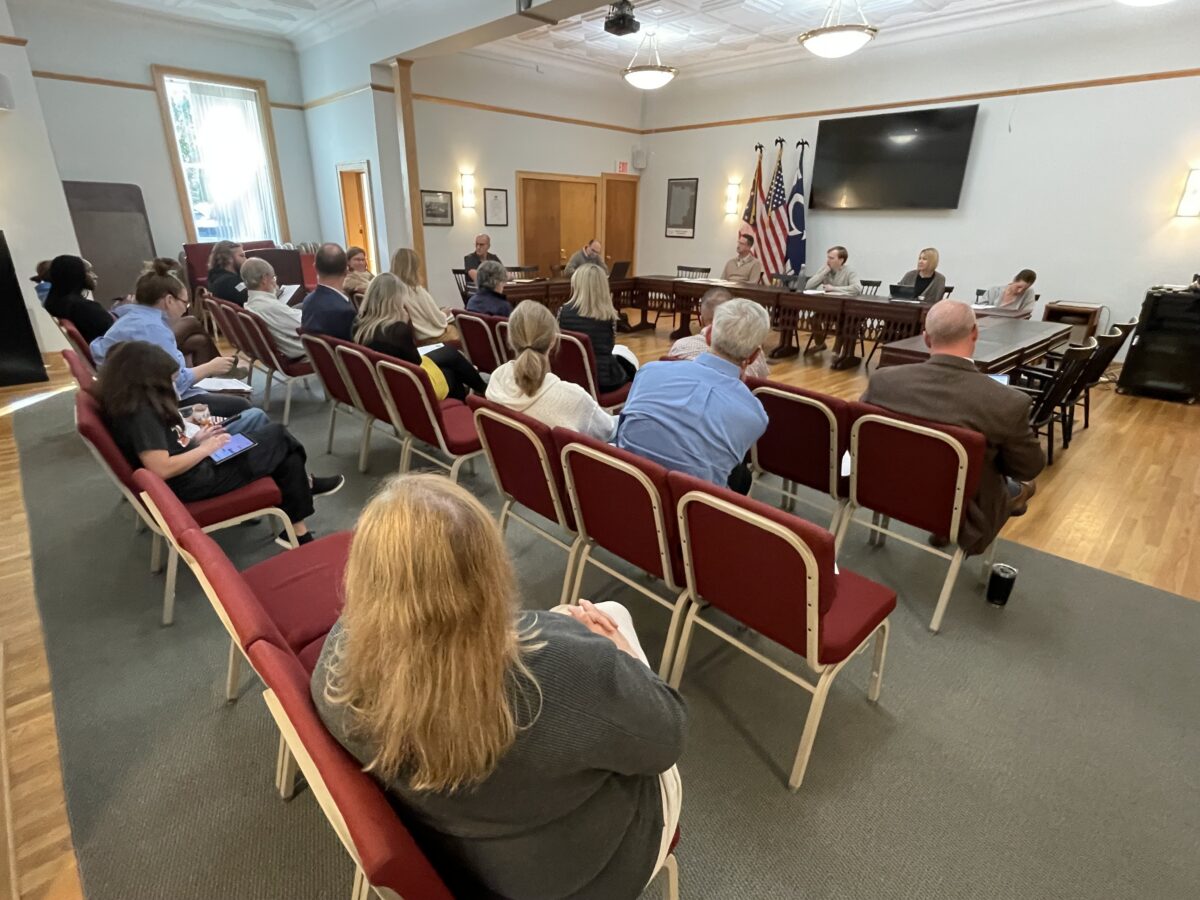
That about 20 people attended the monthly meeting of the Granville community improvement corporation known as Welsh Hills Community Partners was a bit of a surprise, even after a social media tempest put the organization in the spotlight.
“This is easily the best attended meeting we’ve had,” said Drew Menzer, president of the seven-member board, all of whom are volunteers, as he watched a village hall meeting room fill on Monday afternoon.
The regular monthly meeting of the board on Oct. 19 came after some Granville area residents took to Facebook to criticize the concept of a mixed-use development of apartments, shops and restaurants a local developer is considering for land on the east side of Granville.
“It’s a good thing that the community wants to know about this project,” Menzer said. “It’s good to be engaged.”
| Read more: Development proposed for Galway Drive draws tense crowd even before an application submitted
Before taking the opportunity to explain the mission and function of the organization, Menzer said that there is a line between engagement and harassment, and some had crossed that line.
“We have a community member who is fielding calls from people telling him he should move – that he should leave the community,” Menzer said, referring to Seth Teagle, who lives in Granville Township and is a principal in The Stream Group, which is interested in developing 17 acres along Galway Drive.
“We need to be able to have a civil conversation about this,” Menzer said.

He and other members of the board then spent much of the rest of the meeting explaining how it was created and its mission.
The community improvement corporation (CIC) was formed in 2024 by the Granville Area Chamber of Commerce, the Village of Granville and the Granville Exempted Village School District Board of Education, each of which appointed members to the board.
It was briefly known as the Granville Area Community Improvement Corporation, but Menzer said it was a name that “didn’t roll off the tongue” and the new name better reflects the nonprofit’s mission, which is to “invest in infrastructure, support current and future businesses and bring citizens, the village, the school district and our businesses to the same table.”
Courtney Ruppert, Granville’s deputy village manager, described the board’s work as an extension of the village staff in helping field questions from local businesses seeking to move or expand, new business owners, and from developers who might want to build in the village.
“The CIC was seen as an opportunity to help a lean staff,” Ruppert said.
She and Village Manager Herb Koehler said they and the village planning staff routinely field questions from developers or potential business owners who want to know generally what they would need to do to win approval of the village’s decision-making bodies – the planning commission and the village council.
| Read more: Granville council OK’s development corp proposal, Bryn Du barn renovation funds
Village resident Melissah Pawlikowski attended the meeting and volunteered that when she was planning to open a bed and breakfast in Granville, she found it very helpful to have those preliminary conversations about what would and would not pass muster. They helped her avoid potential problems and solidify a plan that was approved.
She also told the board that it might be sowing some confusion in the community by repeatedly saying that it “facilitates” development in the community, because some people hear that as “lobbying” on behalf of a developer or project.
The board says on its website that Welsh Hills Community Partners (WHCP) “do not set policy. Zoning, ordinances and other local policies are set by our elected officials,” and that they “do not decide what gets built. “Whether a project moves forward is decided by the village’s public approval process by village council, the planning commission and the board of zoning and building appeals.”
And it says that the WHCP “are not developers. We do not build, own or profit from private projects, and we have no financial stake in any developer’s success. When a business brings us a proposal, we help it reach the right officials and the wider community through the official process set out in village code.”
Its role is to “support Granville’s long-term economic health,” which Menzer said could take many different forms. For example, he said that if village officials or the Chamber of Commerce came to the board and asked for help recruiting a hardware franchise that would consider opening a store in Granville, the board would do that.
He also said that at one point early in 2026, when there was no apparent buyer for the Buxton Inn, the board considered finding a way to take on the role of a holding company that would take ownership until a buyer could be found. The goal in that scenario was to make sure the iconic original inn and four adjacent houses that make up the bulk of the hotel’s sleeping rooms were not broken up and sold separately.
| Read more: Granville’s Buxton Inn and new owner were made for each other
To date, the Stream Group has not submitted an application for consideration of the “Munson Trace” project through the village planning and permitting process. But like Pawlikowski, the Stream Group made contact with Ruppert and Koehler late last year to get some sense of what type of development it could potentially build in Granville.
After some preliminary conversations, the village staff referred Teagle and The Stream Group to the community improvement corporation to continue the conversation and work toward filing an application with the village.
While some in the community suggested nefarious motives for the preliminary conversations, Pawlikowski said after Monday’s meeting that she has learned enough by listening to people involved in the matter to discern that no one was being underhanded. They could do better at communicating, she said, and the board acknowledged the same and has already taken steps to provide more information on its website. It also plans local speaking engagements to offer more details and answer questions.
Menzer said Teagle and The Stream Group had taken the preliminary step of asking Granville Schools Superintendent Jeff Brown for his thoughts on the development concept, and Brown, who attended the WHCP meeting on Monday, said he told them that three-bedroom apartments were a non-starter because they would potentially bring too many students to the district.
The 72 one-bedroom apartments would bring virtually no students, and the 102 two-bedroom apartments the group proposed would bring 18-20 students, based on a formula Brown said the district developed while planning for the potential of the 500-home “Heath Hills” subdivision proposal that was abandoned by M/I Homes of Columbus under pressure from Heath and Granville residents.
“I get calls all the time from developers,” Brown said. “I’ve had three calls about that site alone. They’re trying to make sure they don’t propose something that is dead on arrival.”
The school district’s interest in the work of the WHCP is to help diversify the tax base by increasing commercial taxes to reduce the burden for residential taxpayers.
“Granville is heavily reliant on residential taxes – 93.7% reliant on homeowners,” Menzer said.
To that end, the school board on Monday night heard the first reading of a resolution on a community taxation policy, which Brown said the board will consider and vote on during its Nov. 16 meeting.
“The primary aim of this taxation policy is to set clear targets and guidelines for managing existing and evaluating new tax revenue to support school district facilities and operations,” the policy says. “This policy outlines the types of taxes that may be used to achieve and maintain financial stability while minimizing the need for requests for additional property and income tax levies.”
The policy will guide the school board in the future and help residents and developers understand the district’s goals for taxation, while holding the district to its stated policies, said Rockmill Financial Consultant David Conley.
Conley praised the board’s nearly year-long process of developing its tax policy, calling it a “pioneer” among other school districts.
“This is a really nice discipline framework that allows us to continue to protect your educational excellence, continue to put taxpayers first when it’s time to think about the best way to support the operations of the district, and to do so in a way where it’s transparent,” Conley said.
He said the policy will guide the district in ways to provide operating revenue while keeping taxes affordable and evenly distributed.
The policy outlines ways to provide financial stability with a minimum of 90 days of cash reserves on hand and a maximum of 160 days of cash reserves on hand. Operating levies would shift to six-year voting cycles, so residents would not have to vote as often.
Additionally, the policy prioritizes community partnerships that would create tax incentives and specific development requirements that benefit the community without burdening the schools.
Alan Miller and Tyler Thompson write for TheReportingProject.org, the nonprofit news organization of Denison University’s Journalism program, which is supported by generous donations from readers. Sign up for The Reporting Project newsletter here.