

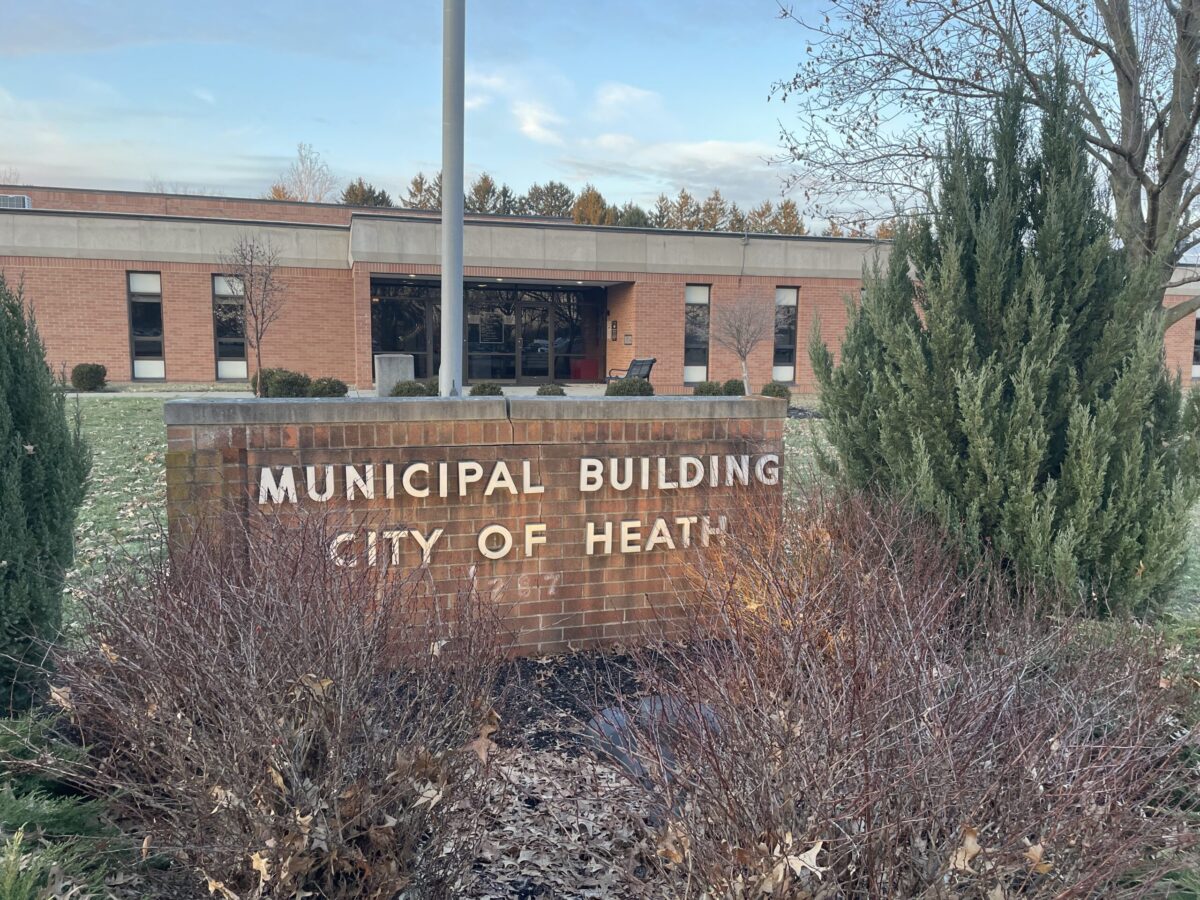
Heath City Council received a new petition with more than double the required number of signatures to put a citywide ban on large-scale data centers to the voters in a special election.
The petition would add “Prohibition of a Data Center” to Article XVII of the Heath charter. If and when the issue makes the ballot, and if voters approve, construction of any large data centers in the city would be prohibited.
Margo Mayberry, 83, delivered a thick stack of signatures in a red folder to Heath City Council members during public comment on Monday, Oct. 19. This petition marks her third attempt at giving Heath voters a chance to decide whether to support a ban on data centers larger than 25 megawatts within the city.
Licking County is currently home to 49 data centers – approved, under construction or in operation. That includes one data center in Heath, under construction by Microsoft on Thornwood Drive at Hallie Lane.
“We’re doing it for the city of Heath to protect the city of Heath,” Mayberry said. “We’re grateful that the reaction was so favorable tonight.”
With help from residents Ruth Prince and Steven Watling, Mayberry collected 568 signatures on the latest petition. They only needed 220 valid signatures to put a proposed charter amendment on the ballot – equivalent to 10% of the total number of votes cast at the most recent general municipal election. In Heath, that means 10% of the 2,199 people who voted in November 2025.
Of the 568 signatures submitted last week, 481 were deemed valid, Board of Elections Director Tess Wigginton said on Monday, Oct. 26.
“It was a much bigger submission this time,” Wigginton said. “They wanted to be absolutely sure” they wouldn’t face the same challenges in submitting enough signatures the third time.
The city attorney said the initial petition didn’t have enough valid signatures, and the city also rejected the petitioner’s effort to withdraw the petition and submit a new one with additional signatures before Friday, Sept. 4 – the deadline for charter amendments to appear on the Nov. 3 ballot.
Read more: Heath rejects petitions to put a data-center ban on the Nov. 3 ballot
Collecting signatures was time-consuming and tedious, according to Mayberry. She and others walked door to door to collect signatures, reaching people who weren’t aware of the petition the first time around, Mayberry said.
“Of the thousands of people we have spoken to since we started in June, 476 the first time, 568 this time, everybody said ‘thank you’ for doing this,” Mayberry said.
Watling said he learned a lot during the petition process, and that social media helped get the word out. Prince said it was a relief when it came time to submit the new petition.
Mayberry’s past two petitions had a total of 276 valid signatures combined. However, Heath’s City Council did not accept the two petitions, as Heath Law Director David Morrison said the city could not legally accept combined petitions under Section 3501.38 of the Ohio Revised Code.
The council’s rejection required Mayberry to restart and recollect all the signatures on one single petition. So Mayberry, Prince and Watling went back to work.
Mayberry’s efforts align with similar petition efforts in Pataskala, Granville, and Johnstown. Now that the Board of Elections has certified the petition, the city council will need to accept the petition and set a date for a special election at the city’s expense.
“Because it was too late to get onto the next general election [Nov. 3], by statute, they’ve got to set a date between 60 and 120 days from when they pass their ordinance,” Wigginton said.
The city has not yet certified the ordinance for the election, but likely will at the next full Heath City Council meeting on Monday, Nov. 2 at 7:30 p.m.
Heath and Johnstown will pay extra to hold special elections, likely sometime in early 2027 for both cities. The city will have to pay to hold this special election, but the cost is unknown.
“I do not have any information for you as to what, if any, cost there is to the city for a special election, but we can work to try to communicate with the Board of Elections on that,” Heath Mayor Mark Johns said.
The special election in Johnstown will likely cost the city around $15,000, Johnstown Mayor Tiffany Hollis said in September.
Maddie Luebkert writes for TheReportingProject.org, the nonprofit news organization of Denison University’s Journalism program, which is supported by generous donations from readers. Sign up for The Reporting Project newsletter here.
Luebkert is one of two Kirtley Mather Fellows at The Reporting Project. The fellowship is created in memory of Kirtley Mather, Denison Class of 1909, with the mission of providing unique opportunities for students to engage in service for the common good.