

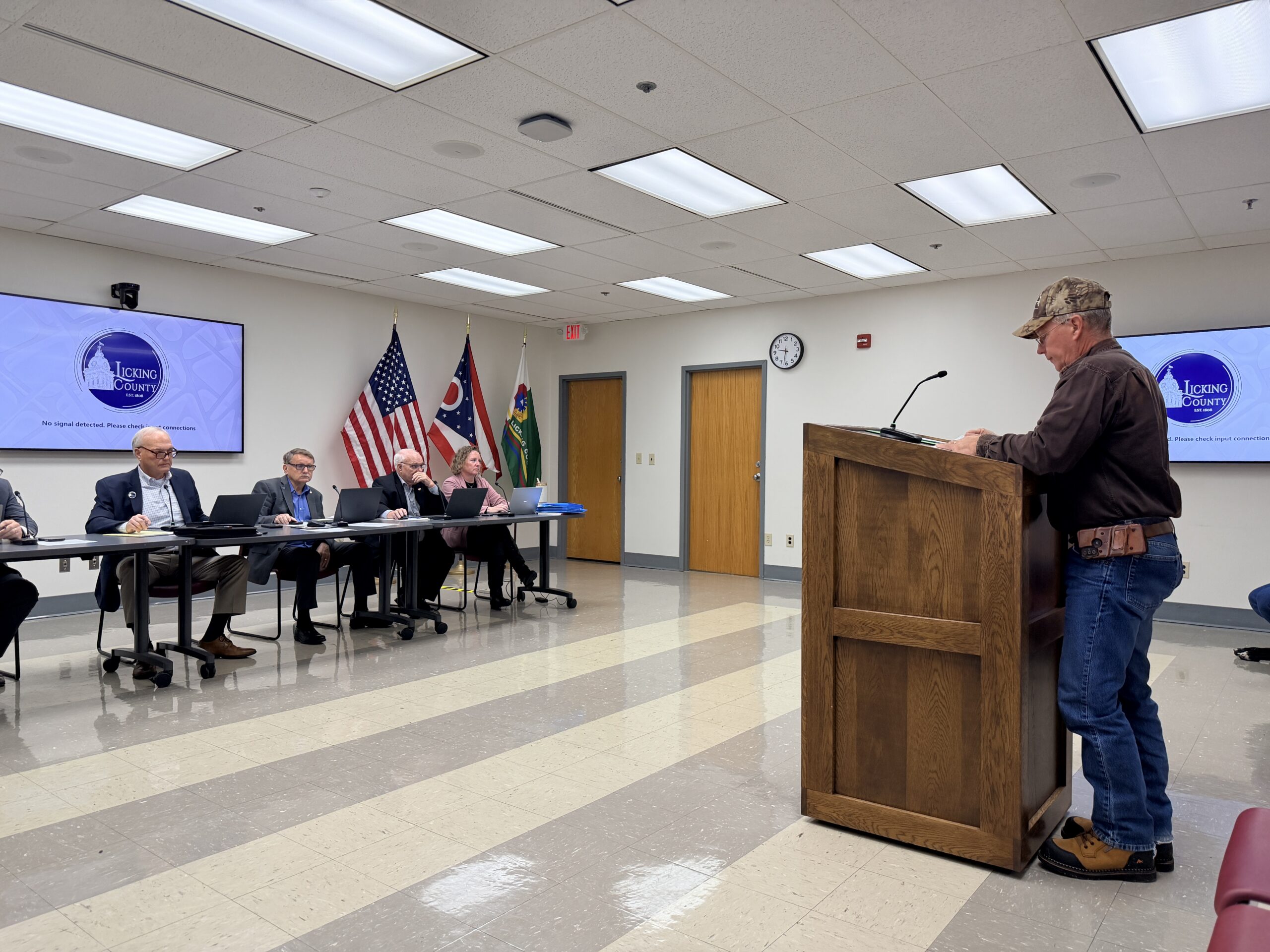
Licking County Commissioners have no plans for a community meeting about Flock license plate surveillance cameras in use around the county, despite calls from community members at multiple commission meetings in the past two weeks.
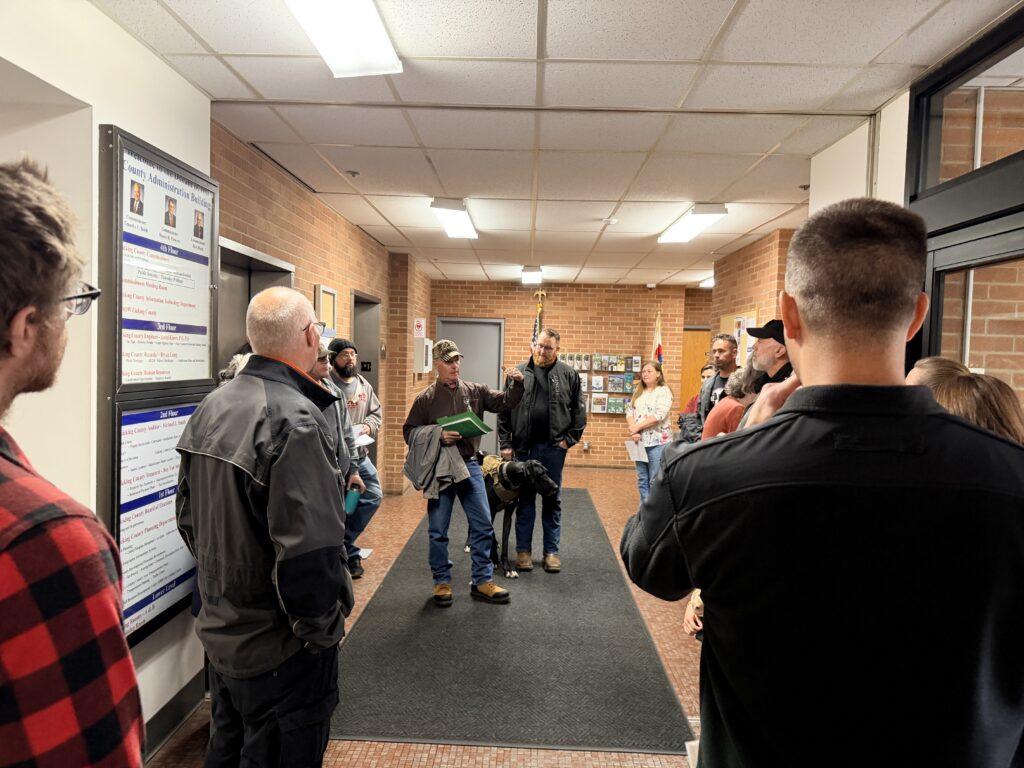
On Thursday, Nov. 12, residents flocked to the weekly Licking County Commissioners meeting to express their concerns about the surveillance technology employed by the Licking County sheriff’s department. Nearly 30 people attended the meeting – relocated from the commissioners’ standard meeting room to a basement meeting room with significantly more space – to offer feedback and ask questions about the devices.
Though Flock Safety cameras – automated license plate readers and vehicle surveillance systems – have been in use around the country since 2017, concerns about privacy have grown in recent years as law enforcement agencies struggle with officers misusing the system and residents resist what they call “unconstitutional surveillance.”
“There are inherent limits on government for a free people,” Newark resident Daniel McKee said during public comment on Thursday. “Let’s not wait for the Supreme Court to remind you where that line is. Let’s realize that there’s a significant amount of municipalities and police departments across the United States, including in Ohio, that are recognizing that this is a constitutional problem.”
The cameras track license plates and feed data into a centralized software platform that links more than 120,000 cameras across the country, including about 60 or so managed by the Licking County Sheriff’s Office. There are more than 60 cameras operating in the county, managed by the Newark Police Department, the Granville Police Department, the Hebron Police Department and the Heath Police Department, among others, according to the Electronic Frontier Foundation.
Concerns about the use of the Flock system rose after police officers across central Ohio were caught misusing the technology. Columbus Police have terminated at least one officer for misuse of Flock records, and the city of Reynoldsburg ended its contract with Flock in September after several of its officers resigned amid investigations into their use of the system.
And in Newark, the Newark Advocate reported one officer searched for the same license plate more than 1,000 times over a 12-day span in 2025, though that officer has not been accused of wrongdoing.
At the Nov. 2 meeting, audience members were not allowed to engage during the presentation, and during the Nov. 12 meeting, commissioners were not supposed to respond to public commenters – even if residents asked questions during their allotted five minutes.
“We’ll be taking notes, and this is not a debate forum. We’re here, as we do every meeting, to hear public comments,” said County Commissioner Tim Bubb. “This is your opportunity to speak to us about flock cameras or anything you’d like to speak about.”
Pat Lebold, a former Newark Township Trustee, was the first speaker during the public comment period at the Thursday, Nov. 12 meeting, calling on commissioners to do more research, and pointed to concerns about the information the commissioners received from Licking County Sheriff Randy Thorp, another elected official in the county.
Thorp and his staff answered questions about the surveillance cameras during a Nov. 2 county commissioners meeting, and Lebold said some of the information was troubling, or, in some cases, wrong.
At the Nov. 2 meeting, Lt. Justin Woodyard “said AI is not used in their camera system,” Lebold said. “This is absolutely false. The Flock system and its servers cannot work or operate without AI. AI is what ties all the cameras together, builds the picture of all the images from all the cameras.”
Online, Flock advertises its “AI-powered video,” and says its license plate readers feature “AI-powered search and alerts” to enable “proactive and reactive search and alerts through natural language input.”
Flock says AI plays a role in “ethical investigation work,” but “most importantly, people stay in control.”
“AI in public safety should support people, not replace them,” according to a Flock blog post: “Smarter, Not Scarier: The Role of AI in Ethical Investigative Work.”
“Flock Nova’s AI reduces friction without reducing oversight,” the blog post continued. “It helps agencies act faster without sacrificing ethics or community trust. It is ethical AI for real work. It is built with the understanding that speed matters, but trust matters more.”
At this point, commissioners said they have heard the concerns from residents and will continue to do their research.
“This has brought a lot of attention, brought a lot of knowledge to us,” said Licking County Commissioner Duane Flowers. “I’m going to look at all this again and try to decipher what’s being said and done. Maybe there needs to be a change of contract. I don’t know. But I will look at it. We need to look at this and take baby steps and make sure we do the right thing.”
Meeting attendees had a final request for the commissioners: Host a town hall or community forum on Flock – and do it during evening hours.
“Host a real town hall,” Granville resident Amy McAllister said. “It’s Mondays at 2 o’clock or Thursdays at 9:30 a.m. … This requires people to get out of work. Do one when people can really come and tell you what they think.”
Commissioners said they have no plans for a town hall, though that doesn’t mean they couldn’t have one down the road. But commissioners aren’t sure they’re the right audience for resident concerns on Flock.
“It’s a statewide and national issue,” Bubb said. “It really needs to be addressed at the state legislature and the national level. If there are 3,000 or more agencies doing this, it’s a bigger picture issue.
“Even if we took those cameras down today, there’s still Flock cameras up in Licking County and all over Ohio,” Bubb continued. “In other words, it’s almost a legislative or a constitutional question.”
Flowers agreed.
“We need our state legislature to step up and put up big guardrails,” Flowers said. “This has to be at the state level. You walk out this door, and they’re [Flock cameras] still – good or bad – they’re still there.”
Bubb said commissioners “can always reevaluate the contract and at some point, the contract will come up for renewal. We can look at it, and we certainly will.”
Lebold said he is a firm supporter of local police, but the use of surveillance technology like Flock crosses a line.
“Sheriff Thorp reassured the commissioners he understands the concerns of the citizens,” Lebold added. “His intention is to protect the data and use it for the good of the citizens of Licking County. But the highway to hell is paved with good intentions. Sheriffs change. Commissioners change. Intentions – good and bad – change.”
Julia Lerner writes for TheReportingProject.org, the nonprofit news organization of Denison University’s Journalism program, which is supported by generous donations from readers. Sign up for The Reporting Project newsletter here.