


Developers proposing a mixed-use commercial development for 17 acres along Galway Drive on the east side of Granville shared details of their concept with The Reporting Project and published a website this week in hopes that the community will thoughtfully consider them before any rush to judgment.
At the same time, a former Granville school board member who helped lead the successful protest against a 500-home subdivision proposed for the Granville Exempted Village School District in the City of Heath, told The Reporting Project that the type of commercial development proposed for Galway Drive would be good for the schools and the community.
The developers said they want to do something positive for Granville and its school district, and they plan to continue community conversations about their concept despite coming under attack before they could formally share details of the proposal, which has not been submitted to Granville officials.
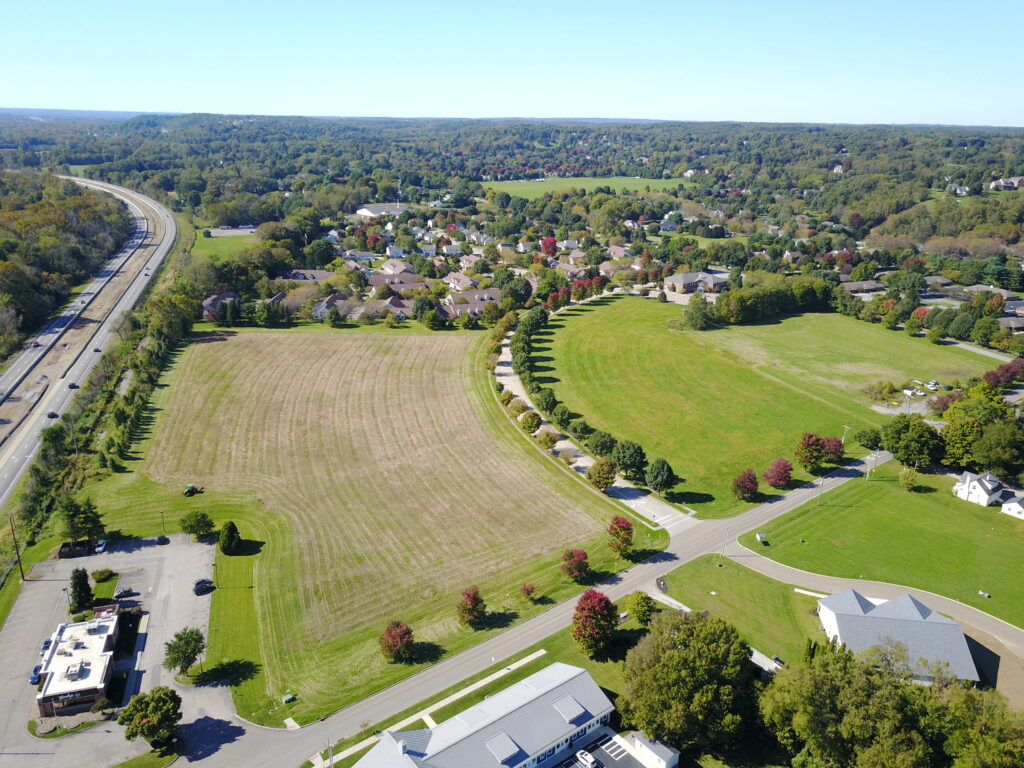
Developers Tim Shaw of Worthington and Seth Teagle, who lives in Granville Township, told The Reporting Project they thought they were doing the right thing by bouncing ideas off of the school superintendent, village planners and the members of the community improvement corporation known as Welsh Hills Community Partners to develop a proposal – a working concept, not a fully baked plan – for a mixed-use development of shops, restaurants and apartments.
And when they had a concept to share, they said they thought again that they were doing the right thing by asking to meet with neighbors in adjacent condos, the Erinwood and the Village Green subdivisions, which are both nearby, to get their input and feedback before submitting an application to begin the official permitting process.
So they were taken aback when speculative social media posts led to more than 100 people showing up at a village council meeting on Oct. 7 to voice concerns about a project that hadn’t been proposed officially and wasn’t on the agenda.
| Read more: Development proposed for Galway Drive draws tense crowd even before an application submitted
Teagle, who has children in the Granville intermediate and high schools, said he and his partners in The Stream Group of Columbus were taken aback by the harsh criticism of a project that would virtually fulfill the vision for that land laid out in the village’s draft comprehensive development plan.
They were also disheartened by the accusation that they were “backdooring this while people were distracted with the Heath Hills” proposal for a 500-home subdivision in the City of Heath and the Granville Exempted Village School District that could have sent up to 1,000 additional students to Granville schools. M/I Homes of Columbus withdrew its Heath Hills proposal after months of protests by Heath and Granville residents.
“We were actually looking for something we could do to help the community – to help the schools,” Teagle said this week. “No one is trying to sneak anything by anyone.”
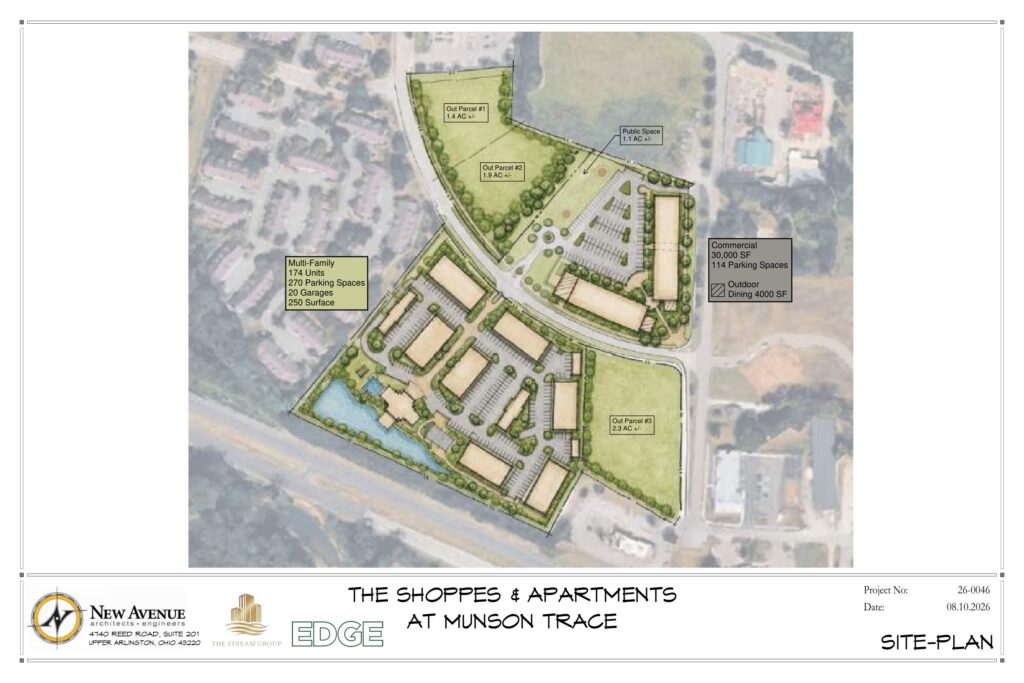
The working proposal calls for shops, restaurants and 174 one- and two-bedrooms apartments would benefit the schools and local taxpayers, he said, because the property currently owned by Licking Memorial Hospital is zoned for commercial use. That means it is taxed at a higher rate than residential property – 43.61 mills compared to 26.14 mills – and therefore it would bring more tax dollars to the district and reduce the tax burden for residential property owners.
| Read more: Granville developer proposes shops, restaurants and 174 apartments near Wendy’s on the east side of town
Shaw said that they want to continue gathering input from the community before submitting an application to the village to begin the official review process, which could take months and would involve multiple public hearings and meetings.
“We like Granville,” he said. “Seth loves Granville because he lives there, so we still have an interest in continuing on, but that’s not without reservations. Currently, we’re still interested in working with Licking Memorial on that land and working with residents on plans.”
Teagle said they want to “find something that works on the site. We want to work with the community. … We’re interested in engaging with people – not arm-wrestling on social media, but talking through it.”
‘This one seems very sustainable’
Thomas Miller, a former Granville school board member and current member of the district’s finance committee, said he thinks the Granville community jumped to conclusions about the project without having facts.
Miller helped lead the fight against the Heath Hills subdivision proposal because he said it would have been a financial disaster for Granville schools.
“My strategy in Heath Hills was to say, ‘Let’s look at the numbers,’ and it was financially horrible,” Miller said. “This one, financially, makes sense to me.”
He said he hopes the Granville community will pause to reflect on the facts, and he believes the community is “mature enough to work through that and offer helpful comments.”
“It might take a while,” Miller said, “but I think they (the developers) can recover. The poor guys got slammed before they could even submit a plan. And they did the right things. First, talk to the schools, check. Then talk with neighbors, check. Then talk with the village about submitting a proposal.”
“But it got blown up before that could happen because we seem to be in the mode of fighting everything,” he said.
That is not beneficial to the community, he said.
“This type of mixed-use development is the only kind that provides enough tax dollars to be sustainable,” Miller said. “I need to see the details, too, but this is the kind of development that could benefit the community. This one seems very sustainable to me.”
He also said there is more than tax dollars to consider, and he said “this is a chance for us to use this as a tool for the community to have a thoughtful conversation.”
Miller said, for example, that 40% of the Granville population is on Social Security, and while 55-and-older communities have provided housing without dramatically increasing school district enrollment, they have not allowed for diversity in the ages of residents.
“Do we want to be a retirement community?” he asked. “We need young professionals here who can engage in the community – to be part of the Rotary and Kiwanis. It would be good for the community.”
As a former school board member, he said employers such as the school district and Denison University “like to hire the best and the brightest young professionals, but they can’t live here because there aren’t any places for them. And they can’t afford to buy a house, so they live in, say, Westerville and at some point they realize they could make more money teaching there and they wouldn’t have to commute.
“Historically, about half of our teachers lived here, and now it’s about a third,” Miller said, specifically citing the lack of housing as a retention problem.
Beyond that issue, teachers and other professionals who live in Granville are more engaged in community events and in support of their students, colleagues and neighbors, he said. “Kids light up when they see their school teachers at Whit’s,” Miller said. “They won’t see them if they live in Columbus.”
Details of an evolving concept
The Stream Group concept is subject to changes as the community offers the kind of suggestions that Shaw said already have helped improve the development plans. If final plans are accepted at some point, Shaw and Teagle said The Stream Group intends to own and manage the apartments long-term.
The working concept currently calls for the following:
– 30,000 square feet of commercial space in two buildings
– 4,000 square feet of outdoor dining space adjacent to the commercial buildings
– 3 out parcels ranging from 1.4 acres to 2.3 acres that could be sites for businesses such as a hardware store, garden center or child-care center
– 1.1 acre of public green space to create a walkable connection between the apartments and businesses
– 102 two-bedroom apartments of 900 to 975 square feet
– 72 one-bedroom apartments of 650 to 725 square feet
– 250 surface parking spaces and 20 garages within the apartment complex
– Clubhouse and pool for residents

This rendering shows the types of siding materials being considered for Munson Trace apartments. 
This is a concept for the apartments. 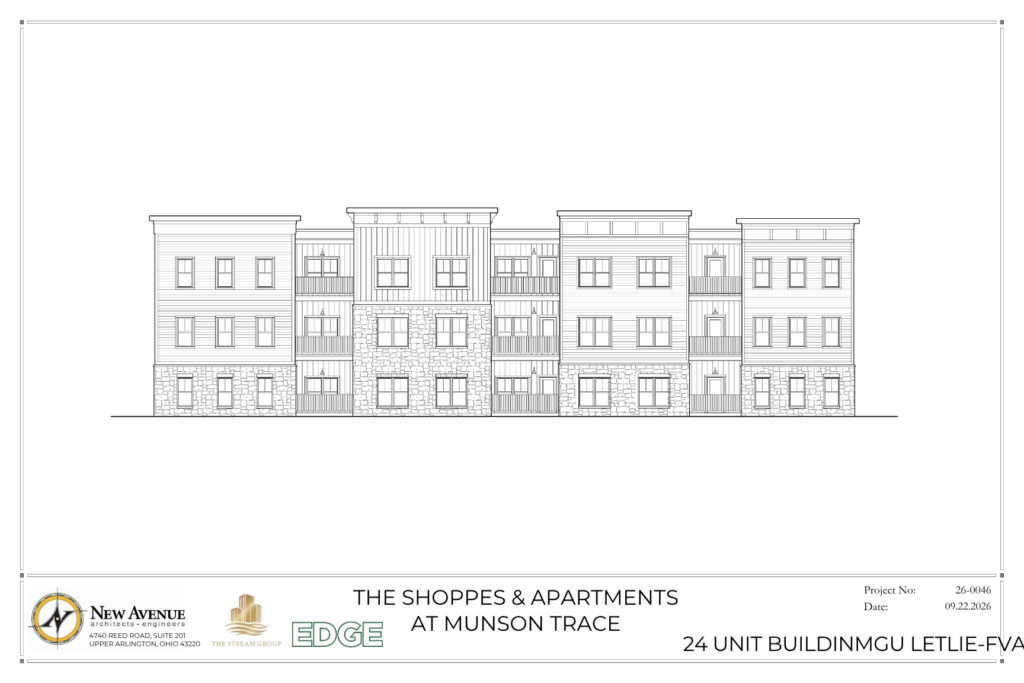
A sketch of a three-story apartment building. 
A sketch of a three-story apartment building. 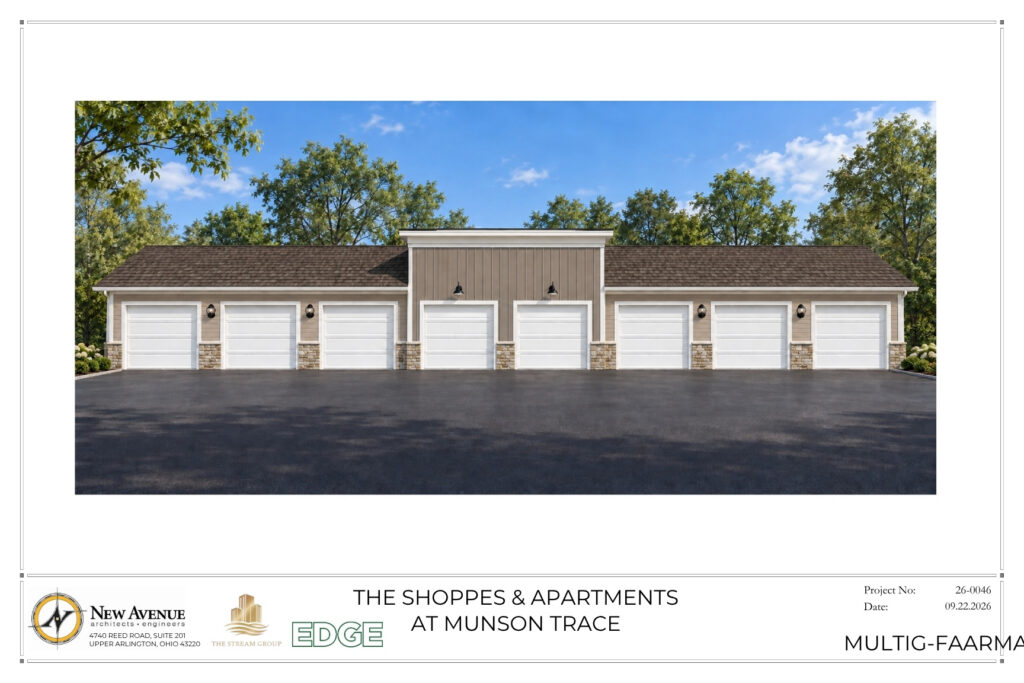
The current plan calls for 20 garages that would be available to apartment renters. 
The club house for the apartment complex at Munson Trace. 
One of the two commercial buildings proposed for Munson Trace. 
The Stream Group has done market research that shows the demand for apartments is high in Granville, and it did a traffic study that indicated the development would have minimal impact on nearby streets.
Shaw and Teagle acknowledged that Newark Granville Road and some intersections along it are already problematic at specific times of day, and that the village is reviewing ways to improve traffic flow.
They said they would be willing to help pay for improvements near the development site, such as traffic signals and turn lanes.
The developers said rents at Munson Trace would be between $1,400 and $1,800 a month, and they estimate that the apartments could house between 250 and 290 people.
Granville Superintendent Jeff Brown told the developers and The Reporting Project that one-bedroom apartments don’t bring in students, and using the district’s calculation of 0.18 students per two-bedroom apartment, the 102 two-bedroom apartments in Munson Trace would be expected to produce 18 to 20 additional students in the school district.
‘Community Reinvestment Area’
Teagle said that to keep rents competitive with other new “Class A” apartments in the area, such as Trailhead Vista on West Main Street in Newark, The Stream Group would need a Community Reinvestment Area (CRA) designation that would send tax dollars on the increased value of the property after construction for 15 years to the developer to help finance the project. After 15 years, the school district and other entities funded with property taxes would receive the full amount.
The school district would continue to receive taxes on the value of the land, which Teagle said will be higher after The Stream Group buys the land, which means that even without taxes from the value of buildings on the land, the district will receive more taxes from the property than it does now.
Teagle estimated that during the 15 years a CRA would be in place, the district would see an additional $5 million compared to what it currently receives from the 8 acres where apartments are proposed. And after the CRA ends in 15 years, the district could expect to receive about $1.4 million a year, “and that’s just from the property where the apartments would be located.”
“Things that right now might seem out of grasp, like money for a new school building – this is a way to get there,” he said, noting that the property taxes from the development after 15 years would reduce the residential property tax burden from the current 91% to about 88%.
And the developers said that if the CRA is approved, they would make payments to the district in lieu of taxes to support the education of any students from the apartments.
Miller said that such payments aren’t required under a CRA, and he was impressed that the developers offered payments in lieu of taxes before being asked.
Logistically, Granville Village Manager Herb Koehler has said that a CRA would require a conversation separate from the Munson Trace development because it’s an economic development tool that is potentially larger than one project.
Koehler said it could be used elsewhere in the village, such as in the redevelopment of the former Denison University steam-heating plant on South Main Street next to Station cafe. Denison built a new steam plant on campus in 2022 and officials have said they would like to see the old plant repurposed, perhaps as a commercial event venue.
Teagle said he hopes to have productive conversations with Granville residents about the Munson Trace project.
“None of the people who have had negative things to say have contacted me,” he said. “I live here, and I’d be happy to talk about it.”
Alan Miller writes for TheReportingProject.org, the nonprofit news organization of Denison University’s Journalism program, which is supported by generous donations from readers. Sign up for The Reporting Project newsletter here.