

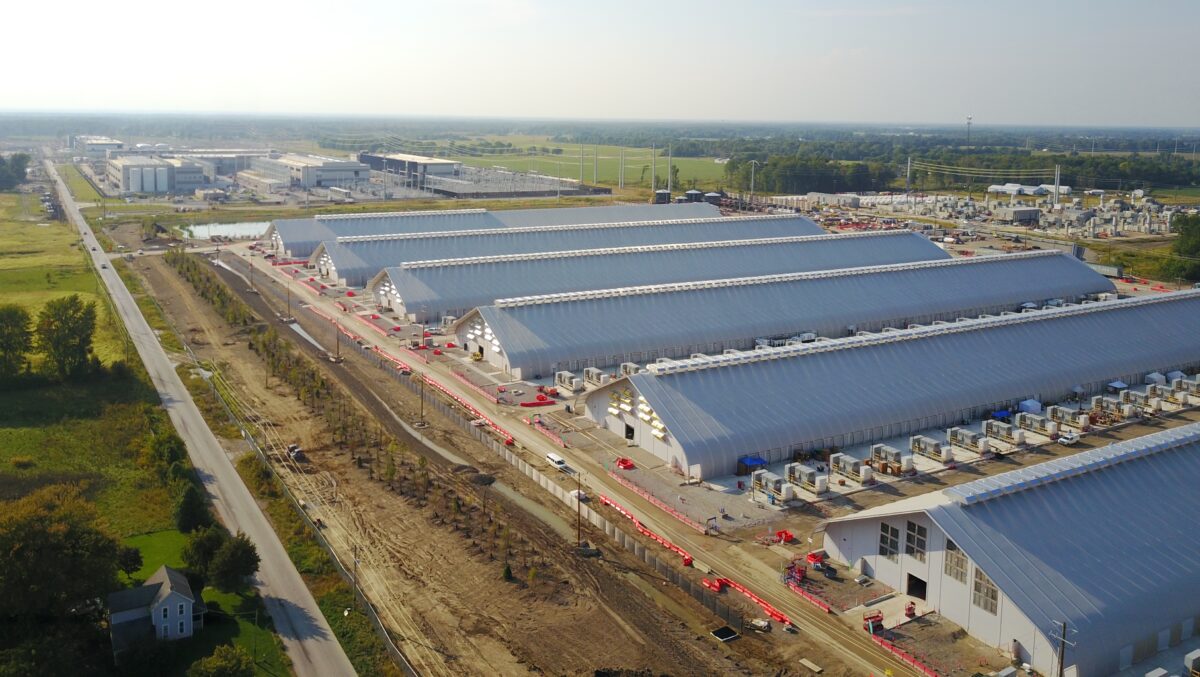
A public hearing on the proposed construction of a 500 megawatt powerplant in western Licking County scheduled for Tuesday is among a growing number of requests for such facilities to provide electricity to data centers.
The hearing at 5 p.m. on Tuesday, Oct. 6, is to allow the public to comment on the proposal by Will-Power to build a natural gas-fired electric generating facility and 260 megawatt battery storage system.
The hearing will be held at the New Albany-Plain Local Schools Annex Building, 79 N. High St., in New Albany. The Ohio Power Siting Board will conduct the hearing, as well as an “evidentiary hearing” on the proposal at 10 a.m. on Wednesday, Oct. 21, at the offices of the Public Utilities Commission of Ohio, 180 E. Broad St. in Columbus.
One such powerplant, a 200 megawatt facility called “Socrates South,” began operation in August in Licking County near the intersection of Beech and Morse roads, according to Matt Schilling, director of public affairs for the Public Utilities Commission of Ohio.
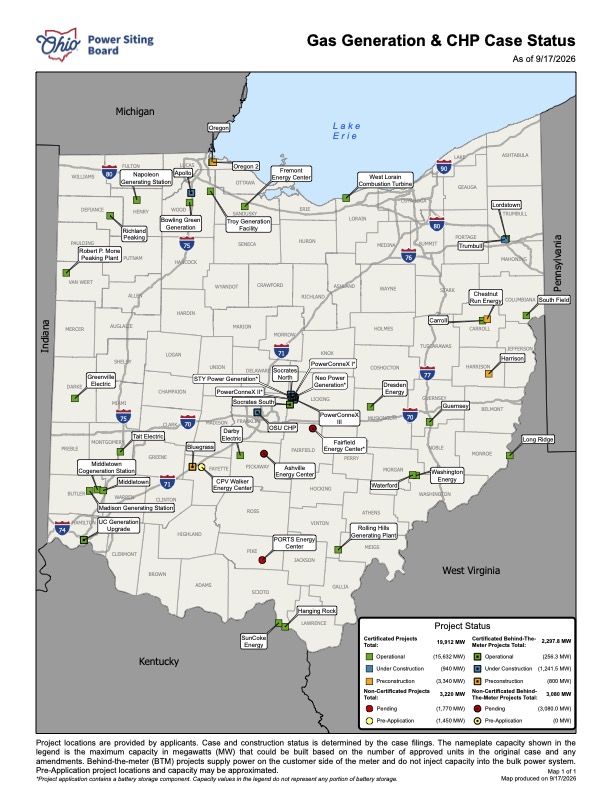
An interactive map of the power plants is available on the Ohio Power Siting Board website. Many of them are classified as “behind-the-meter” generating stations because they serve a single company’s electricity needs and do not provide electricity to the national grid.
“Seven others have been approved by the Ohio Power Siting Board, and we have four under review by the board,” Schilling said. “In total, that’s about 5,300 megawatts. In Ohio, as a whole state, peak demand is about 20,000 megawatts.”
That means the new power plants for data centers, if approved and when built, would generate the equivalent of about 20% of what the entire state consumes on a hot summer day, Schilling said. Utility standards estimate that 1 megawatt would power between 500 to 1,000 homes at any given time.
And while natural gas is seen by some as a relatively clean fuel compared to coal or diesel, the proliferation of such plants has raised concerns in Licking County about the environmental impact.
A group called Community Air Monitoring Licking County has recruited volunteers to host air-monitoring equipment at their homes, businesses and community facilities to obtain baseline data of current conditions so that they see how such developments affect air quality in the future.
That effort was inspired by the Intel computer-chip manufacturing campus being built in western Licking County. But since that was proposed in 2022, the group has raised concerns about diesel-powered back-up generators at many of the more than 50 data centers in Licking County, as well as the emissions from the proliferation of gas-fired power plants.
Other power plants in the pipeline for Licking County include:
- Socrates North, a 200 megawatt facility under construction east of Beech Road and south of Green Chapel Road.
- PowerConneX 1, a 125 megawatt facility under construction east of the intersection of Harrison and Clover Valley roads.
- STY Power Generation Facility, a 250 megawatt facility southwest of the intersection of Harrison and Clover Valley roads.
- PowerConneX 2, a 216 megawatt facility under construction on Clover Valley Road west of Mink Street.
- PowerConneX New Albany 3, a 450 megawatt facility between Clover Valley Road and Mink Street for which the company submitted an application in July.
Schilling said that before power-plant developers apply to the Ohio Power Siting Board for permits, they are required to hold a “town hall” style meeting within the community where facilities are proposed. Then they can submit their application for staff review – which includes the consideration of public comments made during public hearings, which also are required.
“We also collect a lot of online comments,” he said. “Anyone can write an email to a general email address (contactOPSB@puco.ohio.gov), but anyone can also go directly to a specific case docket and file a comment from a form there. The case number should be included in the email.”
The entire process happens within 190 days after a developer submits an application, he said.
“The board definitely takes into account public comments,” Schilling said, “and it has made conditions in approval based on public comments.”
He said that some projects draw little interest, and some draw hundreds of people – as was the case in Ashville, in Pickaway County, and near Millersport in Fairfield County.
The Ashville Energy Center application proposes an 800 megawatt facility south of Columbus near the Village of Ashville, and it has drawn large protests from area residents. The same is true of the Fairfield Energy Center proposal, which is for a 1,300 megawatt facility to power a proposed data center.
“Those two are still pending before the board,” Schilling said. He said the Ashville proposal already had a hearing before the Ohio Power Siting Board, and he expects a decision soon. And he expects a hearing in the near future before a decision in the Fairfield Energy Center case.
And he said that certificates issued by the state typically come with stipulations – some based on staff observations and others based on public comment.
“It’s fair to say that almost every certificate issued by the siting board is with conditions, and they can vary widely,” he said.
Alan Miller writes for TheReportingProject.org, the nonprofit news organization of Denison University’s Journalism program, which is supported by generous donations from readers. Sign up for The Reporting Project newsletter here.