

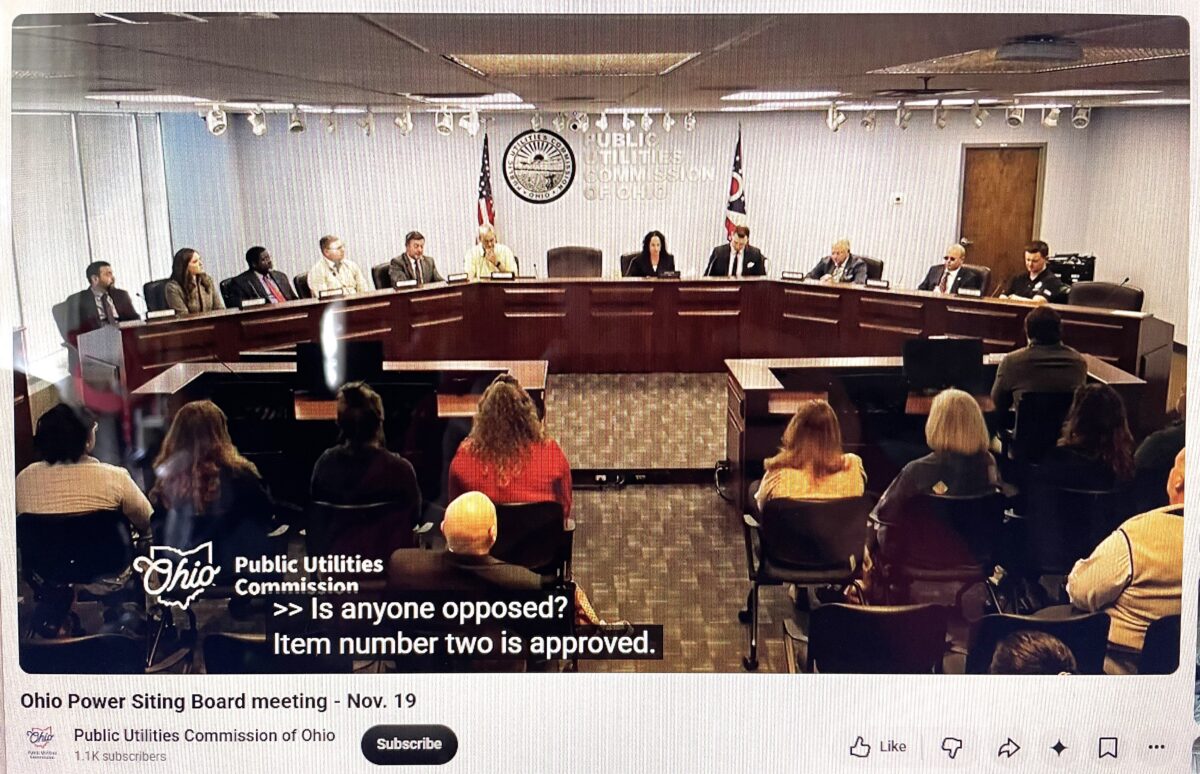
Seven minutes and fourteen seconds. That’s how long it took the Ohio Power Siting Board last week to approve two of the state’s most controversial gas-fired power plants for hyperscale data centers – one in Ashville and one in Millersport.
The 1,350 megawatt “Fairfield Energy Center” will be built near Buckeye Lake in Fairfield County by Advanced Power Services of Boston, and the 800 megawatt “Ashville Energy Center” in Pickaway County by PowerConneX, a subsidiary of EdgeConneX of Herndon, Virginia.
But that’s not all. The board also approved two other projects. One is the 800 megawatt Oak Run Solar Project and a related transmission line on 6,000 acres in Madison County, west of Columbus. The other involved two engineering adjustments for an existing 300 megawatt solar facility built by Hecate Energy of Chicago in Highland County, southwest of Columbus and east of Cincinnati.
The YouTube video of the Nov. 19 meeting in Columbus suggests that the meeting was much longer – 14 minutes and 9 seconds – but about half of that is filled with a message saying “the webcast will begin shortly.”
Another reason for the quick meeting is that the board does not allow public comment at its meetings, which are typically held during the work day on the third Thursday of the month. The Nov. 19 meeting was held at 1:30 p.m.
The board has the sole authority in issuing permits for the construction of power sources in Ohio. Its staff spends months in most cases compiling reports and studies, as well as holding public hearings, before submitting a case to the board with a recommendation on whether to deny, approve or approve the application with conditions.
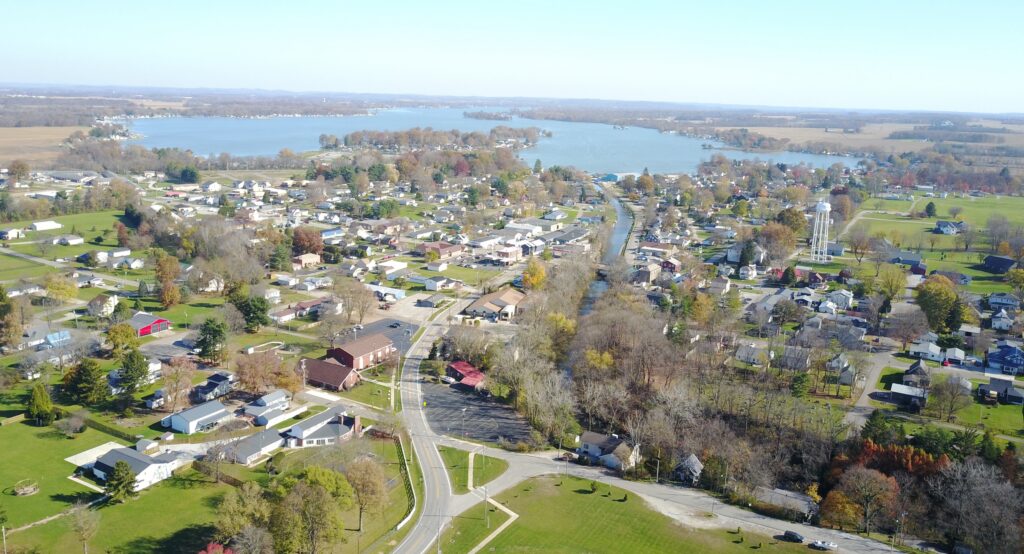
For three of the four projects decided that day, there was no discussion by the board. There was no mention of the concerns raised by hundreds of residents of Ashville and Millersport who showed up at earlier public hearings to raise concerns about noise and light pollution, and the health effects of air pollution from them – thousands of tons of toxic chemicals and fine particulates that will be emitted annually by the plants and which are known to cause respiratory illnesses.
State Rep. Tristan Rader, D-Lakewood, a non-voting member of the board, asked for a moment to put on the record that he drove to Ashville to see where the “Ashville Energy Center” power plant would be located. (OPSB case number 26-196-EL-BGN)
He said he found that it is near houses and “abuts a playground, park and a soccer field where kids are playing.”
Rader, whose biography on the legislature’s website says that he is “a dedicated advocate for sustainability, economic justice, and social equity,” raised questions about the wisdom of allowing such facilities so close to where children live and play, given that they produce thousands of tons of air pollutants a year.
He also asked whether the power plant would be required to have scrubbers or filters on its exhaust pipes to keep fine particulate matter out of the air – and the lungs of children who could develop asthma or other respiratory illnesses.
A siting board staff member said that would be for the Ohio Environmental Protection Agency to address. And even though Andrew Smith, a designee for Ohio EPA Director John Logue, represented the EPA on the siting board that day, Smith said nothing and no one asked for an answer to the question.
With that, the board voted 7-0 to approve the power plant.
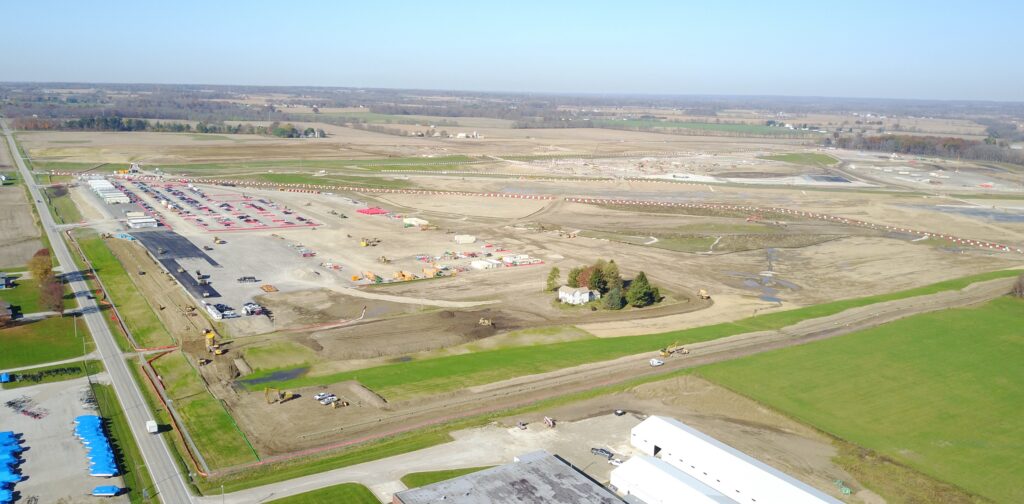
The board spent 34 seconds on the “Fairfield Energy Center” in Millersport, a 1,350-megawatt facility a short distance west of Buckeye Lake, that will become one of the largest “behind-the-meter” plants to date in Ohio. (Ohio Power Siting Board case number 26-160-EL-BGN.)
There was no discussion and the vote to approve was unanimous.
Jenifer French, director of the Public Utilities Commission of Ohio, is chair of the Ohio Power Siting Board and ran the meeting. Others who voted on Nov. 19 were Benjamin Lagrasso, designee for Lydia Mihalik, director of the Ohio Department of Development; Theresa White, designee for Mary Mertz, director of the Ohio Department of Natural Resources; W. Gene Phillips, designee for Dr. Bruce T. Vanderhoff, director of the Ohio Department of Health; Andrew Smith, designee for John Logue, director of the Ohio Environmental Protection Agency; Kelly McCloud, designee for Brian Baldridge, director of the Ohio Department of Agriculture; and Paul Myers, a retired engineer from Lima who represents the public on the board.
Buckeye Lake-area residents who spoke during an Ohio Environmental Protection Agency hearing in Millersport on Nov. 10 implored the EPA to consider the unique climate in that area. They said that because it is a low-lying area with a lot of water, the area is prone to fog and “air inversions” that hold whatever is in the air close to the ground.
Annual emissions from the Millersport power plant, according to its filing with the EPA for an air-pollution permit would be 333 tons of large particulate matter (PM10), 333 tons of fine particulate matter (PM2.5), 86 tons of sulfur dioxide (SO2), 486 tons of nitrogen oxides (NOX), 686 tons of carbon monoxide (CO), 221 tons of volatile organic compounds (VOC), 19 tons of sulfuric acid mist (H2SO4) and 7,232,826 tons of greenhouse gases, which the EPA does not consider applicable in permit consideration.
Annual emissions from the Ashville plant are expected to be the following, according to the PowerConneX case file with the OPSB: 402 tons of large particulate matter (PM10), 402 tons of fine particulate matter (PM2.5), 74 tons of sulfur dioxide (SO2), 154 tons of nitrogen oxides (NOX), 291 tons of carbon monoxide (CO), 291 tons of volatile organic compounds (VOC), 28 tons of formaldehyde (CH2O) and 123 tons of ammonia (NH3).
A new report by Harvard University researchers released on Nov. 16 says that the electricity consumption by 403 hyperscale data centers operating in the U.S. now emits “as much greenhouse gases as the country of Denmark” – 25.7 million tons of carbon dioxide between May 2024 and April 2025, according to Reuters. It said that’s three times more than when the study was conducted in 2018.
Both of the power plants proposed for Millersport and Ashville would serve hyperscale data centers. The “behind the meter” power plants will not be connected to the electricity grid and each would serve only one customer.
Both Vantage and EdgeConneX have facilities in New Albany. Of the 259 data centers proposed, under construction or in operation in Ohio, 135 are in central Ohio and 52 of them are in Licking County, according to Data Center Map, which tracks data centers around the world. Most of the Licking County facilities are in the New Albany International Business Park.
Yet another data center is proposed for Jersey Township, just east of New Albany. The Licking County Planning Commission voted Monday, Nov. 23, to approve a preliminary site plan by Meta’s development arm, called “Sidecat LLC,” for a “620,000-square-foot data center facility and associated uses on 199.8 acres” east of Mink Street near Jug Street.
That data center would be built on property next to the 500 megawatt gas-fired Neo Power plant that Will-Power Ohio plans to build north of Beaver Road in Jersey Township.
If approved, the plant is expected to emit the following pollutants, according to the company’s air-pollution permit application to the Ohio Environmental Protection Agency: 3,471,813 tons of greenhouse gas pollution, 197.1 tons of fine particulate matter, 243.3 tons of Nitrogen Oxides (NOx), 172.73 tons of Volatile Organic Chemicals (VOCs), 189.1 tons of Sulfur Dioxide (SO2), 245.2 tons of Carbon Monoxide (CO) and 40,200 pounds of Hazardous Air Pollutants (HAPs).
Will-Power is a subsidiary of the Williams companies, a natural gas company based in Tulsa, Oklahoma.
Alan Miller writes for TheReportingProject.org, the nonprofit news organization of Denison University’s Journalism program, which is supported by generous donations from readers. Sign up for The Reporting Project newsletter here.