


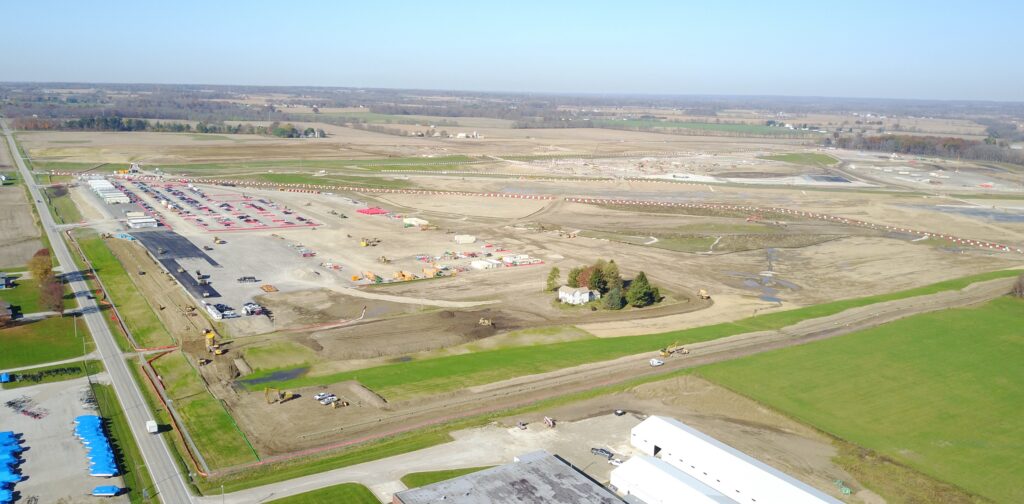
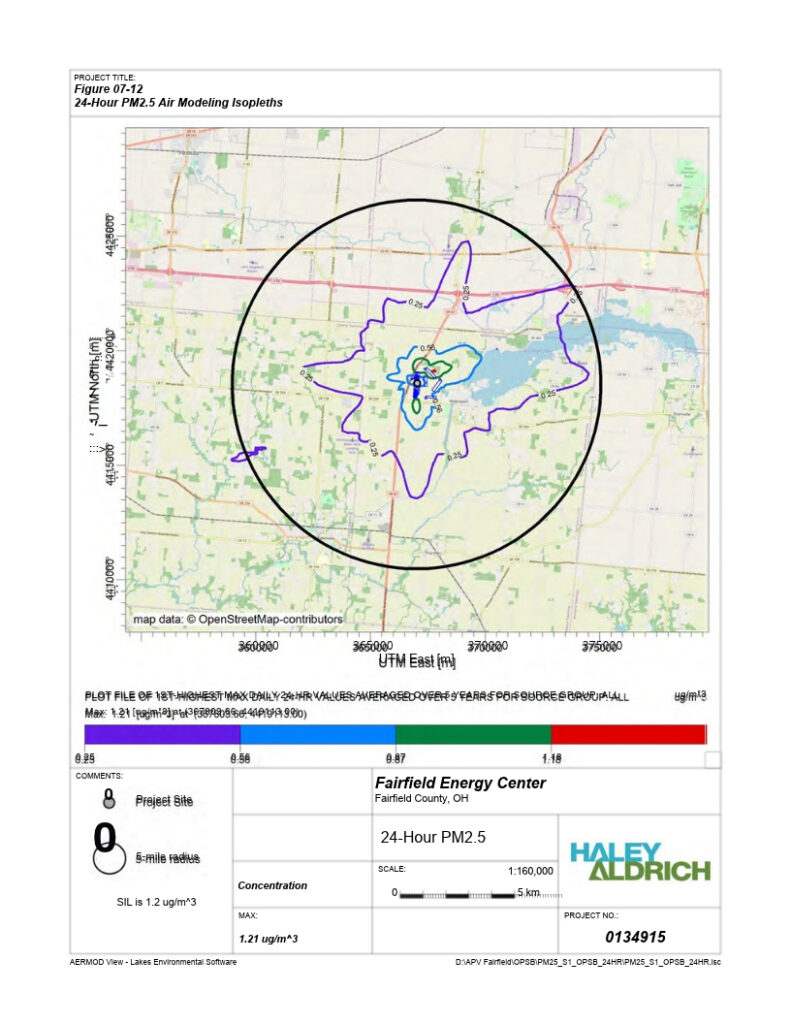
The “Fairfield Energy Center” proposed for a data-center site on 450 acres upwind from Buckeye Lake would produce an estimated 2,164 tons of air pollutants annually, according to the applications by Advanced Power Services of Boston to the Ohio Power Siting Board and the Ohio Environmental Protection Agency.
The plant would serve a $2.1 billion, hyper-scale data center proposed by Vantage Data Centers, which also operates a hyperscale data center in New Albany. The Millersport power plant also would produce an estimated 7,232,826 tons of greenhouse gases a year, which Ohio EPA documents say is “not applicable” in its permitting process.
A draft air-pollution permit being considered by the Ohio EPA says the Ohio Administrative Code requirement to use the “best available technology” in such plants to reduce emission of certain dangerous pollutants doesn’t apply to the individual turbines and engines in the 1,350 megawatt power plant.
A public hearing on the permit application will be held at 6 p.m. on Tuesday, Nov. 10, at Millersport Elementary School, 11850 Lancaster St. Public comments can be filed online through Nov. 12.
The administrative code says the best available technology (BAT) is required when pollutants such as volatile organic compounds, large particulate matter, fine particulate matter and sulfur dioxide are expected to be more than 10 tons per year for each of those pollutants.
But the draft permit to install equipment, which the EPA staff recommends approving, repeatedly includes language that says the emissions from each of the 40 individual turbines and diesel engines are exempted from the BAT requirement.
In an emailed statement, however, an EPA spokesman wrote that, “Fairfield Energy Center is considered a major emitting facility, and it must use Best Available Control Technology (BAT) to comply with state and federal requirements regarding emission sources.”
“Any smaller units where emissions remain below 10 tons per year are not considered significant and may be exempted from BAT requirements under Ohio Revised Code 3704.03,” EPA Press Secretary Bryant Somerville said in the statement.
“When reviewing the permit application, Ohio EPA determined some units at the facility were deemed exempt from the BAT requirements,” Somerville wrote. “There are still, however, additional emissions requirements applicable to limit emissions within state and federal requirements.”
And he wrote that “Ohio EPA applies this approach for all air permitting actions statewide.”
Advanced Power describes itself as “a leader in the movement for more efficient and more sustainable energy” on its website. In its application to the Ohio EPA for the Fairfield Energy Center – which would be among the largest data-center power plants in Ohio to date – says the facility is expected to produce quantities of pollutants far above 10 tons per year:
- 333 tons per year of large particulate matter (PM10)
- 333 tons per year of fine particulate matter (PM2.5)
- 86 tons per year of sulfur dioxide (SO2)
- 486 tons per year of nitrogen oxides (NOX)
- 686 tons per year of carbon monoxide (CO)
- 221 tons per year of volatile organic compounds (VOC)
- 19 tons per year of sulfuric acid mist (H2SO4)
- 7,232,826 tons of greenhouse gases (not applicable in permit consideration)
“It seems like they are stretching the rules – a lot – in approving these plants,” said Cathy Cowan Becker of Hilliard, president of Save Ohio Parks, which opposes gas-fired power plants not only because of the pollution but also because its members say increased demand for natural gas will result in more gas wells in state parks.
Becker said the “simple-cycle” turbines and reciprocating diesel engines like those found in diesel trucks are proposed for the Fairfield Energy Center, and the EPA and OPSB have approved their use elsewhere in Ohio.
“Everyone knows this is not the best available technology,” Becker said. “They issue the permit because each engine and turbine emits less than 10 tons per year per pollutant. But they are permitting the entire facility, not a single engine.”
And that’s not the only concern when it comes to air pollution the EPA allows, she said.
“The Ohio EPA does not consider greenhouse gases at all,” Becker said. “Estimates indicate that 85 million tons of greenhouse gases – as much as is produced by the countries of New Zealand and Israel – would be emitted in Ohio by gas-fired power plants alone. These are environmental people; they should know the effect that will have on the climate.”
Becker was in the room during two public hearings the OPSB held in October for power plants proposed in New Albany, and she also was among a dozen people who spoke to the issue during a New Albany City Council meeting on Nov. 3.
Residents of New Albany have been sounding the alarm in recent weeks about the potential health effects from the volume of such pollutants expected to be produced by seven power plants proposed for the New Albany International Business Park.
| Read more: New Albany mayor and council told to ‘do better’ in protecting area residents from gas-fired power plant pollutants
One of the seven is operating now, four are under construction and applications for two are being considered now by the OPSB. Residents have raised particular concerns about fine particulate matter, which local physicians who testified at recent hearings said can lead to lung ailments and cancer. Here is an interactive map of gas-fired power plants in Ohio.
Becker said most people don’t understand the EPA permitting process, and she fears that has allowed for a false sense of security.
“I become concerned when I sit in a public meeting and hear officials say that the EPA permitted it, so it must be OK,” she said.
The rules for both the EPA and the Ohio Power Siting Board when considering such proposals say that polluters are required to use the “best available technology,” which in the case of data-center power plants would generate more electricity more efficiently and with less pollution than older generations of turbines and diesel-powered back-up generators.
But the “best available technology” such as the “combined-cycle” turbines Advance Power has been using at its Carroll County facility since 2017 is now in such high demand amid the race to build data centers that manufacturers can’t keep up. And data-center companies are building power plants because the national electricity grid is being taxed by the demand for power.
Of the 258 data centers in Ohio, 40 of them are in or proposed for Licking County, and most of those are in New Albany, according to Data Center Map, which tracks data centers around the world. And increasingly, gas-fired power plants are being built with the data centers.
All of them are permitted by the Ohio Power Siting Board, which under Ohio law has the sole authority over where and how they can be built. The board’s staff reviews each case in detail and offers opinions and makes recommendations to the board.
Voting members of the board are Jenifer French, chair of the Public Utilities Commission of Ohio; John Logue, director of the Ohio Environmental Protection Agency; Lydia Mihalik, director of the Ohio Department of Development; Mary Mertz, director of the Ohio Department of Natural Resources; Brian Baldridge, director of the Ohio Department of Agriculture; Bruce Vanderhoff, director of the Ohio Department of Health; and Paul Myers of Lima, a retired electrical engineer who represents the public. All are appointed by Gov. Mike DeWine.
Some of the power plants the OPSB approved for New Albany were done on a fast track, Becker said.
“The OPSB has the standard process with public notice and public hearings and evidentiary hearings, and it has an accelerated process the data centers can use for data center energy facilities,” she said. “Three in New Albany and one in Hilliard were done that way – with no public hearing, no notice, not even a formal vote.”
| Read more: Public hearing draws some support and plenty of opposition to 500-megawatt power plant for data center
Becker said that there are ways for communities to push for better outcomes.
Communities such as New Albany can speak directly to the technology companies and push them to do better, she said.
“They are hosting these big tech companies,” Becker said. “The city needs to get strong with these tech companies to get combined-cycle turbines and/or fuel cells, and push them on best practices for managing electricity load, such as using battery storage rather than diesel-powered generators for emergency back up.”
She said they also can join with other communities in pressing the state to allow more public input in the process or control over their own destiny.
“The legislature gave communities the ability to ban solar and wind facilities, but they can’t do a thing about gas-fired power plants,” Becker said. “That process needs to be the same so that local communities have some control.”
She said the state has rejected about 5.3 gigawatts of renewable energy sources – solar and wind – since 2014, and at the same time it has approved about 5.3 gigawatts of gas plants.
There are other options for generating electricity, such as “virtual power plants” made up of a series of solar panels that data-center operators pay to have installed on homes and businesses in the region, combined with a collection of batteries to store energy for when the sun isn’t shining.
Power not used by data centers in that scenario would go to the grid to help with overall demand.
Google and a company called Voltus announced in October that they would build a 1 gigawatt, virtual power plant across the PJM power grid region, which serves 67 million people across 13 states, including Ohio, and Washington, D.C.
“We’re not saying to New Albany that it should get rid of data centers,” Becker said. “They have 40 of them, and it’s a point of pride. But push to power them in a way that doesn’t harm your residents and the residents of Licking County.”
Alan Miller writes for TheReportingProject.org, the nonprofit news organization of Denison University’s Journalism program, which is supported by generous donations from readers. Sign up for The Reporting Project newsletter here.