


The public hearing in Millersport on Tuesday evening began with a pre-recorded, monotone narration of a slideshow explaining a proposed data-center power plant and how the Ohio Environmental Protection Agency considers whether to approve air-pollution permits for such facilities.

And the hearing ended with a dramatic piano performance by area resident Thane Evans playing his original composition called “The Compromise” for about 50 people seated in the Millersport Elementary School auditorium.
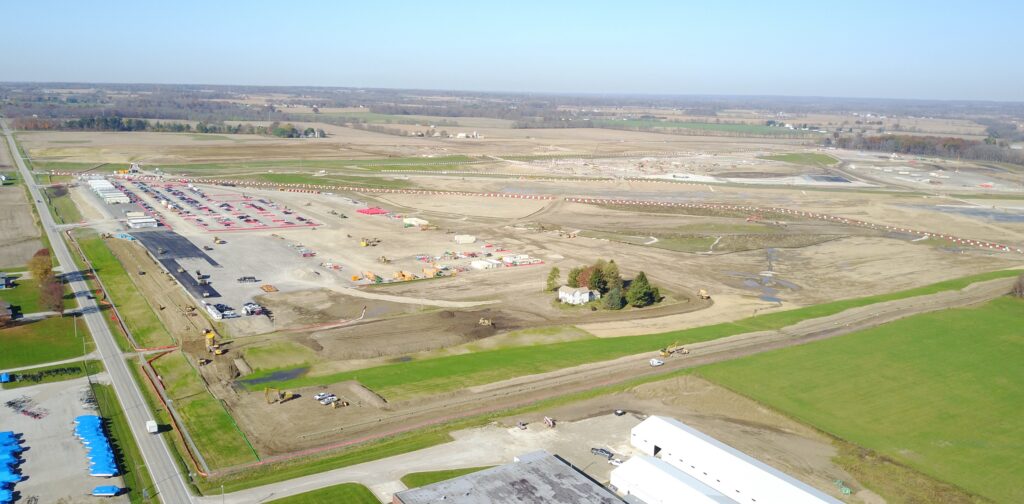
Evans lives in a Victorian farmstead on Rt. 37 just east of where the hyper-scale data center and power plant site is being stripped of topsoil in preparation for construction. He said after the hearing that he used his five minutes allotted to each speaker to play the piece “because the piano was there and everything is being compromised – the land, our health, the community.”
“We have been completely compromised,” he said. “It’s devastating.”
While Evans and his father, John, who owns the brick farmstead on Rt. 37 that dates to the Civil War era, are directly affected by the industrial complex proposed for 450 acres just east of their back door, Thane Evans said he is concerned about the health effects of air pollution on the community.
“I don’t want to see everyone from children to senior citizens hurt by this,” he said.
Evans was referring to the health effects of anticipated air pollution from the proposed 1,350-megawatt power plant – one of the largest “behind-the-meter” plants to date in Ohio. Behind the meter means that it will serve only one customer – a data center being built by Vantage Data Centers – and will not be connected to the regional electricity grid.
Children and senior citizens are most at risk for illnesses associated with the types of pollutants produced by gas-fired power plants, especially fine particulate matter. The “Fairfield Energy Center,” proposed by Advanced Power Services of Boston, would produce the following quantities of pollutants, according to the draft air-pollution permit being discussed at the hearing:
- 333 tons per year of large particulate matter (PM10)
- 333 tons per year of fine particulate matter (PM2.5)
- 86 tons per year of sulfur dioxide (SO2)
- 486 tons per year of nitrogen oxides (NOX)
- 686 tons per year of carbon monoxide (CO)
- 221 tons per year of volatile organic compounds (VOC)
- 19 tons per year of sulfuric acid mist (H2SO4)
- 7,232,826 tons of greenhouse gases (not applicable in permit consideration)
| Read more: Public hearing draws some support and plenty of opposition to 500-megawatt power plant for data center
Ohio EPA Director John Logue will decide whether to approve the air-pollution permit, which the EPA staff has recommended that he approve. Anyone who wants to comment on the permit request can do so online through 11:59 p.m. on Thursday, Nov. 12.

Many of those who spoke during the Ohio EPA hearing on the merits of an air-pollution permit for the facility raised concerns about health – and about the equipment that would produce 2,164 tons of air pollutants annually, according to the company’s applications to the Ohio Power Siting Board and the Ohio Environmental Protection Agency.
One after another, such as Robert Slater II, repeated details in the OEPA and OPSB applications for permits that say the company plans to use 40 electricity generating turbines, three diesel-powered back-up generators and a diesel-powered pump for emergency fire suppression that are not the “best available technology” as required by law.
“There is more efficient technology out there,” Slater said.
And Bill Wershing was among several who said the EPA should consider that the micro-climate in the Buckeye Lake region is unique in central Ohio because it is prone to fog and air inversions that can hold whatever is in the air – such as all of those pollutants – close to the ground for long periods of time.
And several speakers, such as Buckeye Lake Village Council member Kellie Green, expressed their concern for the environmental – and economic – impact on the Buckeye Lake region because pollution from the power plant would fall on that area and affect “the environment and our communities.”
Noah Malik, of New Albany, said he came to the hearing in Millersport because he wants the EPA to consider the big picture – the environmental and health effects of multiple “behind-the-meter” power plants on central Ohio.
| Read more: New Albany mayor and council told to ‘do better’ in protecting area residents from gas-fired power plant pollutants
Seven of those plants are proposed, under construction or in operation in New Albany to serve some of the 40 data centers in Licking County, where the New Albany International Business Park is located.
“I’m especially concerned about the cumulative effect of these plants in Ashville, Millersport, New Albany and Hilliard,” Malik said. “Is the Ohio EPA looking at these combined and the effect on the region?”
The EPA was only taking public comments on Tuesday evening – not answering questions – so no one responded.
Alan Miller writes for TheReportingProject.org, the nonprofit news organization of Denison University’s Journalism program, which is supported by generous donations from readers. Sign up for The Reporting Project newsletter here.