

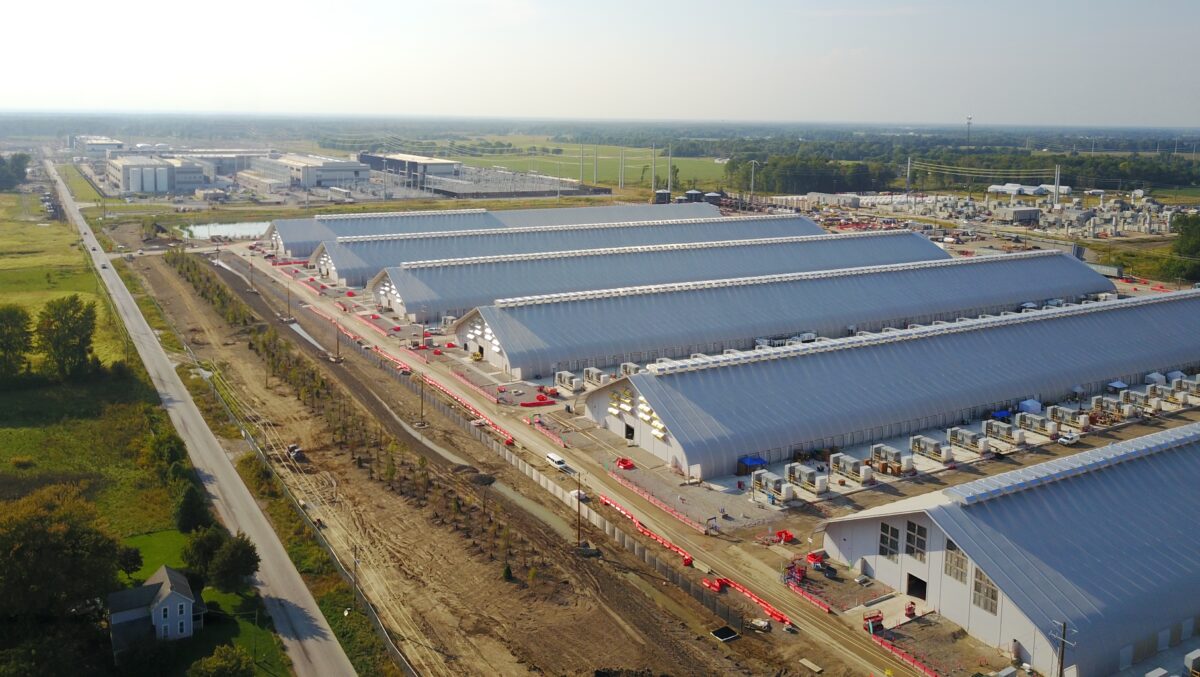
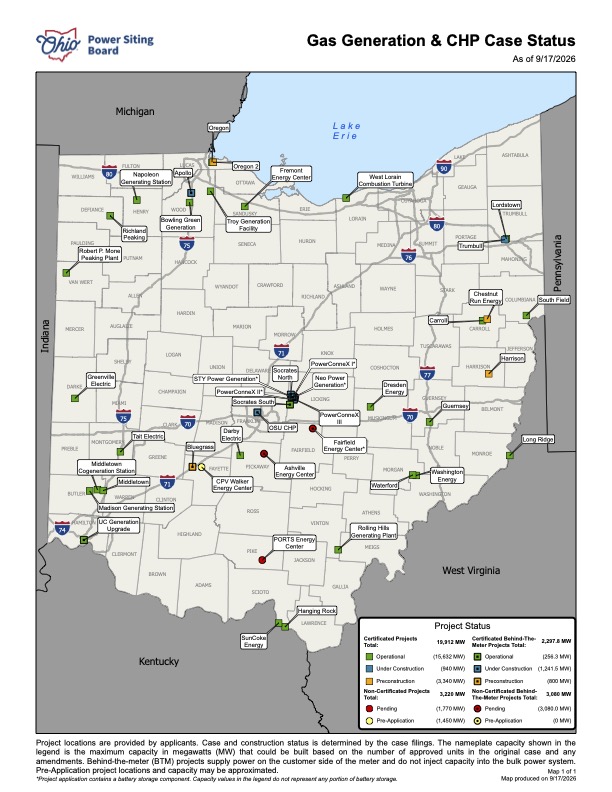
Thursday is decision day for a couple of big, gas-fired power plants that could provide electricity to data centers in central Ohio – one in the Fairfield County village of Millersport and the other in the Pickaway County community of Ashville.
The Ohio Power Siting Board (OPSB) is scheduled to meet for its monthly meeting at 1:30 p.m. on Nov. 19 and will consider the applications for construction of the “Fairfield Energy Center,” proposed by Advanced Power Services of Boston, and the “Ashville Energy Center” proposed by PowerConneX of Herndon, Virginia.
The meeting will be held at the headquarters of the Public Utilities Commission of Ohio, on the 11th floor of 180 E. Broad St., in downtown Columbus, and will be livestreamed on YouTube.
The proposed 1,350-megawatt power plant in Millersport, a short distance west of Buckeye Lake, would become one of the largest “behind-the-meter” plants to date in Ohio. (Ohio Power Siting Board case number 26-160-EL-BGN.)
The OPSB staff held public hearings on the proposals earlier, and Matt Butler, public information officer for the board said that while the Thursday meeting is open to the public, the board meetings do not include time for public comment or testimony.
The public hearings for both power plants drew big crowds of people who raised concerns about air, light and noise pollution. The health effects of air pollution was raised repeatedly at the hearings for those plants as well as others proposed for New Albany.
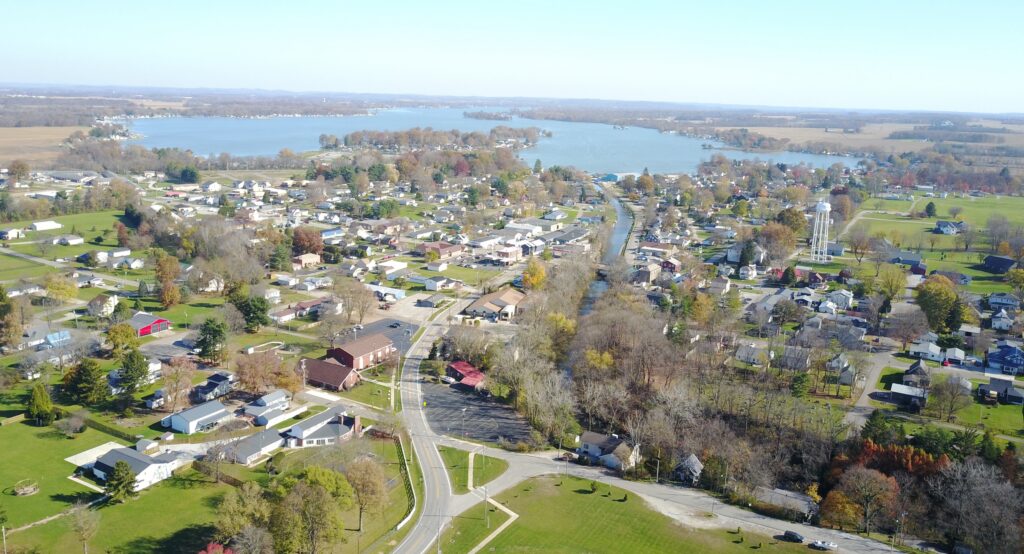
Buckeye Lake-area residents who spoke during an Ohio Environmental Protection Agency hearing in Millersport on Nov. 10 implored the EPA to consider the unique climate in that area. They said that because it is a low-lying area with a lot of water, the area is prone to fog and “air inversions” that hold whatever is in the air close to the ground.
A new report by Harvard University researchers released on Nov. 16 says that the electricity consumption by 403 hyperscale data centers operating in the U.S. now emits “as much greenhouse gases as the country of Denmark” – 25.7 million tons of carbon dioxide between May 2024 and April 2025, according to Reuters. It said that’s three times more than when the study was conducted in 2018.
Both of the power plants proposed for Millersport and Ashville would serve hyperscale data centers.The Millersport plant alone is expected to emit more than 2,100 tons of particulates and chemicals, and more than 7.2 million tons of greenhouse gases, which the EPA does not consider in deciding whether to issue an air-pollution permit.
The “behind the meter” power plants will not be connected to the electricity grid and each would serve only one customer – in Millersport, that’s a data center being built by Vantage Data Centers. The 800-megawatt Ashville facility (OPSB case number 26-196-EL-BGN) is proposed by EdgeConneX, also of Herndon, Virginia.
Both Vantage and EdgeConneX have facilities in New Albany. Of the 259 data centers proposed, under construction or in operation in Ohio, 135 are in central Ohio and 52 of them are in Licking County, according to Data Center Map, which tracks data centers around the world. Most of the Licking County facilities are in the New Albany International Business Park.
Yet another data center is proposed for Jersey Township, just east of New Albany. The Licking County Planning Commission is scheduled to consider an application from Meta’s development arm called “Sidecat” for a “620,000-square-foot data center facility and associated uses on 199.8 acres” east of Mink Street near Jug Street.
The OPSB also is scheduled to decide whether to approve the 800 megawatt Oak Run Solar Project and a related transmission line on 6,000 acres in Madison County, west of Columbus, in a case that dates to 2022.
The OPSB approved the Madison County project and 300 megawatt battery storage system in 2024, but the Ohio Supreme Court reversed that decision in May 2026, ruling that the board hadn’t done enough to address the visual impact of the solar farm. So the developers resubmitted their application, and that is what the OPSB will consider this week.
The board also will consider a request by Hecate Energy of Chicago to approve two engineering adjustments to collection-line locations for its existing 300 megawatt solar facility in Highland County, southwest of Columbus and east of Cincinnati. The OPSB approved that project in 2019.
“For the most part, most people aren’t familiar with the siting board unless it’s hearing a case involving something near them,” Butler said.
Voting members of the board are Jenifer French, chair of the Public Utilities Commission of Ohio; John Logue, director of the Ohio Environmental Protection Agency; Lydia Mihalik, director of the Ohio Department of Development; Mary Mertz, director of the Ohio Department of Natural Resources; Brian Baldridge, director of the Ohio Department of Agriculture; Bruce Vanderhoff, director of the Ohio Department of Health; and Paul Myers of Lima, a retired electrical engineer who represents the public. All are appointed by Gov. Mike DeWine.
Butler said the board meetings are different from the open-house informational meetings and public hearings held in the months before the board gets a case. Board members have access to thick files on each case, including staff recommendations on whether to reject, approve or approve them with conditions.
When the board meets, members sit at the front of the room and the chair, who is the PUCO director, will call cases for consideration and the board members have an opportunity to discuss each one.
“Behind-the-meter projects and solar projects have drawn a lot of participation from local governments and residents, as well,” Butler said. “It’s not uncommon for there to be a crowd at the siting board meetings, but often they are pretty quiet.”
He said board members “can approve, deny or modify and approve a project. They have denied some, including some solar projects, and an electric transmission line project and a wind project were denied.”
Parties to a case, such as the applicant or officials from local governments, who aren’t happy with an OPSB decision have 30 days from the decision to file for a rehearing by asking the board to reconsider all or part of its decision. From that date, the board has 30 days to reconsider.
And if a party to the case is still unhappy after the board’s decision upon reconsideration, Butler said they have 60 days to appeal to the Ohio Supreme Court, which is obligated to consider the case.
If a project is approved and no one applies for a rehearing, the developer of the project is required to file evidence of fulfilling pre-construction requirements, followed by a preconstruction conference with OPSB staff, and then the OPSB staff monitors construction and handles any complaints from neighbors or others during construction.
Butler said the OPSB is the authority over the project for the life of its operation, and the staff continues to monitor it for compliance with the permit approved by the board.
And he expects their workload will continue at a steady pace. Although some power plants are being proposed to connect to the grid to help with increased demand or replace older power sources, such as coal-fired power plants, many are for data centers.
“It’s a trend that’s going to continue,” he said. “We do anticipate we will see other projects across the state. It’s no secret that a lot of this is being driven by data centers. Each and every one behind the meter has been designed specifically to power a data center.”
Alan Miller writes for TheReportingProject.org, the nonprofit news organization of Denison University’s Journalism program, which is supported by generous donations from readers. Sign up for The Reporting Project newsletter here.